Let’s be honest. SEO in 2026 looks almost nothing like it did three years ago.
The businesses that ranked easily in 2022 by stuffing blogs with keywords and building a few backlinks? A lot of them are quietly watching their traffic drop. Not because they did something wrong. But because the game changed while they were playing by the old rules.
Search engines are smarter. Users are more impatient. And AI has walked into the room and rearranged all the furniture.
At Nucleo Analytics, we work with businesses trying to figure out what actually moves the needle in search today and what’s just noise. So skip the “10 quick tips” format. This is what is actually happening in search right now, what it means for your visibility, and where your energy is best spent.
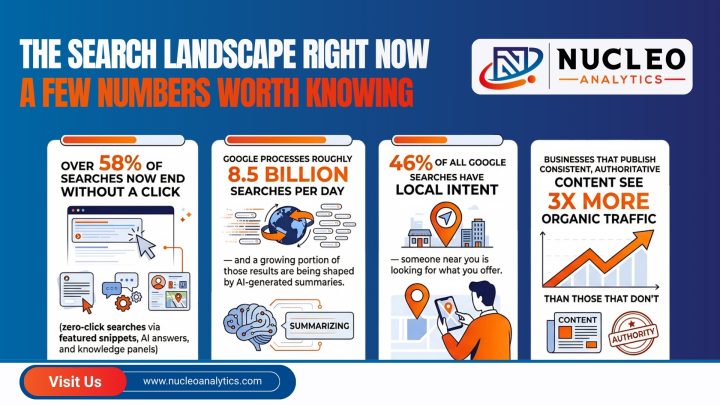
The Search Landscape Right Now — A Few Numbers Worth Knowing
Before getting into trends, some context:
- Over 58% of searches now end without a click (zero-click searches via featured snippets, AI answers, and knowledge panels)
- Google processes roughly 8.5 billion searches per day — and a growing portion of those results are being shaped by AI-generated summaries.
- 46% of all Google searches have local intent — someone near you is looking for what you offer.
- Businesses that publish consistent, authoritative content see 3x more organic traffic than those that don’t
These aren’t reasons to panic. There are reasons to adapt.
Here’s what that adaptation looks like.
Trend 1: AI SEO Trends 2026 — Search Is Getting Answered Before You Click
This is the biggest shift happening right now, and it’s moving fast.
Google’s AI Overviews (formerly SGE) now appear at the top of results for a huge range of queries. Instead of ten blue links, users get a synthesized answer , pulled from multiple sources, before they even see your site listed.
How AI is changing SEO isn’t subtle anymore. It’s fundamental.
The question used to be: Can I rank on page one?
The question now is: Can I get cited inside the AI answer?
To get there, your content needs to be:
- Specific and direct — AI pulls answers from content that answers questions clearly, not content that dances around them
- Well-structured — Headers, bullet points, and clear sections help AI parse and cite your content
- Authoritative — First-hand experience, real data, named authors, and cited sources all signal credibility to both AI and Google’s quality systems
Trend 2: Trends in AEO — Answer Engine Optimization Is Now a Real Discipline
Trends in AEO (Answer Engine Optimization) have moved from “something to watch” to something businesses actively need to build for.
AEO is the practice of structuring your content so it gets surfaced directly in answer-style results -Google’s featured snippets, People Also Ask boxes, AI Overviews, and voice search responses.
The difference between SEO and AEO, simply put:
SEO | AEO | |
Goal | Rank in search results | Be the answer in search results |
Format | Pages and posts | Direct, concise answers |
Trigger | Keywords | Questions and intent |
Result | Click to your site | Often shown without a click |
To optimize for AEO:
- Write in a Q&A format where it makes sense
- Use schema markup (FAQ schema, How-To schema, Article schema)
- Answer the question in the first 40–60 words of your response, then expand
- Target “what,” “how,” and “why” queries directly — these are the ones that trigger answer boxes
Trend 3: Local SEO Trends 2026 — Intent Is Everything
If your business serves a specific geography- a city, a region, a neighborhood, local SEO trends 2026 should be at the top of your priority list.
Here’s why: Google’s local results (the map pack, local listings, “near me” results) are getting more prominent, not less. And the businesses showing up there aren’t necessarily the ones with the best websites. They’re the ones with the most consistent, complete local presence.
What’s changing in local SEO right now:
- Google Business Profile is more important than your homepage for local intent queries. If your GBP is incomplete, inconsistent, or inactive — you’re losing local traffic regardless of how good your website is
- Review velocity matters — not just the total number of reviews, but how recently you’ve been getting them. A business with 200 reviews but the last one from 18 months ago signals stagnation to Google
- Hyperlocal content — blog posts, landing pages, and service pages that mention specific neighborhoods, landmarks, and local context — are pulling stronger local rankings than generic city-level pages
- Voice search and “near me” queries continue to grow. These searches are almost always local in intent, and they pull directly from structured local data
Trend 4: Local SEO vs National SEO — Knowing Which Game You’re Playing
This distinction matters more than most people realize. Local SEO vs national SEO aren’t just different scales — they’re fundamentally different strategies.
Local SEO is about dominating a defined geographic area. The signals that matter most: Google Business Profile completeness, local citations (consistent NAP — Name, Address, Phone — across directories), proximity to the searcher, and local reviews.
National SEO is about topical authority at scale. The signals that matter most: domain authority, content depth across a topic cluster, backlink quality from relevant sites, and technical site health.
Trend 5: Importance of Local SEO — Why Small Businesses Can’t Ignore It
The importance of local SEO has actually grown in 2026, not shrunk — even as AI changes how search works.
Here’s why: AI Overviews and zero-click search affect informational queries most. But local intent queries — “best accountant in [city],” “plumber open now near me,” “coffee shop Ludhiana” — still drive users to local results, maps, and phone calls. These are high-intent, close-to-purchase searches.
For small and mid-sized businesses, local search is often the highest-ROI channel available. You don’t need to outrank Forbes or compete with national brands. You just need to be the clearest, most trusted option in your area for your specific service.
Three things that move the needle most for local visibility right now:
- Google Business Profile — Keep it updated, post regularly, respond to reviews
- Consistent citations — Your business name, address, and phone number should be identical across every directory
- Local-specific content — Pages that speak to your city, your community, and the problems your local customers actually have
Trend 6: Technical SEO — Still the Foundation, Now More Important
Some things don’t change. Technical SEO is one of them — and in 2026, as competition for AI citations and featured snippets increases, the technical health of your site matters more, not less.
AI systems and Google’s crawlers both favor sites that are easy to parse, fast to load, and clearly structured.
What to audit right now:
- Core Web Vitals — LCP (Largest Contentful Paint), INP (Interaction to Next Paint), and CLS (Cumulative Layout Shift) are all active ranking signals. If your site scores poorly here, you’re losing rankings to technically cleaner competitors
- Schema markup — Structured data helps search engines understand what your content is about. For AEO specifically, FAQ and Article schema are non-negotiable
- Crawlability — Broken internal links, orphaned pages, and bloated sitemaps create crawl waste. Google has limited crawl budget; don’t spend it on junk pages
- Mobile-first indexing — Google indexes the mobile version of your site. If the mobile experience is poor, your rankings reflect that
- Page speed — A one-second delay in load time can reduce conversions by 7%. Speed is both a UX and a ranking factor
None of this is glamorous. But a site with weak technical foundations won’t hold rankings regardless of how good the content is.
Trend 7: Content Marketing Trends — Quality Over Volume, Authority Over Output
The “publish more” era of content is over.
Content marketing trends in 2026 are pointing clearly in one direction: depth, authority, and experience over volume. Google’s helpful content system penalizes content that exists to rank rather than to genuinely help. And AI-generated content floods are training Google to be even more aggressive about this.
What’s working:
- First-hand experience — Content written by people who’ve actually done the thing, not just summarized what others have said. Google calls this “Experience” in its E-E-A-T framework (Experience, Expertise, Authoritativeness, Trustworthiness)
- Original data and research — Studies, surveys, internal data points. Content that can’t be replicated by AI because it comes from something real
- Topic clusters, not isolated posts — A pillar page on a broad topic, supported by 8–12 related posts that go deep on subtopics. This signals topical authority to Google
- Named authors with real credentials — Bylines matter. Google looks at whether the person writing about a topic has any reason to be trusted on that topic
Trend 8: Marketing Automation Trends — SEO and Automation Finally Working Together
This is an underrated connection: marketing automation trends and SEO are becoming more intertwined, not less.
Here’s what that looks like in practice:
- Automated content briefs — AI tools that pull search data and competitor analysis to generate structured content briefs before a human writer touches the keyboard
- CRM-to-SEO loops — Data from your CRM (what questions your sales team gets asked, what objections come up, what terms prospects use) feeds directly into content strategy. The best-ranking content often comes from what your customers are already asking
- Automated internal linking — Tools that scan your site and suggest (or implement) internal links to keep crawl flow healthy and distribute authority across pages
- Performance triggers — Automation that flags when a page’s ranking drops, traffic changes, or a competitor moves into your space — so your team responds in hours, not weeks
The businesses combining structured SEO processes with smart automation are moving faster and responding more accurately than those doing everything manually.
What Google’s E-E-A-T Means for You in 2026
Google’s quality guidelines have always mentioned Expertise, Authoritativeness, and Trustworthiness. In 2026, the first “E” — Experience — is the one most sites are still underinvesting in.
Experience means: has the person writing this content actually done the thing they’re writing about?
A review written by someone who used the product beats a summary written by someone who read other reviews. A local business guide written by someone who lives in that city beats one generated from a Wikipedia scrape.
Strong SEO Starts with the Right Strategy and Expert Support
The One Thing Businesses Keep Getting Wrong
Most businesses treat SEO as a one-time project. Fix the site, publish some blogs, check the box.
SEO in 2026 is an ongoing system, not a campaign. The businesses winning in search right now have a process: consistent content, regular technical audits, active local presence management, and a feedback loop between their CRM data and their content strategy.
That system doesn’t have to be complex. But it does have to be consistent.
Final Words
The core of search hasn’t changed; Google still wants to surface the most helpful, credible, relevant answer for every query. What’s changed is how it determines that.
AI is reshaping how answers get surfaced. Local intent is driving more high-value traffic than ever. Technical foundations matter more as competition increases. And content that comes from real experience is pulling ahead of content that’s just well-optimized.
At Nucleo Analytics, we help businesses build SEO systems that account for all of this, not just the parts that were working two years ago. If your organic traffic has stalled or your rankings have shifted without explanation, it’s usually one of the trends covered in this guide. The businesses that adapt earliest tend to benefit longest. That part hasn’t changed.