
The following article will go over what SGE is, how it affects SEO, what possibilities it generates, and how you could equip your company for the next phase of search. We will also show you how Nucleo Analytics, one of the best SEO service providers , could enable you to keep ahead of the curve.
Understanding Google’s Search Generative Experience (SGE)
Through SGE, Google establishes its next search platform by merging artificial intelligence technology to present richer answers with context and dynamic response capabilities within search pages.
AI technology now presents users with compiled summaries before the standard search results at the starting position of their search page. The summaries serve the purpose of answering complex queries better and faster.
When a user conducts a query for “best project management tools for remote teams,” the search provides:
- A detailed overview of top tools,
- Pros and cons,
- Pricing highlights,
- Direct links to deeper information exploration are accessible through the interface without needing users to visit separate websites.
In short, Google is becoming a research assistant, not just an index of links.
How SGE Works: A Peek Behind the Curtain
SGE is powered by a combination of:
- Large Language Models (LLMs): Trained on massive datasets to understand and generate human-like responses.
- Machine Learning Algorithms: Constantly refining the quality and relevance of generated summaries.
- Real-Time Data Integration: Ensuring that information is timely, accurate, and relevant.
When a user inputs a query, Google:
- The system determines what the user intends to find.
- The platform retrieves important information from many verified sources.
- The data gets integrated into an understandable conclusion.
- Displays citation links to source materials for verification and further exploration.
Google constructs its innovation structure by focusing on trustworthy outcomes alongside transparent operations and user satisfaction.
Why Google Introduced SGE: The Bigger Picture
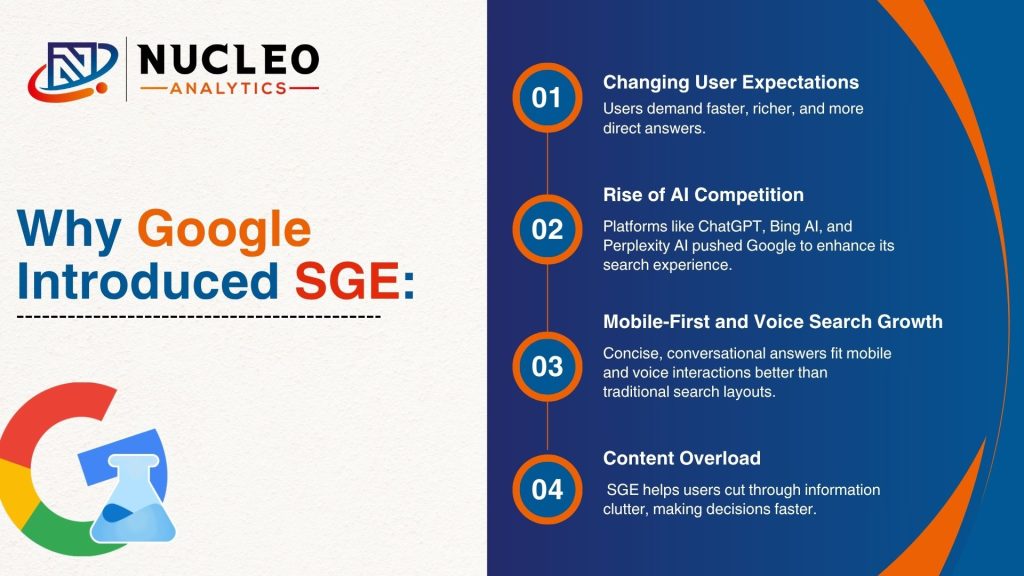
The launch of SGE addresses several critical trends:
- Changing User Expectations: Users demand faster, richer, and more direct answers.
- Rise of AI Competition: Platforms like ChatGPT, Bing AI, and Perplexity AI pushed Google to enhance its search experience.
- Mobile-First and Voice Search Growth: Concise, conversational answers fit mobile and voice interactions better than traditional search layouts.
- Content Overload: SGE helps users cut through information clutter, making decisions faster.
By introducing SGE, Google aims to maintain its position as the primary gateway to online information while embracing the AI revolution.
How SGE Will Impact SEO Strategies
Search Generative Experience (SGE) has major ramifications for SEO. Google’s direct integration of more AI-driven replies straight into its search results is radically changing the conventional methods of generating and assessing natural traffic. Companies that ignore these new dynamics run the danger of having notable declines in both visibility and interaction.
Here’s an even closer look at the changes as well as implications for your SEO plan:
1. Drop in Conventional Click Count
Most of the information consumers look for will be right at hand within the AI-generated snippet at the top of the search results page using SGE. Many consumers may thus have their issues addressed right away without having to click on to a website.
Significance:
- Reduced click-through rates (CTR) even for highly ranked pages.
- More value of branding and grabbing user interest within the SGE itself.
- More is needed to maximize interaction in the fragment than in the page after it.
2. Competition for Visibility
In an SGE-driven world, traditional “Position #1” in the organic results may no longer guarantee the most traffic or attention. Instead, appearing within the AI-generated summary could become the new gold standard.
Implication:
- Earning a place in the generative snapshot becomes more valuable than traditional rankings.
- Traditional SEO metrics like “ranking position” must be paired with newer KPIs, such as “snapshot inclusion rate.”
- You have to target the best content marketing strategy, not just keywords, but also context, entity relationships, and user intent to maximize AI visibility.
3. Emphasis on Topical Authority
Google’s SGE favors reliable, authoritative content sources — especially when summarizing complex queries. Sites that demonstrate deep, comprehensive expertise on specific subjects will be prioritized over those offering only surface-level information.
Implication:
- Building topical clusters around core themes becomes essential.
- Invest in long-term authority building through thought leadership, expert authorship, and high-quality backlinks.
- Publish consistently across related subtopics to reinforce authority signals.
4. Focus on Complex, Conversational Queries
Inspired by a genuine back-and-forth discussion, SGE lets users more conversationally filter or widen their searches. Long-tailed, multi-intention searches will soon take center stage.
Significance:
- Beyond basic keyword matching, SEO techniques must answer complex, multi-layered issues.
- Content has to be organized to foresee follow-up inquiries and offer avenues for more in-depth research.
- Content development will rely more on semantic search engines and natural language processing (NLP).
5. Structured Content Wins
Google’s AI systems perform better when content is organized clearly and semantically. Pages that are easy to parse — with clear headings, bullet points, tables, FAQs, and schema markup — are more likely to be used in SGE results.
Implication:
- Focus on semantic HTML structure: proper use of H1, H2, H3 tags, clear paragraphs, and internal linking.
- Add FAQ sections, how-to guides, and summary boxes to help Google’s AI extract concise information.
- Implement schema markup (like FAQPage, Article, Product, Review schemas) to make content machine-readable and eligible for enhanced AI displays.
Key Challenges Businesses Face With SGE
The introduction of SGE tackles many important trends:
Changing User Expectancies: Faster, more immediate responses are demanded by users from wealthier backgrounds.
Evolution of AI Competency: Google was driven to improve its search experience by tools such as ChatGPT, Bing AI, and Perplexity AI.
Mobile-first and voice search development: More suited for mobile and voice engagements than conventional search layouts are succinct, conversational responses.
Content overload: SGE speeds decision-making by helping consumers sort through information clutter.
Google wants to keep its leading role as the major portal to internet knowledge by including SGE and welcoming the AI revolution.
Opportunities SGE Creates for Businesses
Despite the challenges, SGE opens up new, lucrative opportunities.
1. Establish Thought Leadership
If your content becomes part of SGE responses, your brand is positioned as an expert. This can drive brand recognition and trust without users even visiting your website.
2. Drive Highly Qualified Traffic
Although overall clicks might decrease, the users who do click are likely more engaged and closer to making a purchase decision.
3. Content Diversification
Businesses can expand into:
- Video summaries,
- Audio snippets,
- Interactive content—formats SGE might prioritize in the future.
4. Local SEO Enhancement
Local businesses can appear in SGE for “near me” and location-specific queries, providing a huge boost in visibility.
How to Prepare Your Business for SGE?
Here’s a proven step-by-step action plan to get your business SGE-ready:
1. Create Comprehensive, High-Quality Content
Focus on depth over breadth. Answer every possible user question around a topic.
Tip: Use the “People Also Ask” section in Google to expand your content.
2. Implement Structured Data Markup
Using Schema.org markup improves how AI understands your site, increasing your chances of being featured.
Must-implement schemas:
- FAQ
- How-To
- Reviews
- Local Business
- Product
3. Focus on E-E-A-T
Strengthen your Experience, Expertise, Authority, and Trustworthiness:
- Showcase real authors,
- Provide credentials,
- Get quality backlinks,
- Maintain up-to-date information.
4. Optimize for Conversational Queries
Use natural, question-based language in your headings and text.
Example: Instead of “Benefits of CRM,” use “What are the benefits of using a CRM for small businesses?”
5. Enhance Content Readability
Use short paragraphs, bullet points, infographics, and pull quotes to make content easy to scan.
6. Monitor Performance Closely
Closely monitoring vital performance indicators such as highlighted snippet appearances, changes in click-through rates (CTR), and user engagement metrics including time on page and interaction rates helps one to negotiate the changes brought about by SGE. Tracking these indicators will help you to understand how your material is doing in the new search environment. This information will help you to always adjust and improve your SEO plan so that you remain in line with changing user behavior and search engine priorities.
The Future of SGE: What’s Coming Next?
Experts predict:
- Personalized SGE: Custom summaries based on user search history.
- Deeper Commerce Integration: Direct purchases from within SGE.
- AI-Generated Media: Integration of videos, podcasts, and AI-created infographics.
- Advanced Multilingual Support: SGE is expanding across languages seamlessly.
Staying flexible, curious, and innovative will be the key to long-term success.
How Nucleo Analytics Can Help You Win in the SGE Era
Every business requires adaptation to SGE for survival purposes. The company Nucleo Analytics provides essential services.
Our services help you:
- Create high-authority, SGE-optimized content.
- The implementation of structured data and technical SEO best practices must be performed.
- Your business needs to develop trust and, at the same time, build visibility in its particular area of expertise.
- You should monitor your strategies for immediate alterations and adjustments.
- We help all business sizes harness the evolving AI-driven search world toward their success needs.
You can schedule a cost-free consulting meeting right now.
Final Thoughts
Google’s Search Generative Experience marks one of the most fascinating—and difficult—changes in digital marketing history. Although the changes might appear overwhelming, for companies ready to shift, they provide hitherto unheard-of prospects.
Your company will not only survive but flourish in the new search age by concentrating on content quality, authority, and user experience.
Ready to take center stage in the SGE universe?
Start your Nucleo Analytics journey today!