

Ever feel like you’re screaming into a void? You write a great blog post, hit publish, and literally nothing happens. Google completely ignores it. Your target audience never sees it. It’s frustrating as hell, and honestly, standard SEO advice is pretty useless now.
The internet is flooded with cheap, generic junk content. Google doesn’t want another basic "Top 10 Tips" list. It wants real expertise. It wants deep stuff. To win today, you have to build topical authority from the ground up. You need to become the ultimate go-to source.
This isn't about gaming the algorithm with shady tricks. It’s about proving you know your industry inside and out. Let’s look at how you actually do it.
What Exactly is This Whole Thing Anyway?
Let’s drop all the annoying corporate talk. This concept just means being the most trusted, absolute go-to resource on a specific topic. When you pull this off, search engines trust your site to answer pretty much any question related to that theme.
Think about how you search things online. If you need serious fitness advice, you look for a specialized coach, not a generic news site. Google does the exact same thing. It checks for real content authority before giving out top rankings.
If your site talks about dog food one day and crypto the next, you have zero focus. You confuse the bots. But narrow down and nail one single topic? Your traffic goes crazy.
Why Old-School Keyword Stuffing is Totally Dead
The old way of handling SEO was brain-dead simple. You found a keyword with decent search volume, slapped together a generic article, and did it fifty times. Yeah, those days are long gone.
Google runs on insanely smart neural networks now. It doesn't just match words on a screen. It actually understands what a user is trying to find. This is why topical relevance matters way more than tracking single keywords.
You can't just write one isolated piece of content and expect to rank. You have to cover the subtopics, the edge cases, and the follow-up questions. You need a complete network of information.
The Real Setup: Building a Topic Cluster
You can't get any momentum if your site is a total mess. You need a solid, basic layout to organize your pages. This is exactly where topic clusters change the whole game.
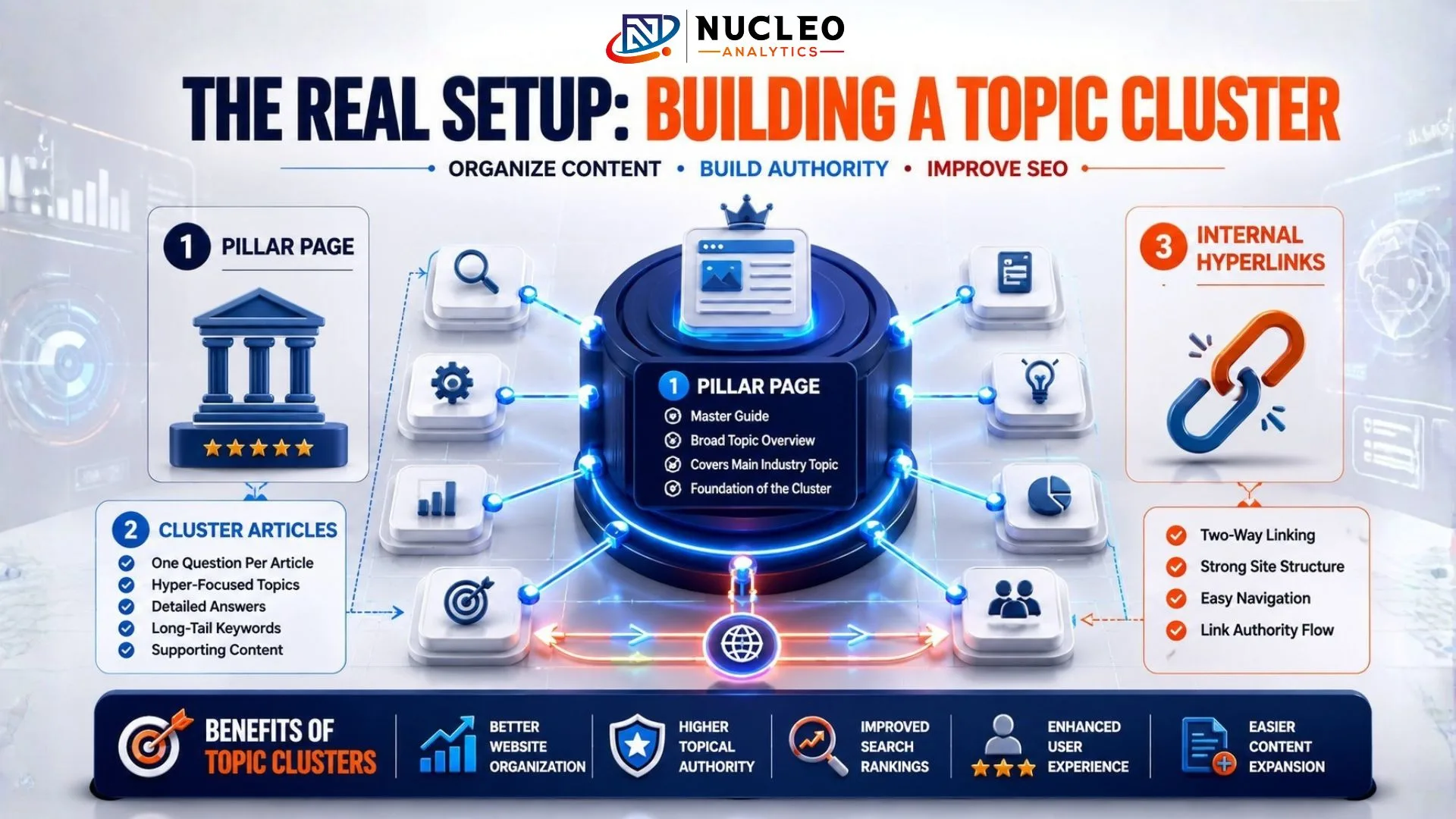
Think of your website like an old-school digital library. Instead of dumping random books in a corner, you sort them into tight, specific sections. A cluster does that for your web articles.
To start, you need one big, massive master page. People call this a pillar page. It gives a broad, high-level overview of your main topic without getting lost in tiny details.
Then, you build smaller, hyper-focused articles. These are your cluster pages. Each one tackles a specific, tight question that connects straight back to your main pillar.
- Pillar Pages: Big, deep guides that give a massive overview of a main market topic.
- Cluster Articles: Short, punchy posts answering single, specific user questions.
- Internal Hyperlinks: The actual pathways that connect all your cluster pages to the pillar.
Step 1: Mapping Out a Plan That Works
Don’t just open a laptop and start typing random ideas. That chaotic approach leads to zero traction. You need a real, focused topical authority strategy if you want to rank.
Look closely at your actual business goals first. What do you actually sell to make money? Your main content topic needs to match whatever keeps your business alive.
Next, list out every annoying problem your customers complain about. Talk to sales, scroll through Reddit forums, check comment sections. Find what people actually struggle to understand.
Take that big list of issues and group them into logic-based buckets. You'll instantly see patterns. Those buckets become the blueprint for your entire content calendar.
Step 2: Going Super Deep, Not Just Broad
Most folks write thin, boring stuff because it’s fast and lazy. They grab the top three Google results, reword the bullet points, and publish. That is a terrible move.
If you want to stand out, you have to go way deeper than the next guy. Cover the weird nuances. Talk about the common mistakes that most beginners get wrong.
Write like an actual practitioner who does the work, not a copywriter. Share real messes you made, actual failures, and raw data. This stuff keeps people reading till the end.
Step 3: Nailing Your Internal Links
Writing great stuff is only half the battle. If Google's crawlers get lost trying to find your pages, your hard work goes down the drain. You have to link them manually.
Every single cluster piece you publish has to link back to your pillar page. This sends a massive signal to search bots. It proves that the master page is the ultimate source.
Also, link your cluster pages to each other whenever it makes sense. If a shoe guide mentions insoles, link directly to your separate insole guide. It keeps readers clicking around.
- Natural Anchor Text: Use normal phrases for your links, never stuff like "click here."
- User Flow: Make sure every link actually helps a human take their next step.
- Passing Juice: Move your site's ranking power smoothly between all related pages.
Real-World Topical Authority Examples to Learn From
Let’s look at how this plays out out there in the wild. Seeing this work in action makes it a million times easier to copy for your own brand.
Take an online shop that sells high-end manual espresso gear. If they want to win search traffic, they shouldn't just target crazy competitive terms like "buy espresso machines."
Instead, they build an insane informational hub all about manual brewing tricks. Their pillar page is a massive, definitive guide on how manual brewing actually works.
Then, they write tons of side articles. They cover water temp, grind sizes, and pour-over steps. They review different paper filters. They cover everything.
Because they mapped out the entire coffee ecosystem, Google views them as true experts. Suddenly, they start ranking for thousands of buyer keywords because of that trust.
How to Actually Track Your Progress
How do you know if this grind is doing anything? You can’t just look at basic traffic spikes and celebrate. You have to look under the hood.
Keep an eye on your impressions inside Google Search Console. If the strategy is working, impressions will jump way before you see actual clicks. It means you're entering the game.
Next, watch your overall keyword footprint. Are you suddenly ranking for weird terms you didn't even optimize for? That means your site’s general relevance is going up.
Check your conversion rates too. People who find you through deep, helpful info trust you way quicker. They are much faster to open their wallets and buy.
Dumb Mistakes You Need to Avoid
Getting your real name online takes time, and it’s, weirdly, also easy to derail your momentum. Be careful with these common traps, so you can keep rolling without losing steam.
Try not to talk about ten separate industries at once. Just choose one niche, focus on it, make it yours completely, then move to the next one. Growth needs a sturdy foundation, not a scattered one.
- Ignoring User Intent: Don't write a long guide when someone just wants a checkout page.
- Orphaned Pages: Never drop a post without linking it to other pages on your site.
- Stale Content: Update your old articles every year so the data doesn't get old.
Getting Real Help With Your Search Presence
Look, managing all of this by yourself is a massive, exhausting chore. It takes endless hours of messy keyword sorting, tech adjustments, and constant writing. Most founders just don't have the time.
That’s where we step in. Over at Nucleo Analytics, we help businesses cut through all the online noise. We don't just hand you a spreadsheet of random words; we build deep content systems that make your site an industry giant.
We study your niche, track your rivals, and run a heavy how to build topical authority for SEO plan built for actual revenue growth. You run your shop, we handle the search pages.
Look, SEO isn't about finding secret loopholes or magic tricks. It’s just about giving people the absolute best answer to their questions. When you commit to a heavy topical authority SEO plan, you stop begging for clicks and start owning your space. Go deep, clean up your links, and give readers real, honest value every single time.