

Every marketing team is using AI to write now. Some swear by it. Some think it will wreck their rankings. Both sides have a point, and both are missing something.
The fear usually sounds like this: Google finds out AI wrote my pages, and my site is done. The truth is more boring. AI content marketing is not a shortcut. It is a faster way to do the same work.
Google has said it many times. It cares about quality, not how the content was made. A great AI page can outrank a bad one written by hand.
The difference was never the tool. It was the process around it. This post is about that process, and the mistakes that get sites flagged.
Does AI Content Hurt SEO?
Short answer: no. Long answer: it depends entirely on how you use it, and pretending otherwise is how people get hurt.
Google updated its spam policies to call out something called scaled content abuse. That means mass producing low-value pages, whether a human does it or a machine does it. The update didn't ban AI. It banned garbage. If you publish a thousand pages that all say the same thing, Google doesn't care whether you typed them or generated them. It just sees spam.
So when people ask whether AI content hurt SEO, the honest answer is that AI itself is neutral. The output is what gets judged. A thin page written by AI will fail. A thin page written by a human will also fail. The algorithm doesn't have a robot detector. It has quality classifiers, and those punish content that doesn't help anyone. AI content SEO isn't about tricking the algorithm. It's about building pages that deserve to rank.
Here's what we see in practice:
- Sites that lose traffic after bringing in AI are the ones that skip editing, skip research, and skip the point of view that makes content worth reading. The machine makes the draft, and nobody looks at it again before publishing.
- Sites that win treat AI like a drafting tool and then do the real work on top of it. They check the facts, add their own examples, and make sure every page answers the exact question someone typed into Google.
- Google doesn't penalize AI-generated content just because it came from a machine. It penalizes content that wastes someone's time, and that is a standard you can actually meet.
- The rankings you lose are rarely the algorithm's fault. They're usually the result of publishing faster than you can think.
Here's a real example. A client came to us with a blog full of posts that said nothing. Every headline promised an answer, and every article danced around it. Traffic was flat for six months. We rewrote the top ten posts with real examples, kept the AI for research and outlines, and traffic started moving within two months. Same domain, same tools. Different process.
What Google Actually Says About AI Content
Google has been asked this question a hundred times, and the answer has been consistent. Using automation to generate content is not against Google's guidelines, as long as the content is useful, original, and made for people first.
The policy that matters is scaled content abuse. Google will take action against sites that mass-produce content with little to no value, regardless of how it was created. That includes content generated with AI, stitched together from different sources, or spun by old-school tools. The common thread is intent. If the intent is to game rankings, you're on the wrong side of the line.
What this means for you is freeing. You don't have to hide your AI usage, and you don't have to lie about it. You have to make content that earns the click. Google's own guidance says to focus on people first, and the practical version of that is simple: would a reader thank you for this page, or would they close the tab?
It also means you can stop worrying about AI detectors. Google has said it doesn't rely on those tools to judge content, because they're unreliable and flag plenty of good writing. The real fight is over usefulness. We see the same pattern in every site we audit at Nucleo Analytics: the pages that tank were published to fill a calendar. The pages that hold were built to answer a question.
Want to know how Nucleo Analytics keeps AI content safe from Google’s spam filters?
How to Use AI Content for SEO
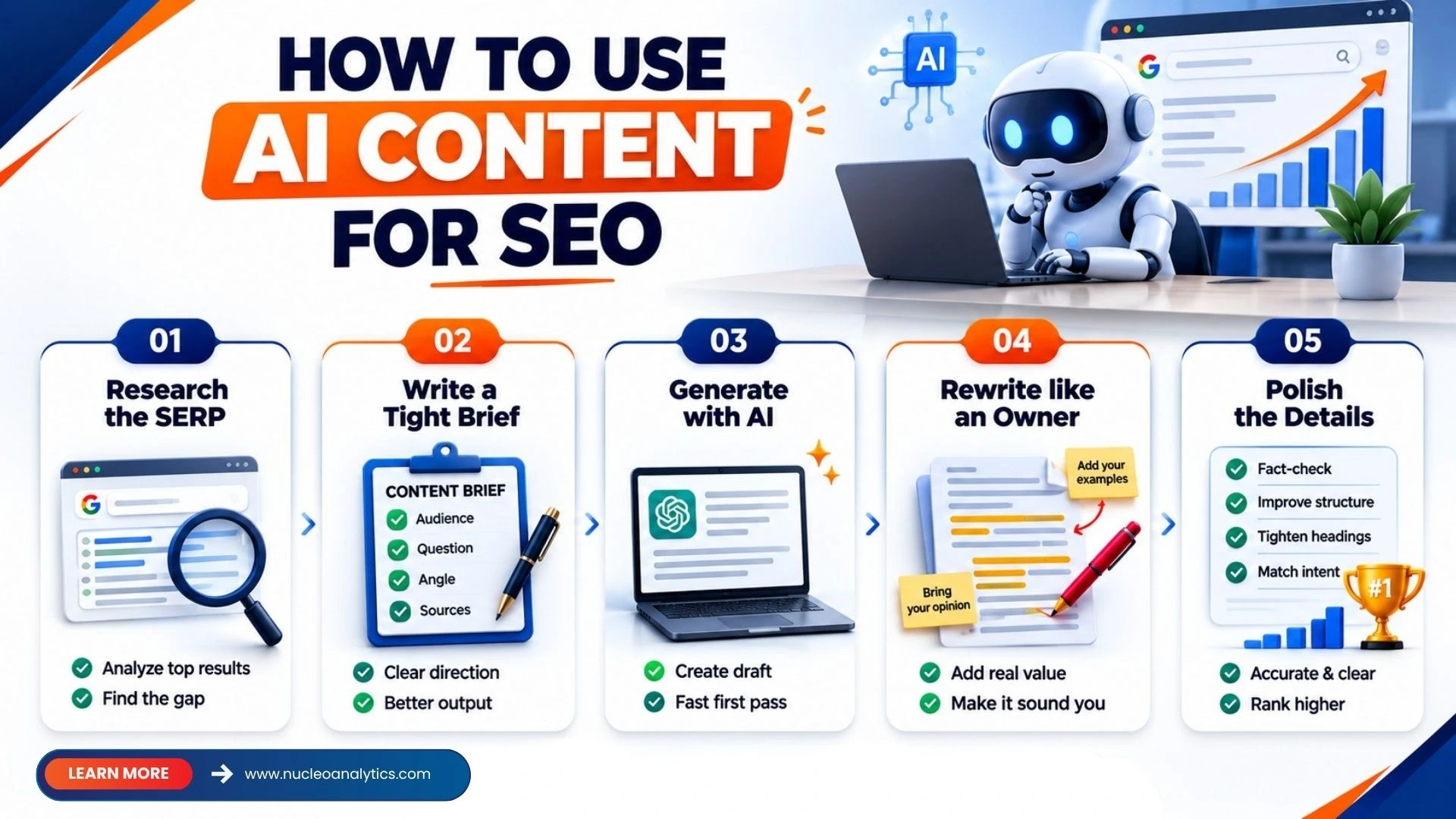
This is the process we use. Nothing fancy, nothing secret. Just the order of operations that keeps pages ranking. Most people skip half of it, and that's where their AI content goes wrong.
Research the SERP first
Open the top five results for your keyword. See what they cover and what they miss. That gap is your angle. If the top results are generic, go deeper. If they're thin, bring the data.
Write a tight brief
Name the reader, the question, the angle, and the sources. Vague prompts give vague content. Nobody sees the brief, but it decides everything.
Let AI draft, then treat it like a rough pass from a new hire
Read for problems, not perfection. Catch the hallucinations and the sentences that sound smart but say nothing.
Rewrite like an owner
Add your numbers, your examples, your opinion. Cut anything you wouldn't say in a meeting. AI tools are fast, but they aren't you.
Polish the details
Fact-check everything, tighten the headings, make sure the intro answers the search intent. That's the whole game of AI content SEO. Match the intent, add the value, stay accurate.
The rewrite is the step everyone hates, and it's the step that decides rankings. A generated draft has no point of view. It doesn't know why your business exists or why anyone should trust you. That knowledge lives in your head, not in the model.
The Human Layer: Editing, Experience, and Trust
Google's quality raters use a framework called E-E-A-T: experience, expertise, authoritativeness, and trust. AI generated content can cover part of the expertise piece if it's trained on good sources. It cannot cover experience. Experience is the stuff you've lived, and no model has lived it.
This is why the winning play is hybrid. Let the AI handle research summaries, outlines, and drafting. Then layer in your experience. The story about the client who doubled their traffic. The screenshot of the analytics spike. The mistake you made that cost you a month of rankings. That material cannot be generated, and it's what separates a page that ranks from one that floats on page three forever.
Trust signals matter too. Put a real author on the page with a real bio. Add a publish date and an updated date. Link out to authoritative sources and link internally to your own best content. These are small things, but they compound, and readers feel them even when they can't name what they noticed.
One more thing. Don't fake experience to game the system. Writing "I have used this tool for years" when you've used it for a week is a trust bomb. Google is getting better at spotting it, and so are readers. If you don't have direct experience with a topic, say so, or interview someone who does.
The human layer is where most AI content marketing falls apart. When you keep the human in charge, AI content marketing works. When you let the machine run the whole show, you're just producing spam at scale with better grammar.
Match Search Intent, Not Just Keywords
Most AI content fails on intent, not grammar. You can write a beautiful page that answers the wrong question. Google will bury it.
Someone searching for a guide doesn't want a comparison. Serve the wrong one, and people bounce. Before you publish, read it out loud. Did it answer the exact query?
Long tail is where you win. Phrases like how to use AI content for SEO for a small agency convert better. Map those at scale and nail the intent.
An AI Content Marketing Strategy That Works
Tactics without a plan are just chaos, and a calendar full of AI posts is not a plan. Any serious content strategy starts with a map. Which pages drive your money? Which keywords sit one step away from a sale? Which questions do your customers keep asking in sales calls, support tickets, and reviews? That research is the foundation, and no tool can do it for you.
Here's what a working strategy includes:
- Build a content map before you generate anything. Pillar pages for your biggest topics, cluster posts that support them, and updates for pages aging out of the top ten. Most teams only do the first one, and that's why their library looks like a pile of unrelated articles instead of a system.
- Mix new content with refreshes. Old posts that are 80 percent accurate but have stale stats are a goldmine. AI can refresh them fast while your team handles the judgment calls the model can't make. That one habit beats creating new losers every time.
- Set a publish standard and enforce it. Minimum length, at least one original example, one data point or quote, and a clear answer in the intro. If the draft doesn't meet the standard, it doesn't publish, no matter how fast it was made.
- Build a feedback loop into the process. Pick one number per page and review it monthly: leads for service pages, qualified clicks for blog posts. If a page is flat after four months, change the angle.
Your AI content strategy should plan for the review hour on every page, because that hour is what actually moves the needle. A good AI content strategy also includes a feedback loop, not just a publishing schedule. The teams that do this well don't have huge content departments. They have one person with a checklist and a clear standard. It sounds boring, and it is. Boring processes are how you get consistent quality, and consistent quality is what Google rewards.
Mistakes That Get Sites Flagged
We should also talk about the mistakes that get sites flagged, because knowing what breaks SEO is half of knowing how to use AI.
Publishing hundreds of pages nobody asked for is the fastest way to run into scaled content abuse. Google's policy on this is real, and it hits sites that flood the index with low-value pages. Publish fewer pages and make them better.
Skipping fact checks is the second fastest. AI tools hallucinate. They invent statistics, fake authors, and confidently wrong dates. One false stat on a high authority page is enough to wreck trust for the whole domain, and it's the kind of thing that gets you flagged in reviews.
Keyword stuffing in new clothes is third. Repeating the same phrase in every paragraph reads as a robot wrote it, because a robot did. Write naturally and let the topic do the SEO work. No prompt can save you from a bad brief.
Ignoring duplicate content is fourth. Ask your AI to rewrite the same source article three times, and you get three nearly identical pages. Google will pick one and ignore the rest. Write one page, do it well, and move on.
And the last one: publishing and disappearing. No updates, no maintenance, no response to feedback. Content is a living asset, and AI makes it cheap enough to keep it alive. Use that advantage instead of pretending a post is done the day it goes live.
Most AI content marketing fails for one reason. The person using it forgot that the machine makes the first draft and the human makes the last one.
Measure the Things That Matter
Once you publish, stop obsessing over the rankings report in week one. SEO moves on a scale of months, and checking every day just makes you anxious. Set a measurement rhythm instead.
Month one, watch indexation. Did Google actually pick up the page? If not, fix the internal links and request indexing in Search Console. Month two, watch impressions and clicks. Are you showing up for the right queries? Month three and beyond, watch position movement, time on page, and conversions.
Engagement matters more than most people think. If a page holds people for three minutes and they click through to another page, that's a signal. If people bounce in ten seconds, the content missed, even if the ranking looks fine.
Pick one number per page and review it monthly. For a service page, that number is usually leads. For a blog post, it's usually qualified clicks to the service page. Decide in advance, or you'll drown in vanity metrics. And if the numbers are flat after four months, change the page. AI makes it cheap to test a new angle.
Conclusion
So does AI content hurt SEO? Only when you let it. The tools aren't the problem, but they aren't the answer either. They just make you faster.
The teams that win treat AI like a fast intern who talks too much. You still check the facts, shape the voice, and make sure every page answers a real question. Skip that and rankings fade, clever prompt or not.
Done right, AI content marketing is just a faster road to the same hard work. Start small. Take one page, run the full workflow, watch what happens over a few months. Then do it again until it's just how you work.
If you want help building that process, reach out to Nucleo Analytics. We've been doing digital marketing long enough to know the difference between writing fast and writing well.
Ready to build an AI content strategy that actually ranks with Nucleo Analytics?