










SEO Content Clusters: Why They Matter & How to Build Them
If you’ve been hanging around SEO circles or just doom-scrolling digital marketing Twitter, you’ve probably heard everyone screaming about SEO content clusters lately. And honestly? They’re kind of right. Clusters do matter. Maybe not in a magical “rank tomorrow” way, but in a “Google actually understands what the hell your site is about” way.
And that’s really the whole game now.
Search engines reward websites that look like they actually know a topic, instead of dropping random 700-word blogs every three months because the marketing team remembered “oh crap, we need content.”
So this guide is for the real people marketers, founders, content writers, and even SEO agencies who want an unfiltered, practical walk-through of how SEO content clusters work and how the heck to build them without losing your mind.
Let’s get into it.
What Exactly Are SEO Content Clusters
Imagine a bookstore.
And inside it, instead of organizing books randomly, you put them into sections like “Cooking,” “Psychology,” “Travel,” etc. And within each section, you’ve got chapters, topics, and subtopics grouped together so people and search engines can find them easily.
That’s a content cluster.
At its simplest:
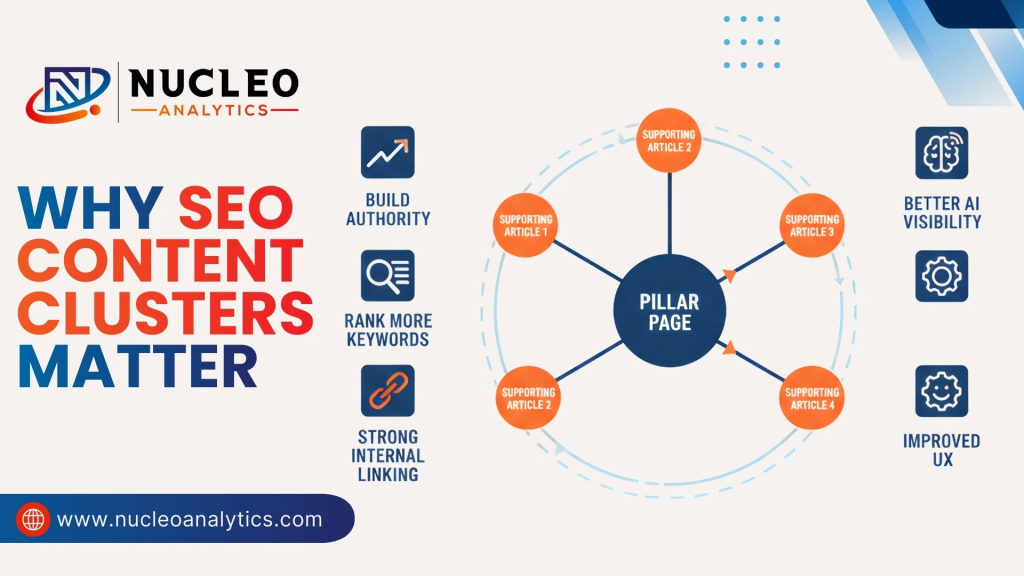
- A pillar page = your big “ultimate guide,” covering the whole topic from a high-level perspective
- Cluster pages = supporting posts that dive deeper into each subtopic
- Internal links = the glue
Together, they help you show Google (and AI systems) that:
- You know the topic deeply
- You’ve created valuable content on multiple angles
- You’re not just winging it
This builds something called topical authority, and yes, it’s exactly what it sounds like.
Why SEO Content Clusters Matter
Here’s the blunt truth: Google wants experts now.
Not random content farms, Not disconnected articles that don’t even link to anything. Not keyword stuffing.
Content clusters help you do all the things modern SEO requires:
Build Topical Authority: Google’s E-E-A-T guidelines care about experience, expertise, authority, and trust. When your site has 1 big guide + 12 in-depth subtopics, you naturally look more authoritative.
Rank for More Keywords: Instead of stuffing 30 variations into one post, you spread them across related posts, and Google understands the whole ecosystem.
Improve Internal Linking: You’re making it easier for crawlers to navigate and index your content properly.
Boost AI Search Visibility: ChatGPT, Gemini, and Perplexity love structured topics. They pick answers from sites that have clearly defined topical clusters.
Better UX for Humans Too: Readers can actually move logically from one topic to the next instead of bouncing after one paragraph.
Basically, clusters are good for robots and for humans, which is a rare W in SEO.
How to Build SEO Content Clusters
Let’s skip the corporate jargon and get into the real-world process.
1. Pick a Core Topic
This is where people mess up. They choose topics like:
- “Marketing” (too broad)
- “SEO copywriting mistakes for dentists in Nevada” (too narrow)
You want something that fits this Goldilocks zone:
Broad enough that you can write 8–20 pieces of supporting content.
Specific enough that you don’t end up covering the whole universe.
Example Core Topics for an SEO Agency:
- “SEO audits”
- “Local SEO optimization”
- “Content clusters”
- “Technical SEO basics”
- “Link building strategies”
If you struggle picking topics, ask yourself:
- What does your brand ACTUALLY sell?
- What do people constantly ask you?
- What are high-value keywords in your industry?
If you still get stuck… honestly, just stalk your competitors. Most of them are doing mediocre SEO anyway, and you’ll get ideas instantly.
2. Do Topic Research Like a Normal Human, Not a Robot
You don’t need 15 tools. Start with simple steps:
Check what people actually search for: Use keyword tools or even Google autocomplete.
Look at competitors: What are their pillar pages? What cluster pages exist around them?
Identify search intent: Are people looking to know, compare, buy, fix, avoid, or understand something?
Create your list of cluster opportunities:
- Questions
- How-to guides
- Best-of lists
- Comparisons
- Troubleshooting guides
- Common problems
- Beginner-level topics
- Buying guides
You’re basically building a map before building a house.
3. Map Out the Actual Cluster
This is where it starts to feel real.
Your Cluster Structure Might Look Like This:
Pillar Page:
SEO Content Clusters: The Complete Guide
Cluster Pages:
- What Is a Content Cluster? (Beginner guide)
- Pillar Page vs Topic Cluster vs Keyword Cluster
- How Internal Linking Boosts SEO
- Best Tools for Content Clusters
- Topic Cluster Examples
- How to Research Topics
- Content Cluster Strategy for SaaS
- How to Measure Content Cluster Performance
- Common Content Cluster Mistakes
- How Content Clusters Improve AI Search Ranking
This is just an example; your actual list depends on your brand.
Want someone to build content clusters for you instead of figuring all this out alone?
Work with Nucleo Analytics, a results-first SEO agency that actually knows how to build cluster-driven growth.
4. Create the Pillar Page First
The pillar page is your “mother content.” It’s the page that:
- gives the full overview
- mentions every subtopic
- links out to cluster pages
- becomes link-worthy
- sets the tone for your cluster
Think long, not short.
Focus on being helpful, not fluffy.
Think “guide people bookmark.”
Your pillar should include:
- A strong intro explaining the whole topic
- Clear section headers
- Links to every cluster article
- Practical examples
- FAQs
- Maybe even a downloadable PDF (great for email capture)
5. Write the Cluster Pages Individually
Each cluster page should go deep, not vague.
Example:
Pillar Page: SEO Content Clusters
Cluster Topic: Internal Linking for SEO
The cluster page should:
- Explain internal linking simply
- Give examples
- Show steps
- Include best practices
- Avoid robotic SEO jargon
- Link back to the pillar page
Rinse and repeat for all subtopics.
6. Link Everything Together
Internal linking makes or breaks your cluster.
Do this:
- Pillar → Cluster
- Cluster → Pillar
- Cluster ↔ Cluster
You’re building a net. A web. A little content universe.
This linking structure tells Google:
➡ “Hey, all these posts belong together.”
➡ “This website understands this topic deeply.”
➡ “Show us more love in the rankings.”
And they usually do.
7. Optimize Like a Human, Not a Keyword Zombie
A few honest tips:
- Use keywords naturally (don’t force them)
- Use variations and synonyms
- Don’t panic about “keyword density.”
- Write conversationally
- Use longer sentences, sometimes short sentences everywhere, and make the content robotic
- Aim for clarity, not perfection
- Add images, examples, and real opinions
Search engines reward content that feels alive, not written by a machine.
8. Track Your Cluster Performance
What should you measure?
- Keyword rankings
- Organic traffic to the pillar
- Organic traffic to cluster pages
- Time on page
- Bounce rate
- Internal link click-through rate
- Conversion rate
Clusters usually grow slowly at first, then boom.
Give it time. SEO is a long game, not a Starbucks drive-thru.
Want your own high-quality SEO content cluster created by experts?
Common Content Cluster Mistakes
1. Creating the content without mapping a structure
A lot of people just start writing because they’re excited or they’ve got a big list of topics. But if you don’t map the cluster first—pillar, subpages, internal links, keyword groupings, the whole thing ends up wobbling. You basically build a house without a floor plan, and then wonder why half the rooms don’t connect.
2. Writing disconnected posts
If your blogs aren’t linking to each other, you’re not building a cluster. You’re just publishing lonely pages floating around your site like forgotten islands. Internal linking isn’t optional here; it’s literally the backbone. Google uses those links to understand relationships. No links = no cluster.
3. Stuffing every keyword on one page
People still do this, somehow. They try to shove all the related keywords into one monster page because they think “more keywords = more ranking.” Or that is not the way clusters work. You are expected to spread the keywords in several pages so that they can stand alone and at the same time support the entire subject. There is no need to hoard keywords by doing so because it only confuses Google and distorts the readability.
4. Making 40 cluster pages nobody wants.
The more content one has, the more authority they will have. There are times when individuals become too caught up to make dozens of thin pages that contribute no value. When it has a page that is solely to fill space and does not answer a question that a real user is asking, then it undermines the cluster. Quality outsmarts quantity at all times.
5. The old posts have not been updated.
Clusters do not exist and hide. Google desires fresh, up-to-date information, particularly in rapidly evolving sectors. When you allow your cluster pages to grow old and not update them, this decreases accuracy, decreases rankings and the entire topical authority of your pages suffers a blow. Maintaining a cluster does not involve optional extra work: updating is part of it.
6. Expecting results in 2 weeks
This hurts, yet it is true: SEO is slow. The content clusters do not become a hit in one night. Even flawlessly performed clusters require time, months even, to create momentum. Patience is the victor, and not impatience. When you want instant results, you will assume that the strategy is not working when, in actuality, you simply did not wait long enough.
Final Thoughts
SEO content clusters are not complex; it only takes time and a strategy at the end of the day. As you make the content of your site focused on a single topic, and even more when you maintain the association of all content, Google begins to figure out what your site is all about. And when that happens, you get easier rankings, more stable traffic, and your content will no longer seem so haphazard.
When you feel your current strategy is disjointed, or you simply feel bored with blogging and sending them to the graveyard, or you want to stop blogging and open up a new channel, clusters are the solution. Create a single good pillar page, buttress it with good subpages, and continue to grow. The momentum actually accumulates over time.
And frankly, when you have 2-3 clusters up and running, you begin to see the long-term compounding effect that most marketers do not get the opportunity to witness.
If you want someone to help you build SEO clusters, write high-quality content, and actually grow your organic traffic.
Frequently Asked Questions
Q1. What are SEO content clusters, and why are they important?
Q2. How many pages should a content cluster have?
Q3. Can small websites use content clusters too?
Q4. How long does it take for content clusters to rank?
Q5. Can someone help me build a complete cluster strategy?
Related Posts
The Importance of Local SEO for Location-Based Businesses
Are you among those who strive to drive more local customers to visit your business?If yes, here is the best way to increase the footfall […]
Complete Guide to Local SEO for Small Businesses
Local SEO gives small businesses a strong way to grow. Customers search online every day for services near them. Appearing in local searches builds trust […]

What Can Competitor Analysis Reveal About Your SEO Performance?
When you look only at your own data, growth can feel unclear. Traffic changes may seem random and confusing. Rankings may move without obvious reasons. […]

eCommerce SEO: How to Rank Higher and Sell More
Running an online store today is no joke. The competition is fierce, and if your store isn’t showing up in search results, you’re basically invisible […]

What Elements Are Foundational for SEO with AI?
SEO isn’t what it used to be. The days of just stuffing keywords and chasing backlinks are fading fast. Now, it’s about intent, context, and […]

Why Your Business Needs an SEO Outsourcing Service in 2026
The online world changes fast. Many in-house teams cannot keep up. Search engines now look for what people need: helpful content and fast websites. Businesses […]