AI search marketing is the new kid on the block that’s shaking up how we get found online. It blends machine learning, large language models, and behavior patterns to shape results, not just keywords and links.
This post breaks down what’s actually different, what still matters, and how you should change your playbook. I’ll keep it practical, no fluff, just stuff you can use.
Whether you’re a marketer, content creator, or business owner, this will help you decide what to continue and what to begin with AI search marketing now.
Why Does It Matter?
Search still drives traffic, but how people find answers is shifting fast. A query used to return a list of links. Now it can return a direct answer, a generated summary, or a conversational result. That changes the whole process from writing content to measuring success. If you ignore this shift, your traffic might still come, but it won’t convert the same way. If you lean into it, you get early wins.
A Short Definition of the Players
Traditional search strategies focused on keywords, backlinks, and on-page signals. That worked because search engines used relatively transparent signals to rank pages. Now, AI systems models and agents analyze context at scale. They can synthesize across sources and generate answers that sit above the links. The rules are changing. The contest is no longer just for the top snippets on page one; it’s for the eyes and trust of the user before the click.
What Is Traditional SEO?
Classic SEO focuses on establishing your website’s presence in the organic traffic stream through the application of classic methods: keyword analysis, meta tags, headings, internal linking, backlinks, and technical measures.
You modify the pages for the bots, keep an eye on the rankings, and pursue the trust of the sites. It is quantifiable, systematic, and has an extensive playbook. The process of running SEO by the book is still followed by many teams that include audits, content calendars, link outreach, and ranking reports.
What Exactly is AI Search Marketing?
The AI search marketing comprises the traditional SEO techniques combined with the artificial intelligence-based content strategy and the optimization done in real-time through models. You do not have to concentrate on a single term to get the most out of your investment; rather, you take a holistic approach by fine-tuning the grouped user needs, answer quality, and your content’s performance through an AI model.
This means using prompt engineering, feeding structured data to models, and thinking about how your content will be used in a generated answer, not just whether it ranks.
How Results Are Presented Now
Search used to be a list and a click. Now it’s answers, cards, and generated summaries. Voice assistants and chat interfaces might be able to respond without ever showing your page. Additionally, SERP features such as People Also Ask and highlighted snippets are changing into more interactional, AI-powered outputs.
This is a significant development: users might receive the required information without going to your site. So visibility is broader than rank; it’s about being in the connected data sources, in the model’s training signals, and in snippets.
Intent > Keywords: The Shift in Focus
The old hockey stick tactic was stuffing pages with keywords and variations. The smarter play now is mapping intent: transactional vs. informational vs. navigational vs. investigational. AI systems care about the users intent more than the exact phrase.
So your job shifts from “what words do they type” to “what do they truly want to know now?” That changes content: shorter quick-answer pieces, longer syntheses, and small content sections that AI can pull from.
Content Creation: Different Workflow, Different Rules
With traditional methods, you brief writers, write long-form posts, and publish. With AI-led marketing, you may prototype answers with models, test them in conversational UIs, and iterate fast. The content still needs to be human-credible, but you’ll often start with model drafts, then humanize them. This speeds things up but increases the need for validation. Don’t publish made-up AI answers. Fact-check. Add citations.
Technical SEO vs. Model-Ready Content
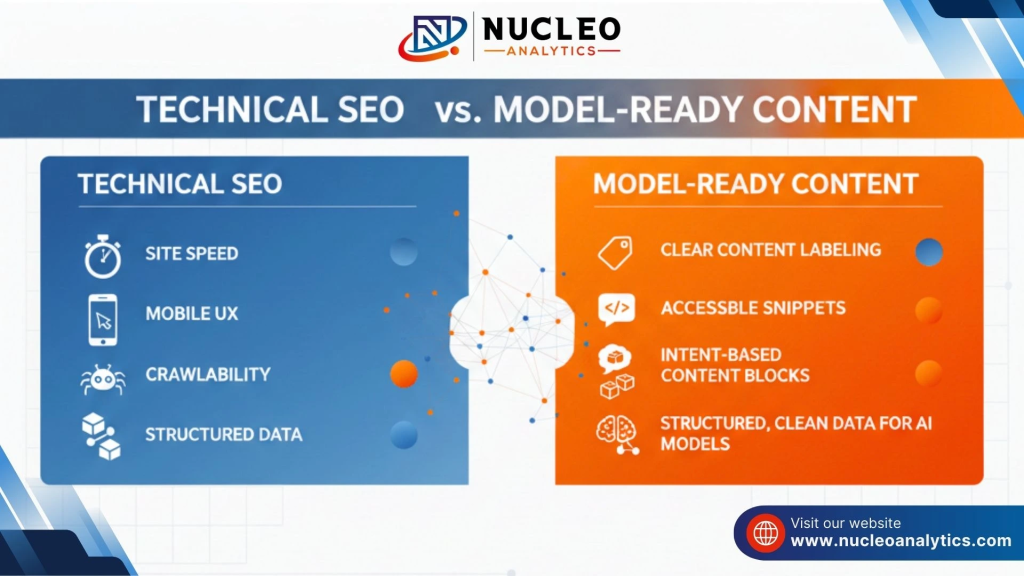
Technical SEO still matters: site speed, mobile UX, crawlability, structured data. But you also need to think about making your content model-friendly.
That means clear content labels for search engines, accessible snippets, and content blocks that answer specific user intents. Models often rely on structured inputs. If you give them clean, well-marked data, they’re more likely to surface your content in a generated answer.
The Role of Structured Data (Schema)
Schema isn’t new, but it’s more valuable now. Structured data helps search engines and models understand your content’s pieces: recipes, Q&A, and product specs. When a model generates an answer, it uses signals from the schema to pick accurate facts. The clearer the structure, the likelier your content will be cited or summarized correctly. So invest in a good schema now, it’s low-effort, high-return.
User Experience and Conversions Change
Measurement: Old Metrics Feel Flat
Rank tracking is still useful, but it’s not the full story. You must track answer appearances, snippet citations, and conversational hits. Engagement metrics like scroll depth, time on page, and conversion per visit become more important. Also measure voice-search performance and usage inside third-party apps that use models. The metric mix expands.
Keyword Strategy in The AI Era
Keywords are not dead; they’re just recalibrated in search engine optimization. You still need to understand what people search for, but your focus should be on topic clusters, content planning based on user needs, and how AI might synthesise answers.
Use keyword data as a starting point, then translate it into concise answer units and longer context pieces. Think in modular content units that models can recombine.
Link Building vs. Signal building
Backlinks are still a powerful signal, but there’s more to signal building than links. Mentions, data sharing across platforms, data connections, and structured citations can indirectly feed models. Think of “signal” as anything that tells an AI or search engine your content is trustworthy: citations, authoritative schema, partnerships, and clean metadata. Also, content quality now can trump link quantity for certain answer types.
Branding and Authority in a No-Click World
Suppose answers are generated without links, brand matters. Models often prefer authoritative domains; they learn from sources labeled as credible. Build off-site signals: be in trusted databases, publish whitepapers, and get mentions in respected outlets. Make your brand the kind models and editors default to when summarizing a topic.
Speed and Iteration Beat Perfection
Traditional content cycles could be slow. With AI assistance, iteration is faster. Publish small, test, refine. Use quick Q&A posts to capture short-tail intent and expand later with long-form, data-rich pieces. Rapid iteration helps you learn how AI surfaces and uses your content.
Personalization and Dynamic Answers
AI enables on-the-fly personalization. A model might tailor an answer to the user’s location, prior searches, or device. So content should consider variable paths: modular, adaptable, and able to feed personalized snippets. Dynamic content that updates based on signals will perform better in personalized outputs.
Tools & Tech Stack: What’s Different
Old stack: keyword tool, CMS, analytics, rank tracker. New stack: prompt frameworks, model APIs, content ops for verification, schema generators, and monitoring for AI citations. You still need analytics, but add tools that show when and where AI mentions or uses your content. Monitoring is now about more than rank; it’s about presence in model outputs.
Prompt Engineering for marketers
Prompt engineering isn’t just for developers. Marketers should craft prompts that surface your content in the best light: accurate, concise, and linked. Experiment with prompt templates that ask models to cite sources or prefer authoritative domains. This is a new craft; treat it like headline testing. Good prompts can make the difference between being quoted or ignore.
Risks: Incorrect AI Data, Misuse, and Trust Erosion
AI can misstate facts. It can also combine sources incorrectly. If model answers propagate false info that’s attributed to you, that’s a problem. You need checks. Use human editors to verify facts, provide clear attributions, and make corrections public when needed. Build a correction process so you don’t lose trust.
Content Quality Standards Haven’t Disappeared
Models favor clarity and accuracy. Thin or generic content gets ignored. Invest in deep research, proprietary data, or unique case studies. Quality content that offers something original will be cited more. Also, focus on readability, short paragraphs, clear headings, and bullets.
How to Audit Your Current Content For AI Readiness
Start with a content inventory. For each page, ask:
- Is there a clear, concise answer to a likely user question?
- Is the data structured and marked up?
- Are sources cited and credible?
- Can sections be repurposed as stand-alone answer blocks?
Pages that tick these boxes are more likely to be used by models.
A Practical Rollout Plan (Step-By-Step)
- Map intent: Create topic clusters and prioritized user intents.
- Create answer blocks: Write short, standalone answers for core queries.
- Add structure: Implement schema and clear headings for those blocks.
- Proof and verify: Human-edit the model-assisted drafts.
- Publish fast: Put small answers live and test SERP responses.
- Measure new signals: Track answer appearances, snippets, and conversions.
- Iterate: Refine based on what gets surfaced and what converts.
This plan keeps you moving without sacrificing quality.
Example: A Content Piece Reworked For AI
Imagine a product comparison page. Old approach: big comparison table, long prose. New approach: short summary answer at top (one-line verdict), FAQ blocks, structured specs (schema), and an expanded deep-dive below. The short answer is what models pick up. The deep-dive is what converts visitors who click.
Team Structure: Who Should Own What?
You’ll need collaboration:
- Content strategists map intent and topics.
- Writers craft human-first drafts and verify facts.
- SEOs handle technical signals and schema.
- Data analysts track new metrics.
- Developers add API hooks and structured feeds.
- Product ensures personalization flows.
Cross-functional teams beat silos here.
Budget: Small Wins, Staged Investment
You don’t need to rebuild everything. Start with high-impact pages: product pages, FAQ, and cornerstone content. Invest in schema and small model experiments. Scale once you see improved visibility or conversion lift. Measure before expanding budgets.
Common Mistakes Companies Make
- Treating AI as a content autopilot.
- Ignoring structured data.
- Measuring only rank.
- Not verifying facts post-generation.
- Failing to optimize conversion paths for no-click scenarios.
Avoid these, and you’ll be ahead.
Ethical And Legal Considerations
Be transparent about AI usage. If content is generated, disclose it where appropriate. Cite primary sources. Respect copyright: don’t paste proprietary data from other sites into models without permission. Keep privacy in mind when personalizing.
Long-Term Outlook: Coexistence, Not Replacement
AI won’t kill SEO. It will change what “SEO” means. The sweet spot is human+AI: humans set strategy, nuance, and verification; AI scales and surfaces content. Focus on depth, trust, and utility that’s evergreen.
How We at Nucleo Analytics Approach This
At Nucleo Analytics, we treat AI as an amplifier, not a replacement. We combine data-driven SEO fundamentals with model-led experiments. Our teams map intent, build structured answer blocks, and run controlled A/B tests to see how AI changes traffic and conversions.
We vet everything, human editors validate model outputs, and our developers make sure schema and technical signals are clean. If you want help shifting your stack and playbook without breaking what already works, that’s our wheelhouse.
Final takeaway
AI search marketing is not about abandoning traditional techniques; it is about enhancing them. Maintain the fundamentals: speed, user experience, excellent content, but also include model-friendly organization, intent focus, and fast testing. Consider AI as a tool that showcases your finest creations to your audience through various channels. If you do this, you become the winner.