If you’ve been attempting to figure out SEO in recent times, chances are that you’ve heard the phrase user intent. It’s bandied about by digital experts, SEO optimization agencies, and marketers like it’s the magic potion for Google rankings, and, honestly, it sort of is.
But what is user intent, anyway? And more to the point, how can it shift the way you produce content and develop your strategy, particularly if you’re managing SEO for international websites or dealing with multiple types of audiences?
Let’s deconstruct it into simple, human speak and discuss how user intent can totally revolutionize your search results.
Understanding What “User Intent” Actually Means
In plain language, user intent (or search intent) is why a person searches for something on Google. It’s the “why” they’re searching.
Consider this: when a person searches “best running shoes,” they likely want to purchase. But when they search “why do runners use carbon plates in shoes,” they’re searching to learn.
Despite the fact that both searches contain shoes, the purpose is completely different, and that alters the way you need to present yourself for those searches.
Search engines such as Google have been perfecting how they handle this purpose for years. They no longer simply match words; they match meaning. That’s why pumping out random keyword-stuffed blogs no longer works.
The Three Core Types of User Intent
Before we get to strategy, it’s useful to know that there are three broad categories of user intent you’ll come across. Every keyword, every search, and every click will sit somewhere within these categories.
1. Informational Intent
This is when someone is looking to learn.
Examples:
- “How does SEO work?”
- “What is content marketing?”
- “Difference between HTTP and HTTPS.”
They don’t want to buy; they want information. Blogs, tutorials, guides, and how-to articles perform well here.
2. Navigational Intent
Here, the users are attempting to arrive at a certain place.
Examples:
- “Facebook login”
- “YouTube Studio”
- “Spotify website”
They already have an idea of what they are after; your role is to assist them in getting there quickly.
3. Transactional (or Commercial) Intent
This one’s action: buying, signing up, or booking.
Examples:
- “Best SEO optimization companies near me.”
- “Buy an SEO audit tool online.”
- “Affordable keyword research service.”
These individuals are prepared to make a decision. Your product pages and landing pages must fulfill this intent flawlessly.
Why User Intent is a Game-Changer for SEO
Google’s whole algorithm has been developed to better comprehend intent than ever before. If your content doesn’t fulfill what individuals essentially want, you won’t rank, even with an infinite number of backlinks you create.
So, why is user intent so critical?
1. It Enhances Relevance
When your page meets someone’s desire, they linger. They click here and there. Google interprets this behavior as an indication that your content is worth it, and rewards it.
2. It Lowers Bounce Rates
Individuals exit pages quickly when they can’t find what they’re looking for. Matching your content with intent keeps them on your page.
3. It Increases Conversions
When you understand what the users want and offer it in simple terms, then the conversions will automatically take place. It is especially important when businesses are using services in the ministries of the optimization of search engines, which do not promote positions but the results.
How to Determine User Intent for Any Keyword
Step 1: Search the Keyword Yourself
Search for your keyword in Google and see the top results.
- Are they product pages or blog posts?
- Are they category pages, guides, or listicles?
This immediately informs you of what kind of content best fulfills the user intent.
Step 2: Search for Clues in the Snippets
Step 3: Analyze the SERP Features
Examples of Matching Intent the Right Way
Suppose you own an agency that does digital marketing.
You are going after the keyword: “best SEO tools.”
- User Intent: Individuals are comparing and contrasting before purchasing.
- What You Should Create: A comparison guide, not a sales page.
Now, another keyword: “buy Ahrefs subscription.”
- User Intent: Purchase intent.
- What You Should Create: A product or pricing page.
When your content is a perfect match for what the searcher is looking for, it not only ranks, it wins.
Why Intent Mismatch Kills Rankings
Think about this: a user searches “how to bake sourdough bread,” and your page is a recipe ad. They’ll bounce immediately.
Google recognizes short visits (or “pogo-sticking”) as a negative sign.
It finds that your page did not get the job done.
And hey, you fall down the rankings.
Intent mismatch frustrates users and annoys Google. It’s comparable to presenting someone seeking a car wash with a blog on how to construct one.
How SEO Optimization Companies Use Intent Strategically
Leading SEO optimization firms don’t simply pack keywords into copy; they learn behavior. They plot search paths and create funnels of copy based on intent.
To illustrate:
- Informational copy raises awareness.
- Comparative copy cultivates leads.
- Transactional copy converts buyers.
When all three layers are linked, SEO ceases to be arbitrary and becomes reliable.
These businesses also employ data, heatmaps, engagement rates, and analytics to monitor the intent of their visitors. They then fine-tune their content to fit it more perfectly.
That’s what makes a difference between mediocre marketers and masters.
Want to make sure your SEO strategy actually matches what people are searching for? Let’s analyze your current content and keyword performance today!
User Intent and the Use of AI in Search
Google’s AI updates (such as RankBrain and BERT) are literally designed around comprehending user intent.
They don’t merely read your keywords; they contextualize.
If a person searches for “best laptops for video editing,” AI knows that the person does not need a Wikipedia entry on laptops but instead needs suggestions.
That makes keyword-stuffing officially dead. The future is only about contextual optimization, using natural language while trying to meet the intent of the search.
How to Create Content That Aligns With User Intent
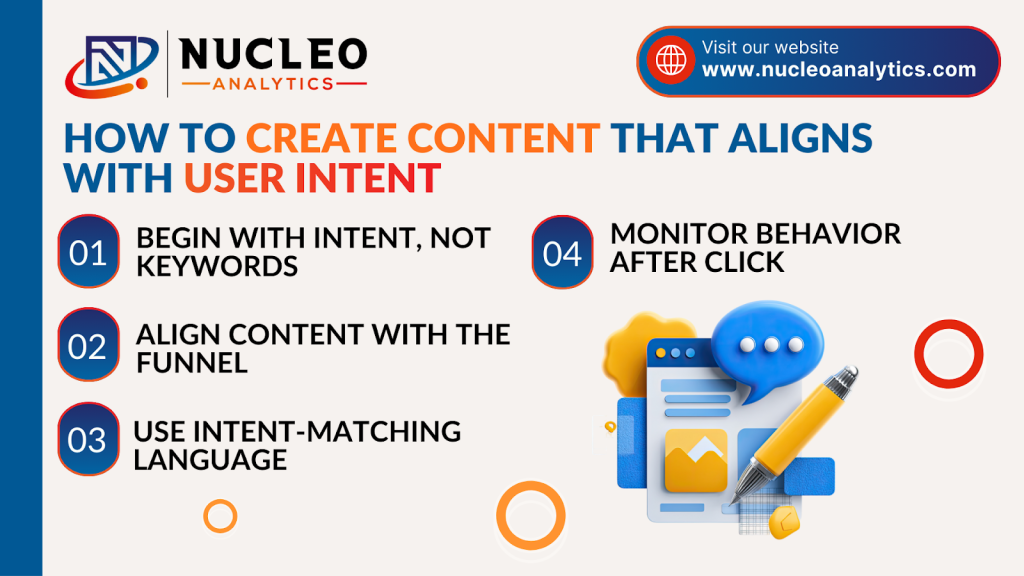
1. Begin with Intent, Not Keywords
When brainstorming ideas, ask: What is the user attempting to do with this search?
This single attitude change makes your entire content strategy smarter.
2. Align Content With the Funnel
Different phases of the buying process require different kinds of content:
- Awareness = blogs, infographics, videos
- Consideration = comparison posts, reviews
- Decision = product demos, testimonials
3. Use Intent-Matching Language
For instance:
- Informational = “how,” “why,” “guide”
- Commercial = “best,” “top,” “review”
- Transactional = “buy,” “hire,” “get”
4. Monitor Behavior After Click
Don’t only monitor rankings. Make sure to monitor how users act after clicking.
Do they scroll, click another page, or bail quickly? These are hints that inform you about whether your intent alignment is working.
SEO for International Sites and User Intent Across Cultures
Here’s something everyone tends to forget: user intent varies by geography.
Someone googling “SEO tips” in America may prefer a tutorial, whereas in Japan, they may be searching for a course.
This is why SEO for international websites is not as simple as translating words. You must localize it, i.e.:
- Tweak examples and references to every culture.
- Tune search behavior (different markets have different preferences, e.g., YouTube vs. blog search).
- Tailor meta titles in regional languages.
Intent comprehension in one area doesn’t translate to another. Savvy marketers adapt intent-based SEO for each audience segment that they cater to.
Tools for User Intent Analysis
You don’t have to guess; you can analyze.
Below are some tools SEO experts use:
- Google Search Console: Indicates what queries drive impressions and clicks.
- Ahrefs & Semrush: Assist in determining keyword intent types and SERP trends.
- AnswerThePublic: Uncovers the “questions” users pose about your subject.
- Google Trends: Helpful in detecting regional intent changes.
Add these along with human judgment, and you have a strategy that is data-backed but human-friendly.
Common Business Fails Regarding User Intent
Let’s face it, most SEO errors occur when people misinterpret intent.
Here are some you can sidestep:
- Creating content only for keywords, not humans.
- Thinking all traffic is good traffic.
- Blending multiple intents on the same page.
- Overlooking “People also ask” queries.
- Forgiving that intent evolves over time.
If your rankings are level yet your optimization and backlinks are solid, the likelihood is that your content intent is wrong.
How Nucleo Analytics Enables You to Win with Intent-Based SEO
This is where our experts at Nucleo Analytics come in.
We assist brands in deciphering what their people actually desire, and then develop SEO based on that knowledge. You might be developing a content strategy, optimizing your pipeline, or handling SEO for global websites, but we make sure your pages perfectly match what users search for.
Our method is more than rankings. We deal with relevance, interaction, and conversions, the things Google appreciates most.
So, if you’ve been wondering why your content isn’t performing, the answer could be intent alignment, and that’s something we can correct.
Ready to turn search intent into real traffic and conversions?
Let’s make it happen! Contact Nucleo Analytics today and get a tailored SEO plan built for your goals.
Conclusion: User Intent Is the Heart of Modern SEO
Search engines are becoming increasingly clever day by day, but the objective remains the same: to provide users with what they desire, quickly.
Once you know why users search, not merely what they search, you open up SEO success that lasts.
For those in the business of employing SEO optimization companies or doing SEO on foreign websites, user intent is not a luxury anymore. It is the backbone of each intelligent ranking strategy.
Align your content with intent today, and you won’t merely ascend the ranks; you’ll remain there.
Don’t pursue algorithms. Focus on human beings. Google will follow.