If your site isn’t ranking the way it should, chances are it’s not because Google changed the rules overnight. More often, it’s because your site never built real topical authority SEO in the first place, or slowly destroyed it without realizing.
Topical authority is no longer optional. Google doesn’t reward random content anymore. It rewards websites that show depth, consistency, and real understanding of a topic. When your site looks scattered, shallow, or confused, rankings suffer quietly. No penalty. No warning. Just a slow decline.
This guide breaks down the most common, real-world mistakes that kill topical authority SEO, even on sites that publish regularly and “do SEO.” These aren’t theory-based problems. These are practical issues we see every day on real websites.
What Topical Authority Actually Means
Basically, topical authority SEO implies that Google has confidence in your site to provide the best answers regarding a certain subject among its few competitors. This trust is established when your material demonstrates mastery over a subject, rather than simply covering it with surface-level and keyword-centric content.
Google determines whether your website continually introduces new content that is related to the specific area and whether the content is logically interconnected and answers user questions. Once this condition is fulfilled, Google starts to rank not just one keyword, but dozens or even hundreds of related searches.
Topical authority cannot be created by a single post. It is a procedure. And the majority of websites do not succeed because they do not create that system at all.
Mistake 1: Treating SEO as a Keyword Game Instead of a Topic Game
One of the fastest ways to kill topical authority SEO is focusing only on keywords instead of topics. Many sites still operate with the mindset of “one keyword, one page.” That approach is outdated.
Google doesn’t rank pages in isolation anymore. It evaluates how well your entire site covers a subject. Slowly but surely, Google is getting accustomed to the practice of content hopping through keywords without a well-defined SEO content strategy, and consequently, getting the wrong impression about your strength.
Mistake 2: Writing About Too Many Unrelated Topics
This is especially common on blogs that try to “grow traffic” by covering whatever is trending. One week it’s SEO. Next week it’s social media. Then AI. Then productivity. Then something else entirely.
From a branding perspective, that might feel flexible. From a topical authority SEO perspective, it’s damaging.
Google needs clarity. If your website is talking about a lot of different things that have nothing to do with each other, Google will not be able to see you as a trustworthy source of information for any of those things. You come across as a broad content provider, rather than a niche expert.
A strong SEO content strategy limits scope. You can expand later, but early and mid-stage sites need focus before breadth.
Mistake 3: No Clear Content Cluster Structure
Publishing content without structure is one of the biggest silent killers of authority. Many sites publish dozens or hundreds of articles, but never organize them into a clear content cluster structure.
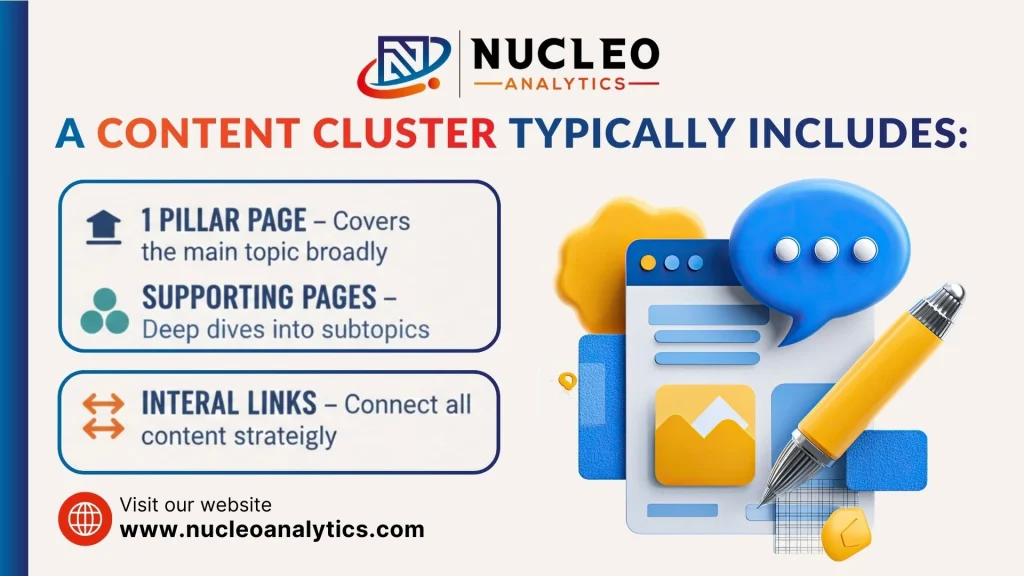
A content cluster typically includes:
- One pillar page that covers the main topic broadly
- Multiple supporting pages that go deeper into subtopics
- Strong internal links connecting everything together
Without this structure, your content competes with itself instead of reinforcing itself. Google sees individual pages, not a unified knowledge base. That weakens topical authority SEO even if the content itself is decent.
Mistake 4: Weak or Random Internal Linking
Internal links tell Google what the relationships among the pages are. When your internal linking practice is weak, inconsistent, or random, then your topical signals are lost.
Among the main internal linking mistakes are linking just from menus or footers, employing the same anchor text in every case, or hardly linking related articles at all. All of these confuse crawlers.
A good internal linking strategy guides Google through your content in a logical way. It shows which pages are central, which ones support them, and how topics connect. Without that, authority doesn’t flow.
Mistake 5: Ignoring Search Intent Across the Topic
You can cover the right topic and still fail if you ignore search intent optimization. This happens when content answers a different question than what users are actually asking.
For example, if someone searches for a “how-to” query and lands on a sales-heavy page, they leave. If they search for a comparison and land on a basic definition, they leave. Over time, Google notices these mismatches.
Topical authority grows when your content consistently matches intent across informational, commercial, and decision-based searches. Weak intent alignment chips away at trust.
Mistake 6: Publishing Thin Content to “Check the Box”
Many sites publish short, shallow articles just to say they covered a topic. These pages add little value and weaken the overall SEO content strategy.
Thin content doesn’t just fail to rank. It actively hurts topical authority by signaling that your site lacks depth. When Google sees too many weak pages within a topic, it questions whether your site truly understands that subject.
Depth doesn’t mean fluff. It means clarity, completeness, and usefulness.
Mistake 7: Letting Old Content Go Stale
Topical authority isn’t static. Content ages. Statistics change. Best practices evolve. When old pages remain untouched for years, they slowly drag down authority.
Outdated content creates broken trust signals. Google isn’t demanding that you be perfect, but it is expecting you to perform maintenance work on your site. By undergoing frequent updates, the site will get the topical authority SEO boost as it reveals that the site is still relevant and correct.
Old content refreshment is frequently the most effective way to attract the audience compared to the new content release in various areas.
Mistake 8: Mixing Beginner and Advanced Content Without Structure
Covering beginner and advanced topics is good. Mixing them without context is not.
If your site jumps from “What is SEO?” straight into highly technical discussions with no learning path, users get lost. So does Google.
A strong content cluster structure creates a progression: foundational concepts first, deeper analysis later. This logical flow reinforces authority and improves user engagement, which supports rankings.
Feeling unsure if your internal links are helping or hurting your SEO?
Mistake 9: No Pillar Pages to Anchor Authority
Without pillar pages, your topical authority floats. Pillar pages act as the backbone of your topic coverage. They summarize the topic, link to subtopics, and serve as the primary authority signal.
Many sites skip this entirely. They publish dozens of posts but never create a central resource. As a result, authority spreads thin across many URLs instead of consolidating.
A solid SEO content strategy always includes pillar content.
Mistake 10: Overusing AI Without Human Direction
AI is a great, fast-working assistant, but the exclusive use of AI usually results in the production of content that is general, superficial, and lacks sophistication. Such content is devoid of nuances, examples, and comprehension of the real world.
Google is getting better at detecting content that doesn’t add anything new. When your site is filled with AI-written pages that all sound the same, topical authority SEO suffers.
AI should assist research and drafting, not replace expertise.
Mistake 11: No Clear Brand or Author Voice
Authority and trust are interlinked, and the latter relies on the former. The credibility of the content is reduced when it is viewed as having no author or not being consistent.
Google wants to see signs of experience and accountability. That doesn’t require personal branding everywhere, but it does require clarity and consistency in how information is presented.
Strong topical authority often comes from sites that sound confident, consistent, and purposeful.
Mistake 12: Missing Semantic Keyword Coverage
To cover a topic thoroughly is to talk about the concepts that are related, rather than simply using the same keyword again and again. When sites fail to include semantic keyword coverage, they look incomplete.
Google expects content to naturally include related terms, questions, and subtopics. When those are missing, it signals a shallow understanding.
Semantic coverage strengthens topical authority because it mirrors how real experts talk about a subject.
Mistake 13: Publishing Inconsistently Within a Topic
Publishing one article, then disappearing for months, then publishing something unrelated weakens authority growth. Google tracks topical consistency over time.
You don’t need daily content. You need steady, intentional expansion within your topic. Consistency reinforces topical authority SEO more than volume ever will.
Mistake 14: Following Trends That Are Not Supporting Your Main Topic
Trends might result in visitors; nevertheless, they might also cut down on your credibility if they are not in line with your primary topic. Covering current issues that have no relation to your basic SEO content strategy merely creates a fuss.
Authority comes from relevance, not reach. Trend content should only be published if it fits naturally within your topic ecosystem.
Mistake 15: Measuring Success Only by Individual Keyword Rankings
Topical authority doesn’t always show up as instant ranking wins. It often shows up as broader visibility: more keywords ranking, more impressions, faster indexing, and stronger internal performance.
When you only track a few keywords, you miss the bigger picture. Authority growth is cumulative. It compounds quietly before it explodes.
What Actually Builds Topical Authority Over Time
Real topical authority SEO comes from focus, structure, intent alignment, and maintenance. It’s not a hack. It’s a system.
You build authority by choosing a topic, covering it deeply, connecting content logically, updating regularly, and aligning everything with user intent. When those pieces work together, Google responds.
Where Nucleo Analytics Comes In
At Nucleo Analytics, this is exactly how we approach SEO. We don’t chase random keywords or publish content for the sake of publishing. We build structured topical ecosystems.
We help businesses:
- Define clear topical focus areas
- Build pillar pages and supporting clusters
- Fix broken internal linking strategy
- Expand semantic keyword coverage
- Align content with real search intent optimization
- Turn scattered blogs into authority-driven assets
The goal isn’t more content. It’s stronger content that works together.
Conclusion: Topical Authority Is Built by What You Don’t Do
Most sites don’t lose rankings because of one big mistake. They lose because of many small ones repeated over time. Scattered topics. Weak structure. Thin pages. No updates. No focus.
If you want sustainable rankings, you have to stop thinking page-by-page and start thinking topic-by-topic.
Fix the structure. Respect intent. Build depth. Maintain consistency.
That’s how topical authority SEO survives. And that’s how it wins.
If your site feels stuck despite “doing SEO,” it’s probably time to rethink the foundation, not the tactics.