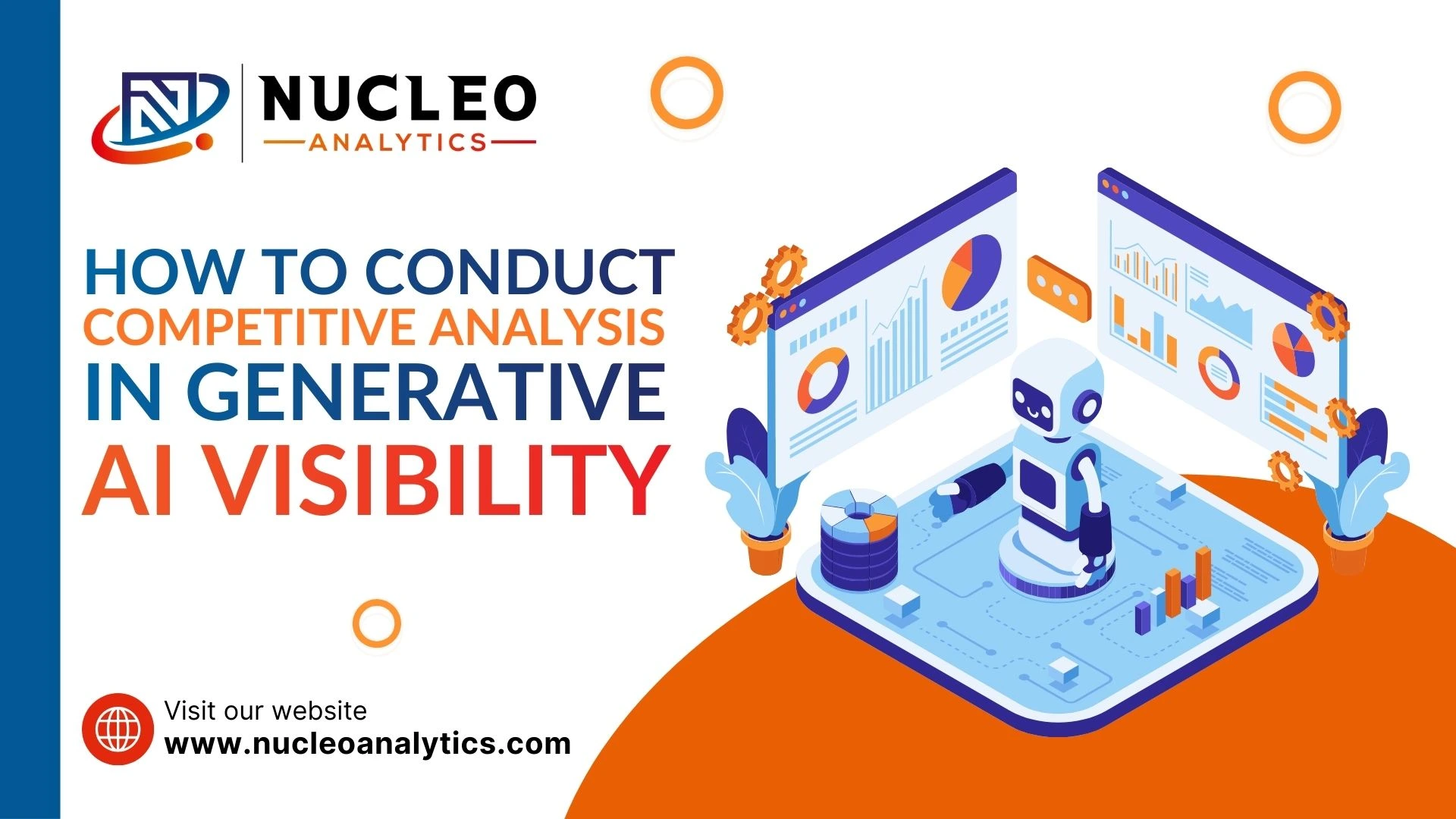
Generative AI is changing the way people are discovering things on the internet. Now that search engines are including AI-driven answers as part of search outcomes, brands are having to relearn how to stay top of mind. It is not merely a matter of being on page one anymore; it is about being within the AI-generated answer itself.
And this is where competitive analysis enters the picture. Knowing how your competitors are showing up in generative AI visibility can give you a competitive advantage. You’re working with an SEO service agency if you’ve heard that you can’t use outdated SEO practices anymore. The game is evolving, and competitive analysis has to evolve, too.
In this article, I’ll walk you through actually conducting a competitive analysis for AI-driven search, step by step, in plain English. No hype, just real techniques you can use.
Why Visibility is Important for Generative AI
Alright, let’s talk about the “why” before we get into the “how.”
Generative AI changes search because:
- AI tools do not just list pages; they generate direct answers.
- Citations (the sources used by AI) are fewer than normal search results.
- Material that is clear, trustworthy, and packed with context has a higher likelihood of being part of AI summaries.
That means if your competitor’s material is getting into AI answers but yours isn’t, they’re getting visibility you’re not. Competitive analysis allows you to notice such gaps and fill them.
Step 1: Identify Who Your Competitors Actually Are
Here’s the twist: your AI visibility competition may not be who you’ve been battling in general SEO.
For example:
In a typical Google search, you are most probably competing with local shops or a blog site.
You can be competing with larger publishers or niche writers, or even with sources of knowledge such as Reddit and Quora, with AI-powered results.
So, the first step is tracking AI rivals. Enter your root keywords into Google’s AI-generated lists (or AI Summaries). See which pages get referenced, what type of content gets referenced, and how often.
Pro Tip: Don’t search just once. Enter the same search from different times and from different devices. AI results occasionally differ depending on context.
Step 2: Track What Content Gets Picked Up
All content types are not equal. Most of the time, AI-driven answers will cite:
- Simple “how-to” tutorials
- FAQ-style responses
- Advanced long content
- Sorted lists and comparisons
What this means is that your verbose competitor who writes step-by-step posts is likely beating your 500-word, well-written blog post.
Consider the following:
- Are others quoted because they sort out content better?
- Do they provide good definitions or overviews at the start of their articles?
- Are they using schema markup to provide context to search engines?
A legitimate SEO service company will be able to guide you through this, but even on your own, you can go through manually and compare what is being consumed vs. what is omitted.
Step 3: Look at Content Depth vs. Brevity
Another humorous thing about generative AI is that it doesn’t always prefer the longest content written. It prefers clarity.
- In any case, you’ll find two poles of the spectrum excelling:
- Bite-sized, concise responses that nail the question within one or two sentences.
- Comprehensive guides that AI can dissect into longer summaries.
Your competitive research needs to try both methods. Your competitor might have a short FAQ page that is being shared, or they might have an omnipotent guide that dominates. Either way, you need to know what method is working for your niche.
Step 4: Examine Authority Signals
AI doesn’t take from wherever it can. It seeks out authority. It may be:
- High domain authority sites
- Websites with a high number of backlinks
- Authoritative content with strong author signals (such as bio pages or credentials)
When examining competitors, look:
- Do they have backlinks enhancing credibility?
- Are they incorporating expert authorship to establish trust?
- Do they maintain a presence of their brand in addition to their website (social mentions, PR, etc.)?
This tells you whether you should focus on technical dominance or clarity of content in order to compete.
Step 5: Check Structured Data and Schema
This is likely one of the most actionable things you can do. A lot of your competition that shows up in AI answers is taking advantage of structured data, like FAQ schema, HowTo schema, and review markup.
Why is this significant? Because AI models prefer to draw on structured signals in order to understand context.
Some of your competitive research will be to search your competitor’s pages through a schema validator tool. If they’re marking up FAQs, images, and steps but you’re not, you know what you need to do.
Wondering if your site has the right schema implemented to be picked up by AI-driven search? Let us have our team audit it for you! Get in touch with us today and discover where you are at.
Step 6: Monitor Generative AI Tools Beyond Google
It is not just Google rolling out AI-generated answers. Bing, Perplexity, and even ChatGPT-based plugins are also affecting search visibility.
Check where your competition is listed on a number of AI tools. For example, if your competition appears on Bing’s AI but you do not, you may lack backlinks or structured content signals.
Step 7: Learn Lessons from “Non-Traditional” Competitors
This is something that people tend to miss: sometimes Reddit, Quora, or a niche forum steals the AI limelight. These are non-traditional competitors, but they can drive your visibility out.
When you see this, ask yourself why. Usually, it’s because:
- They have loads of user-created Q&A.
- Their posts sound conversational and natural.
They are responding to long-tail questions that you missed.
This is a nugget of insight. It means you can pilfer the structure, building your own FAQ center or conversation-structured posts.
Step 8: Compare Keyword Strategies
While AI search is less keyword-driven than vintage SEO, keywords are still significant. AI pulls from content that aligns with user search terms.
Check your competitors’ keyword strategies:
- Are they going for long-tail questions like “how do you change language in Google” instead of just “Google language settings”?
- Are they optimizing for conversational searches like “what’s the best way to…?”
- Are they merging industry slang with everyday terms?
Tracking this enables you to curate your content around the way human beings actually search in an AI world.
Step 9: Watch Engagement Beyond SEO
AI visibility isn’t merely about rankings; it’s also about the way people engage with your content.
Ask yourself:
- Do your rivals get tons of comments or shares?
- Are they on LinkedIn or other social channels where AI spiders may monitor conversations?
- Do they regularly update content?
Sometimes, the difference between being scooped by AI and not is freshness. If your competitor is publishing an update every 6 months and yours hasn’t been touched in 3 years, that’s a fix that can be done in seconds.
Step 10: Develop a Competitive Tracker
This is the step that most businesses skip. They will do an analysis and then say that it’s done. But AI visibility shifts rapidly.
You need a process to track:
- Which competitors are being quoted in the long-term crime
- What content is performing well
- How does it change as there are changes to AI models
Use a plain spreadsheet to start. Note down keywords, quoted competitors, type of content, and authority signals. Over time, you’ll see patterns emerge.
How to Put It All Into Action
So far, we’ve had competitor analysis steps. But what do you do with that information?
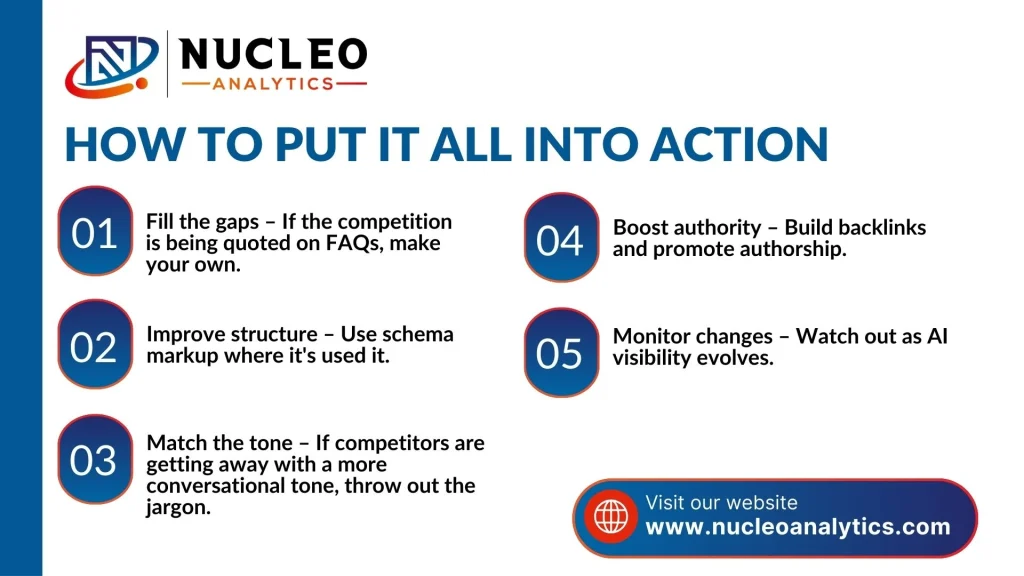
Here’s how to apply it:
- Fill the gaps – If the competition is being quoted on FAQs, make your own.
- Improve structure – Use schema markup where it’s used it.
- Match the tone – If competitors are getting away with a more conversational tone, throw out the jargon.
- Boost authority – Build backlinks and promote authorship.
- Monitor changes – Watch out as AI visibility evolves.
The goal isn’t to mindlessly copy competitors. It’s to find out what’s working and do it better.
Where an SEO Partner Fits In
It’s all doable to do it by hand, but it’s tedious. A quality SEO service agency can assist in making it more manageable, using advanced tools to track AI citations, keyword gaps, and structured data opportunities.
They’ll not only know who’s winning in AI visibility, but why.
Nucleo Analytics: Your Partner to Remain Relevant in the Age of AI
We don’t just observe conventional SEO metrics at Nucleo Analytics. We’re going deeper into generative AI visibility, mapping your competition and how you can beat them. From data structure audits to content gap analysis, we employ real strategies that get you to appear in AI-driven search.
And because no two businesses are alike, we’re developing customized seo services that fit your niche, audience, and goals.
Ready to outpace your competition in AI-driven search? Contact us today and have NucleoAnalytics create a strategy tailored to your brand.
Conclusion
The game of search is being redefined by generative AI. In order to remain competitive, you must understand not only your current position but also how your rivals are performing with an AI-powered results presentation.
Understanding who is quoted, what copy is taking over, and what authority indicators are the most crucial ones can help you create the strategy that will put your brand at the center of AI attention.
This is where a good ally can step in. Under the guidance of a skilled SEO service agency and the benefits of customized SEO services, you’ll have the tools and analysis to stay ahead of the game.