Are you among those who strive to drive more local customers to visit your business?
If yes, here is the best way to increase the footfall of local customers. You must invest in local search engine optimization (SEO).
49% of consumers like to buy from brands with a local presence.
Building your local presence impacts people buying from you. People want to purchase from brands that have a strong local as well as optimized online presence. Basically, It speaks to more of your business credibility.
Investing in local SEO ensures that your business has a local presence to make a positive impression on your audience. It enables you to provide your audience with valuable information. Overall, it develop trust towards your brand to purchase from you.
What is Local Search Engine Optimization (SEO)?

Local SEO is a category of SEO and part of digital marketing strategy that helps more local leads find your business and visit you. It is an excellent way to help your business grow online to enhance its visibility in search results for location-specific queries.
Local SEO strategy involves targeting users in a specific geographic area by leveraging strategies, like local keyword optimization, Google Business Profile listings management, and motivating customer reviews, to grab the attention of the local customers and drive foot traffic to physical locations.
Important Components of Local SEO
Typically, the local search results show in the following places:
- Search Engine Results Pages (SERPs): The results appear in the organic search results of popular search engines like Google, Bing, and Yahoo. They are usually shown with a map, business listings, and authentic contact information.
- Local Pack: In Google search results, the Local Pack is an important section that displays the top three local businesses related to a user’s query, supported by a map, business hours, ratings, and other vital details.
- Google Business Profile Listings: When users search for a specific business or service on Google, the Google Business profile listing may appear in the Knowledge Panel or Google Maps. It shows crucial business information, reviews, photos, and more.
- Google Maps: When users search for businesses or services near their location on Google Maps, local search results are displayed with markers on the map, along with business details, reviews, and contact information in the sidebar.
- Local Directories and Review Sites: Local search results can also be found on popular local directories and review sites where users can search for businesses in their area.
- Social Media Platforms: Local search results may also appear on social media platforms like Facebook, where users can search for local businesses, see reviews, and engage with the business’s social media content.
Key Benefits of Location-Based SEO
Local SEO is indispensable for location-based businesses and has myriad benefits. It acts as a lead magnet – attracts local customers and increases their online visibility. By deploying effective local SEO strategies, businesses can also build customer trust, and drive.
Let us discuss the importance of local SEO for a location-based business:
- Enhance Brand Visibility
Implementing a local SEO strategy increases the online presence of your business in local search results. When users search for products/services near their location, your business is more likely to appear at the top of the results, mainly in the Local Pack. Online visibility ensures that target customers locate your business, which leads to more site traffic. - Increase Targeted Traffic
Local SEO marketing strategy allows businesses to attract highly targeted traffic. When your website ranks well for local keywords, you can connect with the users interested in the products/services you offer in your area. It boosts the chances of sales conversions and parallelly improves the quality of your traffic. - Increase Brand Credibility
When your brand appears in the local search results, mainly in the Local Pack, there is a significant impact on your business credibility and face value. More often users associate with top brands with trust and reliability, they are more likely to engage with your business. When brand credibility increases it improves the key KPIs like click-through rates and rate of conversions. - Enhance User Experience
One of the key aspects of local SEO is optimizing your website and GMB listing for mobile users. Our Leveraging local SEO empowers your business to provide a better user experience by accessing your website on their mobile devices. Exceptional user experience appeases users/visitors and aligns with Google’s preference for mobile-friendly websites, eventually leading to higher search rankings. - Affordable Marketing Strategy
When compared to traditional advertising methods, local SEO is a cost-effective way to reach out to the local audience. Paid advertising can be expensive and many a time it does not guarantee long-term benefits like organic search rankings. By implementing a location-based SEO, you can secure a long-term online presence without ongoing ad spend.
Steps to Create an Effective Local SEO Strategy
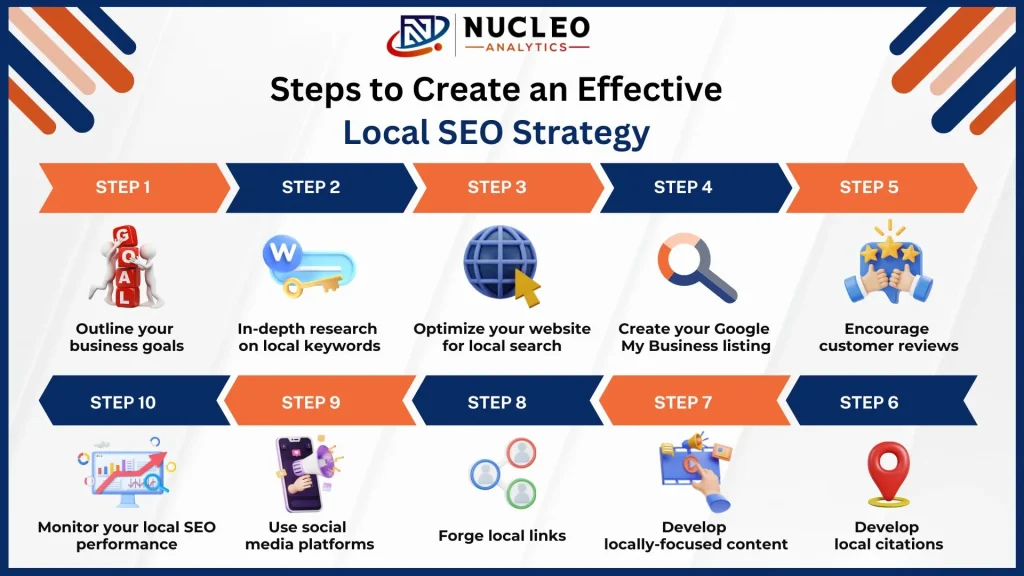
Creating a local SEO strategy is vital syrup to maintain the good health of your business. It is a boon for businesses that want to connect with local customers. Optimizing your online presence for local search can attract more targeted traffic and increase foot traffic to your brick-and-mortar store, thus improving your overall brand reputation.
Let us discuss step by step how to design a powerful local SEO strategy for location-based business:
Step 1: Outline your business goals
The first step is to outline core business goals and objectives for your local SEO strategy, such as increasing foot traffic, enhancing online presence, or generating local leads. Based on the goals the next steps can be decided.
Step 2: In-depth research on local keywords
After defining the goals and objectives, conduct extensive keyword analysis to identify the most relevant and high-traffic keywords related to your business, products/services. Ensure that your prime focus should be on the location-specific terms that are used by your target audience while searching for similar businesses.
Step 3: Optimize your website for local search
Moving forward incorporate the local keywords into your website’s content, meta tags, and URLs. The keywords should be used in the content naturally without compromising its value. You also need to ensure that your website is mobile-optimized and delivers a smooth seamless user experience.
Step 4: Create your Google My Business listing
Thereafter you will have to claim your Google My Business profile and ensure all information that you provide is accurate and up-to-date. You have to include high-resolution images and a detailed business description. Then optimize the listing with relevant categories and local keywords.
Step 5: Encourage customer reviews
Customer reviews play the role of the best social proof. Approach your satisfied customers to share their positive experiences on your Google My Business listing and other review platforms. You need to respond to all reviews, both positive and negative, to showcase your commitment to customer satisfaction.
Step 6: Develop local citations
Maintain authentic business listings on local directories and review sites. So, ensure that your business name, address, and phone number (NAP) are consistent across all platforms.
Step 7: Develop locally-focused content
Create and publish value-added and engaging content on your website. The blog, articles, or posts that serve your local audience, addressing their unique needs, pleases needs pleases your local audience.
Step 8: Forge local links
Develop connections with local businesses and influencers to earn valuable backlinks. It will help to improve your website’s authority for the search engines.
Step 9: Use social media platforms
Engagement with the local audience is crucial. Hence, you have to engage with your local community through popular social media platforms. You should target sharing content that is relevant to the local audience and also participate in local events and discussions.
Step 10: Monitor your local SEO performance
Any strategy implemented needs to be tracked to evaluate its performance. Track your local search rankings, website traffic, and other key performance indicators regularly as it will help to identify gaps that need improvement. Also, make necessary adjustments in your local SEO strategy.
Types of Businesses That Need Local SEO

Indeed local SEO is vital for businesses that serve customers within a specific geographic area. The different types of businesses that benefit from local SEO marketing strategy are as follows:
- Retail stores: Shops, boutiques, etc. deploy local SEO to grab the attention of customers to increase footfall to brick-and-mortar stores and promote in-store events.
- Restaurants and bars: The strategy helps the cafes and bars to reach customers looking for dining options in their area.
- Healthcare: Medical practitioners can use local SEO to connect with patients in their community. Moreover, provide important information like appointments etc.
- Law firms: Professional businesses like accounting offices, real estate agencies, etc. can deploy local SEO to reach clients searching for their services.
- Event venues: Local SEO can help businesses like theaters, museums, amusement parks, and event spaces attract visitors looking for entertainment in their area.
- Fitness centers: Gyms and fitness studios leverage local SEO to connect with potential members looking for nearby fitness options.
- Hotel business: Local SEO can help hotels and other lodging providers connect with travelers searching for accommodations.
- Educational institutions: Leveraging local SEO can help schools, universities, and training centers reach out to potential students looking for educational opportunities within their community.
Wrapping Up:
Local SEO for location-based businesses is a must-have strategy. In the modern digital landscape, the majority of consumers rely on online searches to find local products and services. Optimizing your online presence for local searches has become more important than ever as it significantly impacts your visibility, credibility, and revenue.
So, it’s time to take the first step towards revolutionizing your local SEO efforts with Nucleo Analytics – one of the top digital marketing companies with a long clientele list and a plethora of services. The top in-house marketing experts are here to guide you through your exciting journey. Surely, they will help you to optimize your local SEO outreach to enhance your marketing strategies,
Connect with your ideal customers, and drive significant results. Call us at +91- 959-209-7054 to book an appointment.