
company logo
company logo
  • home
  • Services
    • SEO
    • Social Media Marketing
    • Google Ads
    • Reputation Management
    • International SEO
    • Local SEO Service Agency
    • Custom Website Development
    • Mobile-Application-Development
  • Outsource
    • SEO Outsourcing Agency in India
    • SEO Consultant India
    • SEO Reseller Services
  • Testimonials
  • Case Studies
  • FAQ
  • Blog
Contact Us
company logo

Helping businesses grow through strategic Digital Marketing, Custom Website and Mobile App Development, AI, and Innovative technology solutions that deliver measurable, long term results.

Follow us :

FacebookInstagramPinterestlinkedinYoutube

Quick Links

  • Home
  • Services
  • Testimonials
  • Case Studies
  • FAQ
  • Blog
  • Contact Us

Services

  • SEO
  • Social Media Marketing
  • Google Ads Services
  • Reputation Management
  • International SEO
  • Local SEO Service Agency
  • Custom Website Development
  • Mobile Application Development

Policy

  • Terms of Service
  • Cancellation & Refund Policy
  • Support
  • Privacy Policy

Contact Info

  • Nucleo Analytics office on Google Maps
    1688 Sector 82, JLPL Industrial Area, Sahibzada Ajit Singh Nagar, Punjab 140308, India
  • Contact Nucleo Analytics by phone+91-959-209-7054
  • Email Nucleo Analyticsinfo@nucleoanalytics.com
©2026 Nucleo Analytics.All Rights Reserved.
Terms of usePrivacyRefunds & Returns

AI SEO Strategies Businesses Must Use in 2026

Modern indexing systems evaluate content depth and information hierarchy. Pages that lack structured flow experience reduced visibility across AI-generated results. Content must therefore be engineered for machine interpretation while remaining readable for users. AI SEO Strategies establish the foundation for visibility in environments where ranking depends on meaning extraction and structured knowledge representation.

AI SEO Strategies Businesses Must Use in 2026
AI SEO strategies
Modern indexing systems evaluate content depth and information hierarchy. Pages that lack structured flow experience reduced visibility across AI-generated results. Content must therefore be engineered for machine interpretation while remaining readable for users. AI SEO Strategies establish the foundation for visibility in environments where ranking depends on meaning extraction and structured knowledge representation.

AI SEO Strategies define structured systems used to improve visibility across AI-driven search environments. These systems process content through semantic analysis, entity recognition, and intent mapping instead of simple keyword matching. Search engines now function as generative systems that extract meaning and produce direct responses.
User behavior has shifted toward conversational queries that carry full context. Search engines interpret these queries through layered meaning rather than isolated keywords. Content visibility depends on clarity, structure, and alignment with user intent patterns. This blog explains how businesses can improve visibility and build AI-ready SEO systems for modern search environments in 2026.

How SEO vs AI search optimization Reshapes Ranking Logic

SEO vs AI search optimization reflects a fundamental shift in ranking systems, where traditional SEO relies on backlinks and metadata-based relevance scoring to determine visibility. AI search optimization prioritizes meaning and structured knowledge representation.
Search engines now build knowledge graphs that connect entities, topics, and relationships. These graphs help systems generate summarized answers instead of static search results. Content that aligns with these structures gains stronger visibility. Ranking systems now evaluate clarity and structural consistency. Pages that lack an organized explanation flow often fail to appear in AI-generated responses. Structured content improves extraction efficiency.

How AI SEO vs traditional SEO Changes Content Architecture

AI SEO vs traditional SEO highlights a transition from link-based ranking models to meaning-based interpretation systems. Traditional SEO rewards external authority signals such as backlinks and domain strength. AI SEO evaluates how well content communicates structured information.
Search engines now focus on content clarity and contextual relationships. This shift changes how websites must be structured at both the page and domain levels. Content must follow logical progression rather than isolated keyword targeting. Internal consistency across pages improves the machine's understanding of entire websites.


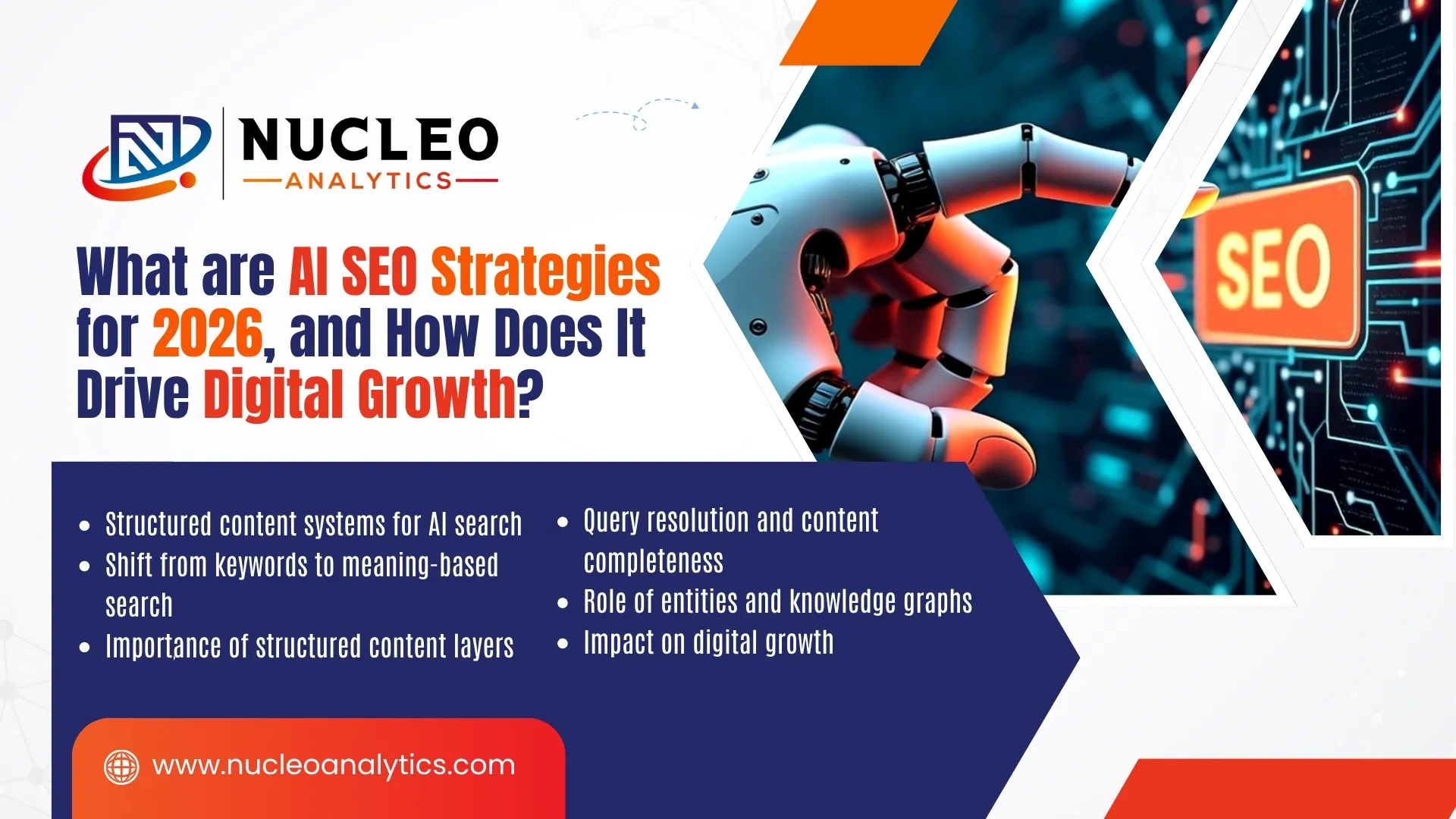
What are AI SEO Strategies for 2026, and How Does It Drive Digital Growth?

AI SEO strategies for 2026
  • Structured content systems for AI search
AI SEO strategies 2026 are structured content systems built for generative search engines that understand meaning instead of keyword matching. These systems use semantic analysis, entity mapping, and intent signals to measure content relevance and quality. Search engines now focus on how clearly content represents knowledge rather than how often keywords appear.
  • Shift from keywords to meaning-based search
Search behavior has moved from short keyword queries to full intent-based questions. Because of this shift, content must align with meaning-based interpretation models. AI systems analyze context, topic depth, and relationships between ideas to decide visibility. Pages that lack a clear structure often lose visibility even if the topic is relevant.
  • Importance of structured content layers
Digital visibility now depends on structured content layers that move from basic explanation to deeper context. Each layer must build on the previous one to improve clarity and machine understanding. When content is scattered or loosely connected, AI systems struggle to interpret meaning. This reduces inclusion in generated answers.
  • Query resolution and content completeness
Search engines now measure how fully content resolves a user query. Partial or unclear explanations reduce the chance of extraction in generative systems. Complete and structured content improves understanding and increases visibility across AI-generated responses. Content must aim to fully answer the intent within a single structured flow.
  • Role of entities and knowledge graphs
Ranking models now focus on entity relationships and knowledge graph integration. Content must clearly define topics, connect related concepts, and maintain structured associations across sections. This helps AI systems understand how information links together and improves ranking strength in AI-driven environments.
  • Impact on digital growth
AI SEO strategies directly influence digital growth by improving how content is discovered and reused across AI systems. Strong structure increases visibility, improves content selection in AI answers, and builds long-term search presence. Businesses that adopt structured systems gain more stable and scalable organic growth in AI search environments.


How To Optimize A Website For AI Search Using Structured Content Systems?

To optimize a website for AI search, content must be built using a structured semantic architecture. Each page should focus on a single intent-driven topic supported by logically connected sections that guide machine interpretation. This improves clarity and strengthens contextual understanding across the system.
Search engines now evaluate websites at the domain level using entity consistency, topical alignment, and semantic relationships. Structured content improves indexing efficiency and enhances retrieval accuracy in AI-generated results. Pages with clear hierarchy and defined informational boundaries perform better in extraction systems.
Internal linking is a structured method used to connect related pages within a website. It builds clear topic relationships across the site and supports smooth information flow between content pages. This improves how search systems understand content connections and interpret the website's meaning. This structure contributes to the formation of an internal knowledge graph within the domain. Each linked page acts as a connected entity that strengthens overall topical relevance and improves semantic understanding.

Want stronger visibility inside AI search systems?

How Does Generative Engine Optimization Work in AI Search Systems?

Generative engine optimization focuses on how AI systems extract structured content and create unified responses from different sources. Instead of ranking pages in a fixed list, modern search systems collect relevant information parts and combine them into one clear, generated answer.  This changes the role of content from “rankable pages” to “extractable knowledge units.”
Additionally, content writing must allow AI models to identify definitions and relevant information without confusion. When information is organized into clear sections, AI systems can reuse it more accurately inside generated responses. This improves both visibility and content selection probability.
Search engines evaluate content using interpretability and extraction quality signals based on semantic parsing models. These systems measure how easily information can be structured into meaningful outputs for generative responses. Content with unclear ideas and inconsistent structure reduces machine readability and lowers chances of inclusion in AI-generated summaries. It also weakens alignment with entity-based indexing systems.
Further, generative systems rely on consistency across content segments. If different sections of a page contradict or repeat information in unstructured ways, extraction quality decreases. Thus, structured formatting and clear topic boundaries improve machine understanding and enhance reuse across generated answers.

What is AI Search Optimization and Why It Matters for Visibility?

AI search optimization is a structured process that improves how AI-driven search systems interpret and retrieve content based on meaning instead of keyword repetition. These systems use semantic analysis and context mapping to match content with user intent.
Search behavior now follows intent-based queries, where users ask full-context questions. Visibility depends on how well content aligns with these intent signals and maintains clear information flow. Weak structure reduces machine understanding and lowers extraction potential in generative systems.
Content must follow a clear hierarchy with logically connected explanations. Structured formatting improves how AI systems extract and reuse information in generated responses. It also increases the chance of inclusion in synthesized answers. Search engines now evaluate clarity at the sentence and section levels. Pages with structured and contextual content achieve higher ranking and indexing across AI-driven search environments.

How to Integrate AEO with SEO for Better Search Performance?

Integrating AEO with SEO combines traditional ranking optimization with answer-focused structuring. SEO improves visibility through ranking signals, while AEO improves direct response extraction. Content must be structured so answers appear clearly within context, which improves ranking performance and AI-based visibility. Search engines now prioritize content that provides immediate informational value. Structured response mapping increases visibility across generative systems.
People searching for “how to do AEO” require intent-based content architecture, structured answer segmentation, and semantic optimization aligned with AI retrieval models to improve extraction accuracy and visibility across generative search systems. Structured responses improve visibility in AI-generated environments. Content must follow logical hierarchy and clear explanation flow, which improves how systems interpret and extract information.

How Micro Influencers vs AI Influencers Impact Digital Distribution?

Micro influencers vs AI influencers represent a shift in content distribution systems. Micro influencers build trust through human experience and audience engagement. However, AI influencers scale content distribution across multiple platforms using automated systems, which increases reach consistency and content exposure. Both models influence how content spreads across search and social ecosystems. Hybrid strategies improve engagement and visibility outcomes.
B2B content strategy for AI search focuses on structured technical content designed for decision-making environments. These systems require detailed explanations and evaluation-based frameworks. Content must support complex buyer journeys through structured information layers. AI systems prioritize clarity and relevance in technical content extraction. Domain authority improves when content demonstrates consistent expertise across related topics. Structured knowledge improves long-term visibility.

Final Thoughts
Search engines now operate through generative models that extract and synthesize information into direct answers. Content must therefore be designed for machine readability and structured knowledge flow. Traditional optimization models alone no longer ensure visibility in AI-driven ecosystems. Structured intelligence frameworks now determine long-term digital performance.
AI SEO Strategies define the foundation of modern search visibility systems. These systems rely on semantic understanding, structured architecture, and intent-based content interpretation.
At Nucleo Analytics, we develop AI-native SEO systems to align with evolving search architectures and generative retrieval models. These systems support sustainable visibility and scalable digital growth.

Looking to scale content for AI visibility and structured SEO systems?

Table of Contents

  • How SEO vs AI search optimization Reshapes Ranking Logic
  • How AI SEO vs traditional SEO Changes Content Architecture
  • What are AI SEO Strategies for 2026, and How Does It Drive Digital Growth?
  • How To Optimize A Website For AI Search Using Structured Content Systems?
  • How Does Generative Engine Optimization Work in AI Search Systems?
  • What is AI Search Optimization and Why It Matters for Visibility?
  • How to Integrate AEO with SEO for Better Search Performance?
  • How Micro Influencers vs AI Influencers Impact Digital Distribution?

Recent Posts

_

SEO vs AI Search Optimization: What's Actually Changing and What You Should Do About It

Jul 13, 2026

_

How Website Speed Impacts SEO and Conversions

Jul 13, 2026

_

Best Website Design Practices for Small Businesses

Jul 13, 2026

_

Website Redesign: When Should You Do It?

Jul 13, 2026

_

Wix vs WordPress: Which Platform is Better for Business Websites?

Jul 13, 2026

Need Help With Your Ads?

Our PPC experts analyze your campaigns and uncover hidden opportunities to boost ROI.

faq_background

Frequently Asked Questions

Find quick answers to the most common questions our clients ask about our services.

faq illustration
Related Posts
We’re proud to still be working with many of the same people that hired us in our early days.
SEO vs AI Search Optimization: What's Actually Changing and What You Should Do About It

SEO vs AI Search Optimization: What's Actually Changing and What You Should Do About It

The “Is SEO dead?” conversation still comes up a lot in 2026, but the answer is simple: it is not. What has changed is how people search and how they get information, and that is where SEO vs AI search optimization beco…

Read More
How Website Speed Impacts SEO and Conversions

How Website Speed Impacts SEO and Conversions

Most businesses do not realize how much a slow website hurts them until traffic drops or conversions start looking terrible. The problem is that website speed issues usually work quietly in the background. Visitors do n…

Read More
Best Website Design Practices for Small Businesses

Best Website Design Practices for Small Businesses

For many customers, a business website represents their first interaction. Everyone checks a website to get information about services and compare the alternatives that serve their needs.

Read More