

That was exactly the situation inside this project. The company already had product-market fit, and growth looked healthy as customer acquisition improved steadily after stronger SEO campaigns and paid acquisition improvements. However, the problem sat deeper inside the infrastructure layer because the backend architecture had stopped matching the company's growth curve.
This case study explains how a SaaS company rebuilt major backend systems using the Go programming language to improve scalability, concurrency handling, deployment reliability, and operational efficiency across high-volume workloads. The short version feels simple because Go helped stabilize a backend that was struggling under growth pressure. The migration improved API response times by 63%, increased concurrent request handling by 4.7 times, and significantly reduced infrastructure overhead during scaling periods. Engineering teams also reduced debugging time after simplifying backend services.
This project also explains why conversations around golang scalability, golang performance, and why to use golang continue to grow across modern SaaS engineering teams. The biggest takeaway from this migration had very little to do with trendy programming languages. The real lesson involved operational simplicity because complex systems eventually punish fast-growing companies, and this backend had reached that point.
The Company Grew Faster Than the Infrastructure
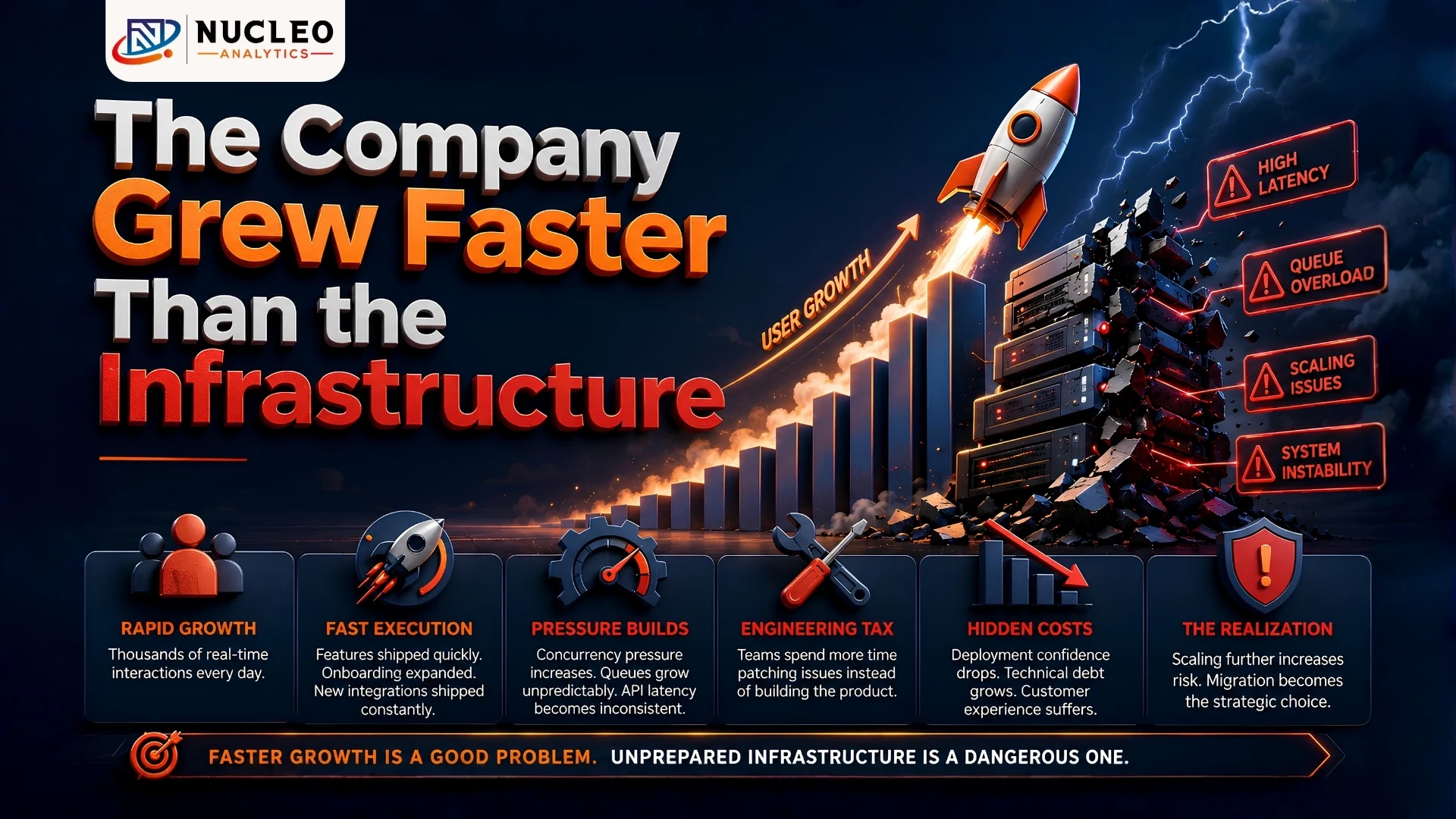
The client operated a communication-focused SaaS platform supporting thousands of real-time interactions every day. Early growth moved quickly because the engineering team prioritized speed during the startup phase. Features shipped rapidly. Customer onboarding expanded steadily. New integrations are entered into production constantly.
That strategy worked extremely well during the first growth stage. The problems appeared later.
As traffic increased, backend services started fighting against concurrency pressure. Multiple services processed asynchronous workloads simultaneously, while queue systems expanded unpredictably during peak activity periods. API latency also became inconsistent across important customer-facing workflows.
The engineering team spent increasing amounts of time patching scaling issues instead of improving the product itself. That creates dangerous momentum inside growing startups. Backend instability slows innovation quietly. Teams lose deployment confidence. Technical debt expands every quarter. Customer experience weakens gradually until performance issues become impossible to ignore. The company realized scaling the existing architecture further would create larger operational risks later. That triggered the migration discussions.
Why the Original Backend Started Breaking Down
The original stack relied heavily on Python-based services connected through asynchronous workflows. During the early startup phase, that approach made perfect sense. Python helped the team move quickly because the ecosystem supported rapid development and fast prototyping. This is why the golang vs python conversation matters so much inside scaling environments.
Python performs extremely well during early product development because teams can build features rapidly. The ecosystem feels flexible and developer-friendly. Startups benefit heavily from that flexibility while validating products and acquiring customers. Scaling introduces different priorities.
This platform processed authentication workflows, notification systems, analytics requests, API traffic, queue workers, synchronization events, and customer activity streams simultaneously. As concurrency increased, performance bottlenecks became harder to control inside the Python services.
Memory usage climbed aggressively during traffic spikes. Queue workers slowed unpredictably. Backend response times fluctuated during heavier workloads. Infrastructure expansion also became expensive because scaling required additional compute resources constantly.
Why Use Golang for Backend Scalability
The engineering team evaluated several backend options before rebuilding the infrastructure layer. The final decision focused less on hype and more on operational efficiency. This is where the question of why use golang becomes practical.
Go handles concurrent workloads extremely well because goroutines consume minimal memory compared to traditional threading systems. Backend services can process large request volumes while keeping infrastructure overhead relatively low. The runtime also behaves consistently under scaling pressure.
That operational consistency became extremely valuable during this migration. The engineering team needed infrastructure capable of supporting future growth without creating deployment instability every time traffic increased.
Go also simplified service orchestration heavily.
The backend architecture originally contained overlapping dependencies and unnecessary communication layers between services. Go encouraged cleaner service design because the language naturally favors simplicity over abstraction-heavy engineering patterns. That reduced debugging friction significantly after deployment.
The Migration Started with High-Load Services
The company avoided rewriting the entire platform immediately because full migrations create unnecessary operational risk. Instead, the engineering team targeted the highest-pressure services first.
Authentication systems moved first. Notification handling services followed immediately after. Queue workers and real-time event processing systems entered the migration pipeline next because those services processed the largest concurrency loads daily. The performance improvements appeared surprisingly fast.
Response times stabilized almost immediately after deployment. CPU spikes dropped heavily during peak traffic periods. Queue systems processed workloads faster because the Go workers handled concurrency more efficiently under sustained load. The engineering team also gained stronger deployment confidence because the services behaved predictably during scaling events. That operational confidence mattered almost as much as raw performance improvements. Teams move faster when infrastructure stops creating fear around deployments.
Golang Scalability Changed Infrastructure Planning
One of the largest improvements appeared during load testing. The Go services handled dramatically larger workloads without requiring aggressive infrastructure expansion. The previous backend architecture required additional compute resources frequently whenever traffic increased.
The Go-based systems handled similar workloads using far fewer resources while maintaining stable response times across production environments. That is where golang scalability became extremely important for long-term growth planning.
The company reduced scaling pressure across:
- Compute infrastructure
- Memory allocation
- Deployment complexity
The services also became easier to distribute across container environments because the applications remained lightweight and operationally stable during scaling tests. The backend finally started feeling prepared for growth instead of reacting against it constantly.
Why Golang Performance Matters Beyond Speed
Most developers reduce performance conversations to raw execution speed. That misses the operational reality completely. Backend performance also affects deployment confidence, infrastructure predictability, debugging efficiency, concurrency handling, and overall system stability. This migration improved all of those areas simultaneously.
That is where golang performance created the biggest operational advantage. The backend stopped behaving unpredictably during traffic spikes. API behavior remained stable under sustained load. Queue workers processed jobs consistently without sudden memory expansion. Infrastructure recovery also improved during deployment cycles because the services remained easier to isolate operationally.
Those improvements rarely sound exciting inside technical marketing discussions. They matter enormously during real-world scaling. Customers rarely complain directly about backend architecture. They simply notice when products feel unstable or unreliable during important workflows. This migration reduced that friction heavily.
The Backend Architecture Needed Less Complexity
One major problem inside the original infrastructure involved architectural sprawl. Services multiplied rapidly during the early growth stages. Several systems handled overlapping responsibilities while dependency chains expanded across disconnected environments. Debugging production issues became frustrating because tracing failures required engineers to jump across multiple unrelated services.
The migration introduced a cleaner backend philosophy focused on operational simplicity. The engineering team rebuilt services around modular workflows, lightweight communication patterns, isolated responsibilities, and cleaner deployment structures. That architectural cleanup improved long-term maintainability significantly. This is where a strong golang project structure became valuable operationally.
Go encourages cleaner service organization because the language discourages unnecessary abstraction layers. The resulting backend became easier to understand, maintain, and debug during scaling events. The engineering team spent less time untangling infrastructure problems after the migration stabilized. That created stronger engineering velocity long-term.
Technical Optimization Improved Product Experience
The backend improvements affected much more than engineering operations. Frontend responsiveness improved almost immediately because APIs returned data faster and handled concurrent requests more efficiently. Dashboard workflows loaded more smoothly across mobile devices. Real-time interactions also became more reliable during higher usage periods.
This project invested heavily in Technical Optimization in Web Development because backend performance directly influences customer experience.
The engineering team improved:
- API response handling
- Backend caching systems
- Deployment workflows
Those improvements reduced friction throughout the entire product environment. Performance influences retention more than many businesses realize. Users rarely explain why products feel frustrating. Delayed interactions quietly damage engagement over time. The infrastructure cleanup reduced those hidden friction points significantly.
SEO and Backend Infrastructure Connect Closely
Many companies treat engineering and SEO like unrelated departments. That creates major blind spots during growth. Backend speed influences rendering performance, page interaction speed, crawl efficiency, engagement behavior, and overall user experience. This migration reinforced how closely SEO and web development connect inside modern platforms.b
The frontend experience improved because the backend infrastructure responded more consistently during high-traffic periods. Faster rendering improved engagement quality across important landing pages and customer dashboards.
That improved:
- Session duration
- Interaction quality
- Conversion stability
Performance optimization supported both infrastructure quality and search visibility simultaneously. Google increasingly measures real-world experience signals. Backend performance influences those signals heavily.
Want backend infrastructure that handles real growth pressure smoothly? Build scalable systems with Nucleo Analytics.
Website Monitoring Became Operationally Essential
As the migration expanded, continuous Website monitoring became extremely important across production environments. The engineering team tracked uptime, API response behavior, memory usage, queue processing performance, deployment stability, and infrastructure health constantly. This operational visibility allowed faster issue detection before customer-facing failures appeared. Monitoring also improved deployment confidence significantly.
Engineers validated backend behavior immediately after releases instead of waiting for customer complaints to reveal problems later. Growing platforms require continuous operational visibility because backend degradation usually happens gradually before major incidents occur. Monitoring helped prevent small performance issues from turning into expensive outages.
Golang for Startups Makes Operational Sense
This project reinforced why conversations around golang for startups continue growing aggressively across scaling SaaS companies. Startups need backend systems supporting:
- rapid scaling
- stable deployments
- manageable infrastructure overhead
Go supports those goals extremely well because the language keeps services lightweight, efficient, and operationally predictable during growth phases. The engineering team also onboarded developers faster after the migration because the architecture became easier to understand operationally. Cleaner systems create better engineering momentum during scaling periods.
Complexity eventually slows every fast-growing company. This migration focused heavily on removing unnecessary complexity before the infrastructure reached larger breaking points.
Deployment Stability Improved Immediately
One overlooked benefit appeared quickly after the migration stabilized. Deployments became far less stressful. The previous architecture occasionally triggered cascading failures during releases because service dependencies behaved unpredictably under heavy workloads. The Go services improved deployment reliability heavily because the runtime environment remained cleaner and easier to isolate operationally.
Rollback procedures also became simpler. The engineering team reduced operational anxiety around production deployments significantly after stabilizing the backend layer. That improved development velocity because teams shipped updates faster without fearing infrastructure instability constantly. Stable systems improve engineering culture more than many companies realize.
Redirect Handling and Infrastructure Cleanup
The migration also included a cleanup across older routing systems and outdated service pathways. Several legacy endpoints relied on inconsistent redirect behavior, affecting API routing efficiency during infrastructure transitions. The engineering team implemented cleaner request management while using proper 307 temporary redirect handling during migration phases.
This preserved request behavior safely while reducing routing inconsistencies throughout production environments. Small backend improvements create larger stability gains over time. That became extremely clear throughout this project.
Infrastructure Costs Finally Stabilized
Scaling problems eventually become financial problems. The original backend consumed growing infrastructure resources whenever traffic increased. The Go services handled larger workloads using significantly lower operational overhead during production scaling events.
That reduced long-term pressure across:
- compute expansion
- resource allocation
- deployment inefficiency
The company also improved long-term website development cost forecasting because infrastructure behavior became more predictable after stabilization.
Predictable systems create stronger business planning. The engineering team could finally focus on growth initiatives instead of constant resource firefighting.
SEO Monitoring Process Improved Technical Visibility
The migration also improved technical visibility across product performance systems. Engineering and marketing teams aligned more closely during deployment planning. That created a stronger SEO monitoring process connected directly with backend performance metrics.
Faster infrastructure improved rendering consistency, interaction speed, and engagement quality across important search-facing pages. Technical optimization started supporting search visibility directly instead of operating separately from the SEO strategy. That alignment improved both traffic quality and user retention over time. Modern growth systems require engineering and marketing alignment much earlier than most companies expect.
User Intent Influenced Backend Decisions
One interesting lesson appeared during optimization planning. Backend systems influence user intent satisfaction heavily. Users expect applications to respond instantly during important workflows. Slow dashboards, unstable APIs, and delayed notifications create friction quickly during high-intent product interactions. The infrastructure improvements focused heavily on reducing delays across:
- login systems
- dashboard rendering
- notification delivery
That improved usability directly because the backend finally supported customer expectations consistently during important product moments. Backend speed affects trust more than many teams realize.
The Final Results After Four Months
The migration produced measurable improvements across the entire infrastructure layer within four months after deployment. API response times improved by 63%. Concurrent request handling increased by 4.7 times across production environments. Infrastructure overhead dropped significantly during traffic spikes. Deployment stability improved heavily during scaling events. The engineering team also reduced debugging time substantially because the backend architecture became cleaner and easier to maintain operationally.
Most importantly, the platform finally felt stable under growth pressure. That operational stability allowed the company to focus on product expansion instead of constantly firefighting infrastructure.
What Most Startups Get Wrong About Backend Scaling
Many startups delay infrastructure cleanup for too long. That creates dangerous technical debt. Teams continue patching scaling problems repeatedly instead of simplifying the architecture early enough. Short-term fixes eventually compound into larger operational failures during growth phases.
The smartest decision inside this project involved recognizing the scaling wall before catastrophic instability appeared.
The migration succeeded because the company treated backend infrastructure like a growth system instead of a maintenance burden. That mindset changed the entire trajectory of the platform.
Conclusion
This project showed why the Go programming language continues to gain momentum across modern backend engineering teams focused on scalability and operational simplicity.
The migration improved:
Deployment stability
Concurrency handling
Infrastructure efficiency
The largest gains came from simplifying backend architecture before scaling pressure created larger operational failures. Conversations around golang scalability, golang performance, why use golang, golang for startups, and golang vs Python became extremely practical throughout this migration because the infrastructure needed long-term stability under aggressive growth conditions.
Nucleo Analytics helped transform a fragile backend environment into a faster, cleaner, and far more scalable infrastructure prepared for future expansion.