

That is one of the biggest challenges startups run into. Building quickly is important, but building systems that can continue scaling without creating technical chaos later is equally important, too. This is where the Go programming language keeps gaining attention among startups and growing tech companies. Go is not just popular because it is modern.
Startups increasingly choose it because it balances simplicity, scalability, and backend performance without introducing unnecessary operational complexity early in growth. That is why conversations around golang scalability, golang performance, and golang for startups continue growing across development teams today.
Why Use Golang for Startup Products
When startups ask why use golang, the answer usually comes down to practicality.
Startups often need to:
- Launch quickly
- Keep infrastructure manageable
- Handle growth efficiently
- Avoid unnecessary technical debt
Go supports all of those things fairly well. Unlike heavier backend systems that sometimes become difficult to maintain as products evolve, Go focuses on:
- Simplicity
- Speed Concurrency
- Clean architecture Efficient deployment
That combination allows smaller teams to build scalable systems without needing massive engineering structures behind the scenes. At Nucleo Analytics, we often see startups choose Go because it allows them to scale products while keeping backend systems relatively manageable over time.
Golang Scalability Helps Products Grow Smoothly
Scalability is one of the biggest concerns for startups building digital products. An application that performs well with a few hundred users may begin struggling once:
- Traffic spikes
- APIs expand
- Integrations increase
- User activity grows
This is where golang scalability becomes valuable. Go was specifically built for dealing with concurrent operations in a really efficient way, mostly by using goroutines, which are way lighter than the traditional threading models.
That allows applications to:
- Process more requests
- Handle traffic spikes better
- Maintain stable performance
- Scale infrastructure more efficiently
For startups, this matters because backend instability can quickly affect customer experience and product reputation.
Golang Performance Supports Better User Experience
Backend speed directly affects how products feel to users.
Slow APIs and delayed responses create:
- Frustrating experiences
- Higher bounce rates
- Lower retention
- Reduced engagement
That is one reason golang performance is often a major advantage for growing products. Go compiles directly into machine code, which helps applications run efficiently under higher workloads.
This makes Go useful for:
- SaaS platforms
- Real-time applications
- API-heavy products
- Cloud-native systems
- Scalable backend infrastructure
At Nucleo Analytics, we often see performance improvements become increasingly important once startups begin focusing on long-term user retention and growth.
Golang vs Python for Startup Applications
The discussion around golang vs python comes up frequently in startup environments.
Python is extremely popular because:
- Development moves quickly
- The ecosystem is flexible
- AI and automation support is strong
But Go often becomes attractive once scalability and infrastructure efficiency become priorities.
Go usually performs better in:
- High concurrency environments
- API-heavy systems
- Performance-intensive workloads
- Backend scalability
Python remains excellent for rapid experimentation and machine learning workflows. But many startups eventually move parts of their backend systems into Go once products begin scaling beyond early-stage traffic levels.
Golang for Startups Helps Reduce Technical Complexity
One of the hidden problems startups face is growing technical complexity.
As products evolve, backend systems often become harder to maintain because:
- Architecture becomes inconsistent
- Dependencies increase
- Scaling introduces operational issues
- This is where golang for startups becomes particularly useful.
Go encourages:
- Simpler architecture
- Cleaner backend services
- More maintainable systems
- Easier debugging
That simplicity becomes valuable later when development teams expand, and products continue evolving. At Nucleo Analytics, we often see startups underestimate how expensive technical complexity becomes over time.
Golang Project Structure Improves Long-Term Maintainability
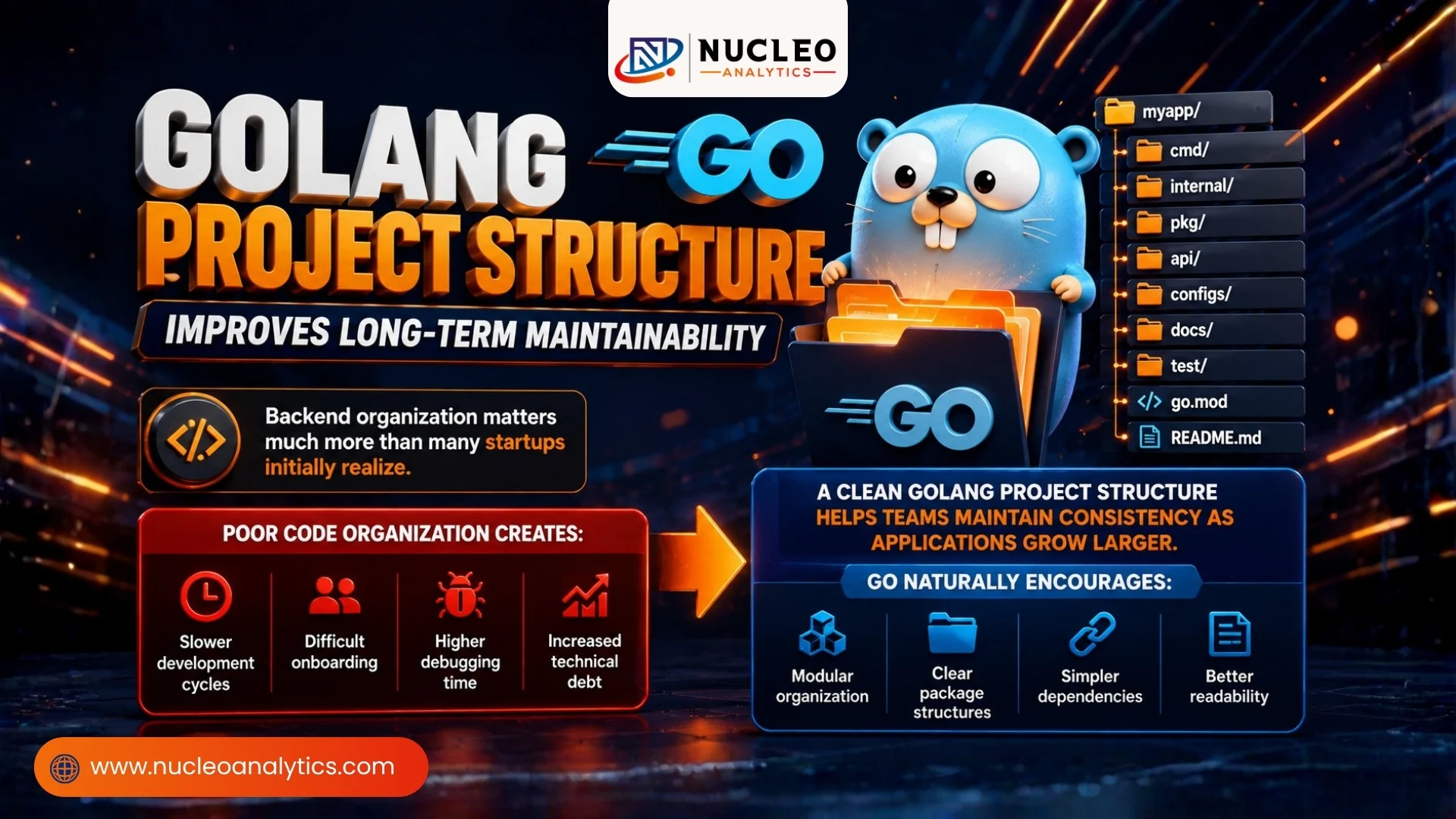
Backend organization matters much more than many startups initially realize.
Poor code organization creates:
- Slower development cycles
- Difficult onboarding
- Higher debugging time
- Increased technical debt
A clean golang project structure helps teams maintain consistency as applications grow larger.
Go naturally encourages:
- Modular organization
- Clear package structures
- Simpler dependencies
- Better readability
That makes long-term maintenance easier compared to systems that become overly abstracted or heavily layered. This is especially important for startups where smaller teams need to move efficiently without constantly fighting backend complexity.
Backend Performance Also Impacts SEO and Marketing
A lot of startups think backend decisions only affect engineering teams.
But backend performance now directly influences:
- User experience
- Search rankings
- Conversion rates
- Marketing performance
This is where things like:
- Technical SEO
- Core web vitals optimization
- Building a mobile friendly website
- become connected to the backend architecture itself.
Slow APIs and unstable infrastructure negatively affect website speed, responsiveness, and user retention. At Nucleo Analytics, we often see technical performance become a critical part of broader growth planning.
Need Scalable Backend Support for Your Startup?
Core Web Vitals Optimization Depends on Stable Systems
Google increasingly evaluates websites through real-world user experience metrics.
That includes:
- Loading performance
- Responsiveness
- Visual stability
This is why Core Web Vitals optimization has become important for startups focused on visibility and growth.
Backend systems heavily influence these metrics because:
- APIs affect page rendering speed
- Server delays impact loading performance
- Infrastructure bottlenecks reduce responsiveness
Go’s lightweight architecture often helps improve consistency under heavier workloads. That consistency becomes increasingly important as startup products attract larger audiences.
Mobile Friendly Website Performance Matters More Than Ever
Most startup traffic now comes through mobile devices. That means having a mobile friendly website is no longer optional. But mobile optimization is not only about responsive design anymore.
Backend performance affects:
- Mobile load speed
- API responsiveness
- Content rendering
- Overall usability
Mobile users are usually far less patient with delays. Even small performance problems can increase abandonment rates quickly. At Nucleo Analytics, we often see backend optimization directly improve mobile engagement and retention metrics.
Technical SEO Relies on Backend Stability
Modern technical SEO depends heavily on infrastructure quality.
Search engines increasingly evaluate:
- Site speed
- Mobile usability
- Crawl efficiency
- Response times
- Technical reliability
Even backend issues like excessive redirects or unstable APIs can affect search performance. For example, handling redirects properly matters during migrations and architecture changes. A 307 temporary redirect might work right in some situations, but wrong redirect handling still can create crawling inefficiencies, if the systems are not configured properly. Backend quality is also getting more important, and that affects how search engines understand and rank your website more and more.
Scalable Systems Help Reduce Backend Errors
As traffic grows, unstable systems often begin producing more backend conflicts and failures. One example developers sometimes encounter is HTTP status code 409, which usually indicates request conflicts within backend logic or concurrent operations. These issues become more common when systems are not designed for scalability from the beginning. Go’s concurrency model often helps reduce performance bottlenecks and backend instability under higher workloads. That makes scalable backend planning especially important for startups expecting rapid user growth.
Website Development Cost Depends on Scalability Decisions
A lot of startups focus heavily on launch budgets. That makes sense early on, but scalability decisions also influence long-term Website development cost.
Backend systems that are poorly optimized often create:
- Higher infrastructure costs
- More maintenance work
- Frequent performance fixes
- Earlier rebuild requirements
Meanwhile, scalable architecture usually creates:
- Better operational efficiency
- Easier maintenance
- More predictable growth
At Nucleo Analytics, we often encourage startups to evaluate long-term scalability instead of focusing only on short-term launch speed.
Digital Marketing Strategy Depends on Technical Performance
A strong Digital marketing strategy now depends heavily on technical website quality. Marketing performance is directly affected by:
- Website speed
- Mobile optimization
- Technical SEO
- User experience
- Backend stability
Even high-performing campaigns struggle if users land on slow or unstable platforms. This is why technical teams and marketing teams increasingly work together during growth planning. Scalable backend systems help support:
- Better conversion rates
- Stronger retention
- Faster landing pages
- Improved search visibility
Backend development now plays a much larger role in business growth than many startups initially expect.
How We Approach Scalable Startup Development at Nucleo Analytics
At Nucleo Analytics, we believe scalable startup systems should balance performance, simplicity, maintainability, and long-term growth planning from the beginning.
Some startups need lightweight APIs and backend services. Others require larger, scalable infrastructures involving technical SEO support, integrations, cloud architecture, and long-term optimization planning.
Our approach focuses on:
- Scalable backend architecture
- Clean development workflows
- Technical optimization
- Performance consistency
- Long-term maintainability
Because startup growth becomes much easier when backend systems are designed to scale properly from the beginning instead of being rebuilt constantly later.
Conclusion
Startups face constant pressure to move quickly while still building systems capable of supporting future growth. That is why the Go programming language continues to become a strong choice for scalable startup products.
Discussions around golang scalability, golang performance, golang for startups, and why use golang continue growing because businesses increasingly need backend systems that remain efficient, maintainable, and reliable under increasing workloads. In the end, scalable development is not only about handling traffic. It is about creating products capable of supporting long-term growth without creating operational instability, technical debt, or performance problems later.