

Backend costs are one of those things that quietly grow in the background while SaaS teams focus on building features and shipping updates. Because early traffic is modest and infrastructure is still inexpensive, everything initially feels stable. But as the product scales, those backend expenses start increasing in a way that is hard to ignore or control.
But as the product scales, those backend expenses start increasing in a way that is hard to ignore or control. Most of the problem usually comes from how backend systems are designed in the early stages of development. Teams often choose speed over structure, which makes sense when you are trying to validate a product quickly. The issue is that these early choices often stay in the system far longer than they should and slowly increase operational costs.
This is where technologies like golang start to become relevant in real production environments. The efficiency of backend systems is strongly impacted by the go programming language's reputation for managing high concurrency with minimal resource consumption. Systems designed with golang for backend services frequently need fewer resources to manage the same volume of traffic.
Another reason this matters is because backend efficiency is not just a technical concern anymore. It directly influences how much a SaaS company spends every month on infrastructure. Poor backend design leads to higher cloud usage, more scaling pressure, and less predictable costs over time. In this blog, we will break down how Go reduces backend costs in SaaS companies. We will also look at how engineering decisions around golang for backend development impact scalability, performance, and long term infrastructure spending.
The Real Reason SaaS Costs Spiral Out of Control
Engineers notice performance issues, but finance teams notice billing spikes first. That gap is where most SaaS cost problems actually begin. A lot of teams also underestimate how quickly user behavior scales load. One feature can multiply API calls across the entire system architecture. Without careful backend planning, that growth becomes expensive very quickly.
How Go Changes Backend Economics
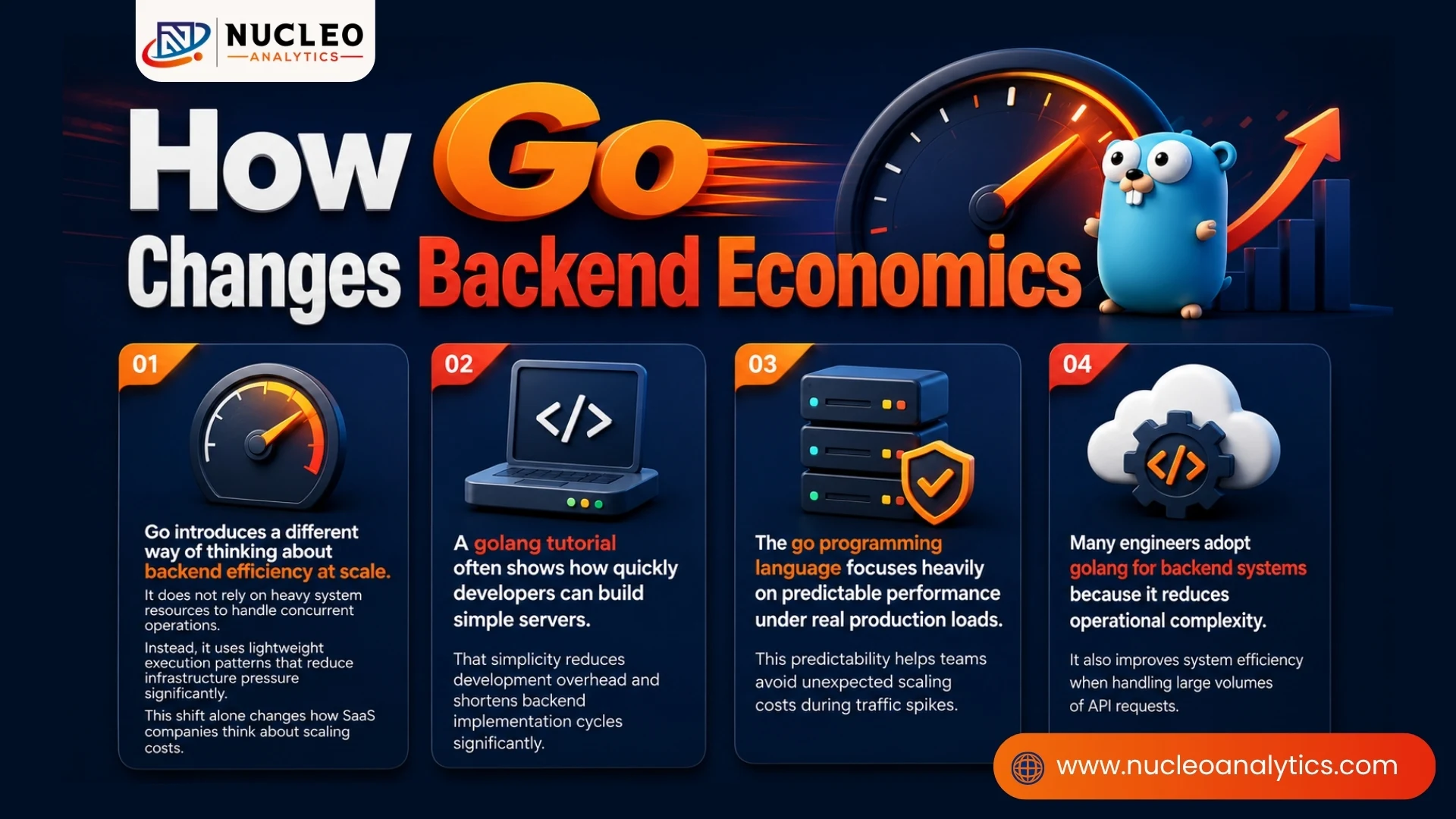
Go introduces a different way of thinking about backend efficiency at scale. It does not rely on heavy system resources to handle concurrent operations.
Instead, it uses lightweight execution patterns that reduce infrastructure pressure significantly. This shift alone changes how SaaS companies think about scaling costs.
Golang tutorial
A golang tutorial often shows how quickly developers can build simple servers. That simplicity reduces development overhead and shortens backend implementation cycles significantly.
Go programming language
The go programming language focuses heavily on predictable performance under real production loads. This predictability helps teams avoid unexpected scaling costs during traffic spikes.
Golang for backend
Many engineers adopt golang for backend systems because it reduces operational complexity. It also improves system efficiency when handling large volumes of API requests.
Why Backend Efficiency Matters More Than Features
Most SaaS roadmaps are driven by feature delivery and customer demands. However, backend efficiency quietly determines whether those features remain affordable to run. Every inefficient endpoint adds cost every time a user interacts with the system. This creates long term financial pressure that is often ignored early on. Backend optimization is not about reducing functionality or limiting innovation.
It is about ensuring that growth does not destroy profitability over time. Companies that ignore this usually face scaling problems much earlier than expected. Nucleo Analytics focuses on building backend systems that stay efficient even as SaaS products start scaling fast
The Startup Reality of Backend Cost Growth
Startups often focus on speed rather than backend efficiency in early stages. This makes sense initially but becomes expensive when user growth accelerates. Infrastructure costs can quickly overtake revenue if systems are not optimized properly. That is when engineering decisions start affecting business survival directly.
Golang for startups
Many founders choose golang for startups because it handles growth efficiently. It allows teams to scale backend systems without immediate infrastructure overload.
Performance Under Load and Real World Behavior
Real production systems behave very differently from development environments. Traffic spikes, concurrent users, and API bursts expose backend weaknesses quickly. Systems that look stable in testing often struggle under real world demand.
Go performs well in these conditions because it handles concurrency efficiently. It keeps resource usage stable even when request volume increases significantly. This reduces the need for aggressive infrastructure scaling during peak usage periods.
Backend Communication and Data Consistency
HTTP status code 409
Redirect Behavior and System Efficiency
307 temporary redirect
Backend Optimization and User Experience Connection
Mobile friendly website
A mobile friendly website depends heavily on fast backend response times. Slow APIs reduce mobile usability and negatively affect overall user experience.
Backend Speed and SEO Performance
Search engines evaluate website performance as part of ranking algorithms . Slow backend systems reduce crawl efficiency and impact indexing behavior negatively. This creates indirect SEO challenges that affect organic visibility over time.
Technical SEO
Strong technical SEO depends on stable and fast backend infrastructure performance. Search engines reward websites that consistently deliver fast response times.
Think your backend is already cost optimized at scale?
Core Performance Metrics That Impact Revenue
Core web vitals optimization
Digital marketing strategy
Infrastructure Spending and Long Term Cost Control
Website development cost
The Website development cost increases when backend systems require frequent scaling adjustments. Efficient architecture reduces long term maintenance and operational expenses.
Common Mistakes in Backend System Design
Where Go Fits in Modern SaaS Architecture
Developer Productivity and System Maintainability
Observability and Production System Control
Common Performance Bottlenecks in SaaS Platforms
Why Engineering Decisions Affect Business Margins
Final Thoughts
Backend optimization is not a one time technical improvement for SaaS companies. It is a continuous process that directly affects cost structure and scalability. Ignoring backend efficiency leads to hidden costs that grow over time silently.
Go provides a practical and efficient foundation for building scalable backend systems. It reduces infrastructure waste while maintaining strong performance under load. This combination makes it a strong choice for modern SaaS architectures. Teams that invest early in backend efficiency tend to scale with fewer financial surprises.
They also maintain better system stability and predictable operational costs over time. That balance between performance and cost is what drives sustainable SaaS growth. Nucleo Analytics helps companies build and optimize backend systems for long term efficiency.