









Is White Hat Parasite SEO Safe? Google-Compliant Tactics Explained
SEO has never been static. What worked even a year ago may not work today, and strategies once considered risky are now being revisited in a more refined, ethical way. One such strategy is parasite SEO, specifically, its white hat version.
For many marketers and business owners, parasite SEO raises red flags. The word itself sounds questionable. But in reality, when done responsibly, white hat parasite SEO can be both safe and Google-compliant.
The real issue isn’t whether parasite SEO works. It’s whether it’s done with intent, quality, and respect for Google’s guidelines. At Nucleo Analytics, we’ve seen this strategy help brands gain visibility without putting their websites at risk, but only when applied correctly.
What Is Parasite SEO?
Parasite SEO is an SEO method that involves publishing content on third-party sites that have a high authority rather than depending solely on the brand’s website. As the latter are already strong in terms of their domain authority, they will help content appear sooner in the search results.
Parasite SEO, rather than waiting for months to get the authority on a new website, gives the advantage of exposure right away by using reliable platforms. This method is particularly beneficial in competitive sectors where getting to the top of the search results naturally can be a time-consuming and costly process.
Some of the usual practices are writing articles for major blogs, providing expert opinion articles, improving personal pages on reliable networks, or distributing lengthy informative writings on popular domains.
White Hat vs Black Hat Parasite SEO
Not all parasite SEO is created equal. The difference between safe and risky comes down to execution.
Black Hat Parasite SEO
Black hat parasite SEO relies heavily on manipulation, and it is not unusual to see this kind of technique involved. It quite often includes the use of low content or irrelevant content, keyword stuffing, giving false information about the content through titles, or taking advantage of the platform’s weaknesses for ranking higher in a very short time. So, for all its usefulness, even this gets caught up in the last phase, in some penalty or drop in ranking.
Google actively targets content that exists only to manipulate search results without offering real value.
White Hat Parasite SEO
White hat parasite SEO is a term associated with the use of ethical SEO practices. It gives priority to the creation of original, high-quality content that really helps the users as its mainstay. The content is also relevant to the specific platform on which it’s published and matches the users’ search intent.
This approach works with Google’s algorithms instead of trying to outsmart them.
Is White Hat Parasite SEO Safe According to Google?
Yes, white hat parasite SEO is safe when it follows Google’s quality guidelines.
No doubt, Google is not going to punish content just for the reason that it has been made available on an external site. Content quality, relevance, and user experience are the factors that matter most. If the content is valuable in a true sense and gives the right answers to the user’s questions, then Google has no cause to view it negatively.
At Nucleo Analytics, there is definitely an emphasis on compliance. What sets things apart lies in the manner in which one does things and plays by the rules of Google evaluation.
Why Google Allows Parasite SEO to Rank?
The main objective of Google is to provide users with the best possible answer. When a trustworthy and influential website puts out informative and well-articulated content that meets the needs of the users, the website is then rewarded by Google.
Ownership of the content is not the deciding factor. Quality is. This is why expert articles, guest posts, and brand-authored content can rank well when published on reputable platforms.
The Importance of User Intent in Parasite SEO
User intent is the foundation of successful parasite SEO. Before publishing content, it’s important to understand:
- What the user is searching for
- Whether the intent is informational, commercial, or navigational
- Which platform best fits that intent
For example, educational content performs well on publishing platforms, while comparison-based content may work better on review-focused websites.
Nucleo Analytics prioritizes intent-driven SEO strategies because content that doesn’t match intent rarely performs well, no matter how authoritative the platform is.
Platforms Commonly Used for White Hat Parasite SEO
The practice of white hat parasite SEO depends on reliable sources that have high editorial criteria and user confidence. Such sources are already acknowledged and trusted by both users and search engines.
Some of the main platforms on which to share the content are industry blogs, media publications, professional networks, business directories, and knowledge-sharing platforms. The most important factor is relevance. The platform must fit with the topic and audience.
Posts on sites that are not at all authentic or of utmost respect do nothing but weaken your site’s trust and authority.
How White Hat Parasite SEO Improves Brand Visibility?
Ranking is just one aspect of the overall picture, while parasite SEO is the main factor in brand visibility. Users may not click the link right away, but the brand gets recognition and trust through frequent visibility. Eventually, consumers start to relate the brand with knowledge and dependability. This is a big plus for startups or brands that are already in a tough competition.
At Nucleo Analytics, parasite SEO is often used to support broader digital marketing goals, not just traffic generation.
Get clear answers to complex SEO questions.
Common Mistakes That Make Parasite SEO Risky
Parasite SEO is an unsafe method when it is regarded as a shortcut. Typical errors are, publishing low-quality content, excessively optimizing keywords, disregarding platform rules, or being only concerned with backlinks. Google possesses a great skill to spot patterns that imply manipulation.
Sustainable results do not rely on the number of investments, but on consistency, quality, and relevance.
Parasite SEO vs Traditional SEO
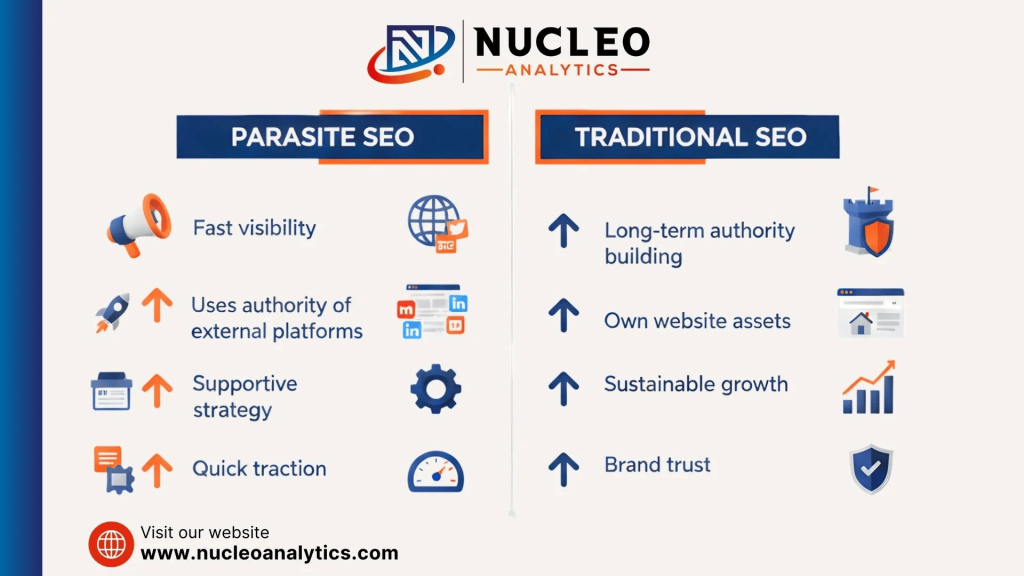
Parasite SEO is not a substitute for traditional SEO. It is more effective when used as a supportive strategy. Traditional SEO is all about making one’s own assets authoritative, whereas parasite SEO uses the power of external platforms for quicker visibility. Their union forms a balanced SEO environment.
Nucleo Analytics integrates both approaches to ensure long-term growth without unnecessary risk.
How Long Do White Hat Parasite SEO Results Last?
If the method is properly followed, white hat parasite SEO can bring about the benefits that last for a long time. Rankings are usually stable since the content is on trusted sites and keeps giving value. But just like in every SEO technique, the content has to be kept an eye on and updated now and then to be in the spotlight.
Is White Hat Parasite SEO Right for Every Business?
White hat parasite SEO is most effective for those companies that have real knowledge and an expert. It works better in hard-fought industries or for brands that want a faster change in perception. It could be the case that it does not fit companies that just focus on promotional messages or provide less content.
How Nucleo Analytics Approaches White Hat Parasite SEO?
At Nucleo Analytics, parasite SEO is considered a strategic element rather than a quick fix. The method is based on data analysis, user intent research, and ethical optimization practices. Merging SEO know-how with analytics-assisted insights, Nucleo Analytics enables brands to expand their visibility and be in sync with Google’s changing standards at the same time.
Conclusion
White hat parasitic SEO is not risky if it is done correctly. It fits Google’s guidelines, meets user requests, and gives true benefits. The problem is not the tactic; it is wrong use. If the parasitic SEO is regarded as a spam method, it will not succeed. If it is regarded as a visibility strategy based on providing value, it will succeed.
As search engines continue to prioritize quality and trust, ethical SEO approaches will always outperform shortcuts. That’s the principle behind how Nucleo Analytics builds sustainable SEO strategies—and why white hat parasite SEO remains effective today.
Get clarity on white hat and black hat SEO methods.
Frequently Asked Questions
Q1: Can parasite SEO work for competitive industries?
Q2: Is white hat parasite SEO safe for long-term growth?
Q3: Does Nucleo Analytics combine parasite SEO with traditional SEO?
Q4: Does Nucleo Analytics recommend parasite SEO?
Related Posts

Proven Local Link-Building Tips for Small Businesses
In this high-stakes online environment of today, small businesses wonder: How can we really get noticed? Yes, building a cool website and having great products […]

How to Get Google Rankings Back if Your Positions Dropped?
If your Google ranking dropped dramatically, relax. Thousands of webmasters wake up in the morning to discover their pages floating away from Page 1 to […]

Emerging Trends in Answer Engine Optimization 2025
Search is evolving, and fast. It’s no longer just about getting your website to show up on Google’s first page. In 2025, the goal has […]
What is the Process of SEO Monitoring?
You have created a webpage. You’ve released some incredible content. You’re prepared to take the world by storm, but here’s the thing: traffic by itself […]

Why does My Website Not Show Up in Google Search Results?
Today’s competitive digital market requires more than a website. The real test is making sure your website is visible on search engines, notably Google, which […]
Common Mistakes That Kill Topical Authority in SEO
If your site isn’t ranking the way it should, chances are it’s not because Google changed the rules overnight. More often, it’s because your site […]