








How Much Does SEO Cost in the US in 2026?
Every business wants better visibility online. More traffic, better leads, more calls, more sales, and more people actually finding the business instead of competitors. That’s usually why companies start looking into SEO in the first place.
But SEO today isn’t the same thing it was a few years ago.
Search engines have become smarter. AI-generated content flooded the internet. User behavior changed. Even the way people search is shifting because of AI tools and conversational search experiences. So businesses now need more than basic keyword placement and a couple of blogs every month.
Modern SEO involves technical SEO, content strategy, local SEO, SEO monitoring, user intent optimization, AI search visibility, and sometimes even full website improvements. And honestly, that’s where many businesses get confused. One SEO agency talks about backlinks. Another focuses on content clusters. Someone else pushes AI search marketing. Half the time, business owners are left wondering what actually matters.
The reality is, SEO is not a one-size-fits-all service anymore.
A local business trying to rank in one city will need a very different strategy than an eCommerce store selling products nationwide. A startup building visibility from scratch has different priorities compared to an established company protecting years of online authority.
That’s why understanding how SEO works and what affects SEO services in the US matters before choosing any SEO agency or digital marketing partner.
This guide breaks it all down in a practical way. No robotic jargon. No overcomplicated marketing talk. Just a clearer look at how SEO works in 2026, what businesses should actually focus on, and how to choose the right strategy for long-term growth.
Why SEO Costs More in 2026
SEO got harder. Simple as that.
Five years ago, businesses could publish random keyword blogs and still rank. Today? Google is smarter. AI-generated junk is everywhere. Competition is brutal.
Now SEO requires an actual strategy.
Here’s what agencies are handling behind the scenes now:
- Technical SEO optimization
- Search intent analysis
- Content clustering
- AI search visibility
- Core Web Vitals
- Local map optimization
- Schema markup
- SEO forecasting
- Competitor gap analysis
- User behavior tracking
- Conversion optimization
- SEO monitoring
- International targeting
- Link authority building
And honestly, businesses expecting all that for $300 monthly… that’s not realistic anymore.
What Affects SEO Pricing in the USA?
Industry Competition and Business Goals
Not every business competes at the same level online. A local bakery trying to rank in one town will need a very different SEO strategy than a law firm, SaaS company, or national eCommerce brand competing across the entire US.
The tougher the competition, the more work goes into SEO. That usually means deeper keyword research, stronger content strategies, ongoing technical SEO, backlink building, and regular SEO monitoring.
Business goals matter too.
Some companies only want more local calls. Others want nationwide traffic, online sales, or international visibility. Bigger goals naturally require broader SEO efforts.
For example:
- A local dentist may focus mainly on local SEO and Google Maps rankings
- An online clothing store may need eCommerce SEO, product optimization, and SEO content clusters
- A software company may target national keywords and long-form authority content
Website Condition and Technical SEO Needs
Sometimes the biggest SEO problem isn’t the content. It’s the website itself.
A slow website with broken pages, poor mobile experience, messy structure, or indexing issues makes SEO harder from the start. Before rankings improve, technical SEO work usually needs to happen first.
This can include:
- fixing crawl errors
- improving site speed
- optimizing Core Web Vitals
- cleaning duplicate content
- improving mobile usability
- setting up schema markup
For example, if an eCommerce website has thousands of product pages but poor internal linking and slow loading speeds, search engines may struggle to crawl and rank the site properly.
In many cases, businesses also need website redesign services or UX improvements alongside SEO because design and performance now directly affect rankings.
Content Strategy and User Intent
SEO in 2026 is no longer about stuffing keywords into random blogs. Search engines care much more about relevance and user intent now.
Businesses that want stronger visibility usually need:
- service pages
- location pages
- blogs
- SEO content clusters
- FAQs
- educational guides
- optimized landing pages
And all of it needs to match what users are actually searching for.
For example:
Someone searching “best accountant near me” wants local service options quickly.
Someone searching “how to reduce business taxes legally” is looking for educational information first.
Good SEO strategies build content around both types of searches instead of chasing keywords blindly.
Local SEO, National SEO, and International SEO Scope
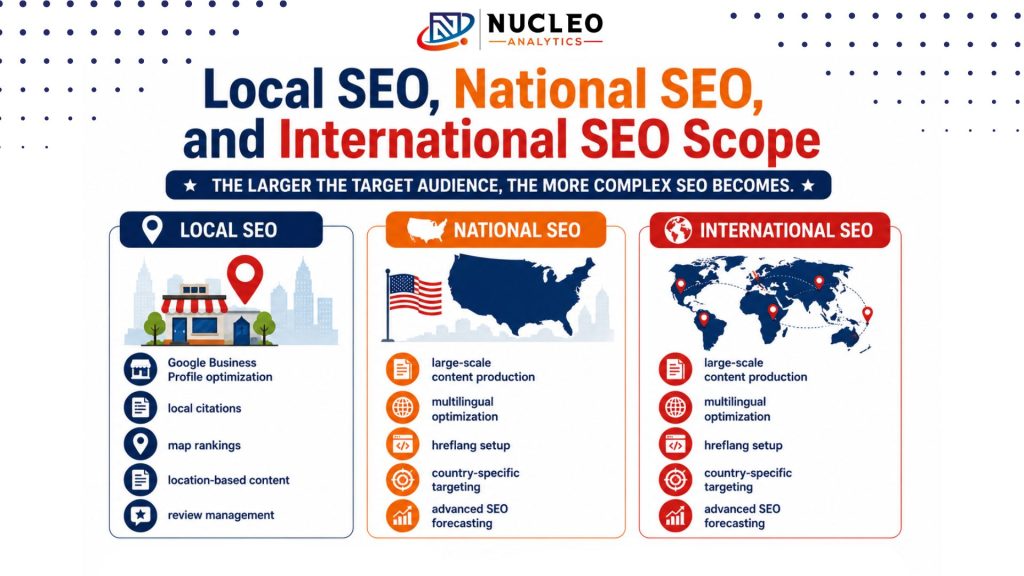
The larger the target audience, the more complex SEO becomes.
A local business usually focuses on one city or service area. But businesses targeting multiple states or countries need broader optimization strategies.
Local SEO often involves:
- Google Business Profile optimization
- local citations
- map rankings
- location-based content
- review management
Meanwhile, national or international SEO may require:
- large-scale content production
- multilingual optimization
- hreflang setup
- country-specific targeting
- advanced SEO forecasting
For example, a restaurant in Dallas needs a completely different SEO approach than a brand selling products globally in multiple languages.
Website Size and Business Type
The size of the website changes the amount of SEO work involved.
A small business website with 10 pages is easier to optimize than an eCommerce store with 5,000 products or a large enterprise website with multiple departments and service categories.
Different business types also have different SEO needs:
- local service businesses rely heavily on local SEO
- eCommerce stores need product and category optimization
- SaaS companies often focus on educational content and technical SEO
- enterprise websites need ongoing SEO monitoring and scalability
Larger websites usually require more content management, technical maintenance, and structured SEO systems to stay competitive.
Agency Expertise and SEO Strategy Quality
Not all SEO agencies work the same way.
Some focus only on basic keyword placement and reports. Others build complete strategies around technical SEO, content marketing, AI search visibility, user intent, and long-term growth.
An experienced SEO agency usually brings:
- better technical analysis
- clearer SEO forecasting
- stronger content planning
- advanced SEO monitoring
- strategic decision-making
For example, a good agency won’t just say:
“Here are your rankings.”
They’ll explain:
- why rankings changed
- how traffic behavior is shifting
- what competitors are doing
- where growth opportunities exist
- how AI search trends may affect visibility
That strategic depth changes the overall SEO process significantly.
Technical SEO Costs in 2026
Technical SEO is one of the biggest reasons SEO pricing has increased.
And honestly, most businesses ignore it until rankings tank.
Technical SEO includes:
- Crawl optimization
- Site architecture fixes
- Core Web Vitals
- Schema markup
- Redirect management
- XML sitemaps
- Indexing improvements
- Duplicate content cleanup
- Mobile optimization
- JavaScript rendering fixes
Some SEO agencies include technical SEO monthly. Others charge separately.
Either way, it matters more than people think.
Need SEO That Actually Makes Sense?
eCommerce SEO Costs Are Higher for a Reason
Managing an online store requires extensive optimization, which is why costs are typically higher
An online store may have:
- hundreds of products
- thousands of pages
- category optimization needs
- technical SEO issues
- duplicate content risks
- structured data requirements
- conversion optimization challenges
eCommerce SEO campaigns often include:
- collection page optimization
- product SEO
- internal linking systems
- SEO content clusters
- transactional keyword targeting
- image optimization
- user intent analysis
And yes, AI search marketing vs. SEO is becoming part of eCommerce discussions now, too.
How to Choose the Right SEO Agency
This matters more than price alone. The cheapest SEO agency usually isn’t the best.
But the most expensive one isn’t automatically great either.
Look for:
- proven case studies
- technical SEO knowledge
- content strategy expertise
- Understanding of user intent in SEO,
- local SEO experience,
- clear reporting, and
- realistic expectations
Also, pay attention to communication.
If an agency talks only in buzzwords and never explains things clearly… that’s usually a bad sign.
Looking for SEO That Fits Your Business Goals?
Is SEO Still Worth Paying For in 2026?
Yes. Absolutely.
But bad SEO isn’t worth paying for.
That’s the difference.
Organic search still drives:
- high-intent traffic
- long-term visibility
- brand trust
- lower acquisition costs over time
Paid ads stop when budgets stop.
SEO keeps working long after content is published.
That’s why businesses still invest heavily in:
- seo services for small businesses
- outsource digital marketing services
- hire seo experts for a small business
- digital marketing consultants for small businesses
The companies showing up consistently online usually aren’t there by accident.
There’s a strategy behind it.
Conclusion
SEO pricing in the USA in 2026 varies widely because businesses vary widely.
A local restaurant won’t need the same SEO strategy as a nationwide eCommerce brand. A startup doesn’t require enterprise-level SEO forecasting from day one. Context matters.
But one thing is clear now:
Modern SEO is no longer just keywords and backlinks.
It’s technical SEO, local SEO, user intent optimization, AI visibility, content clustering, SEO monitoring, and long-term digital positioning working together.
And honestly, businesses that treat SEO like a cheap shortcut usually end up frustrated later.
The smarter move is finding an SEO agency that understands your goals, explains the strategy clearly, and builds sustainable growth over time.If you’re looking for a team that combines SEO strategy, content marketing, technical optimization, and real business-focused execution, Nucleo Analytics can help build a practical roadmap that actually fits your business instead of forcing generic packages on you.
FAQs
What is the Average SEO Pricing Usa Businesses Will Pay in 2026?
What Are the Factors That Contribute to the Differences in Costs Among Local SEO Companies?
Do Monthly SEO Packages Include Technical SEO?
What’s the Cost of SEO for Small Businesses in the USA?
Does AI Take the Place of SEO in 2026?
Related Posts
Which SEO Tools Actually Perform Best in 2026? We Tested 11
There are more tools than ever in 2026. Some promise AI magic. Some promise “one dashboard to rule them all.” And some still rely on […]
How SEO Enhances Your Digital Marketing Strategy?
A strong digital marketing plan is crucial for every company in today’s fast-paced digital world to succeed in the competitive world. Every effective digital marketing […]
Common Mistakes That Kill Topical Authority in SEO
If your site isn’t ranking the way it should, chances are it’s not because Google changed the rules overnight. More often, it’s because your site […]
The Importance of Local SEO for Location-Based Businesses
Are you among those who strive to drive more local customers to visit your business?If yes, here is the best way to increase the footfall […]
Why is Google Not Indexing My Pages?
In the digital world, websites need Google visibility to attract traffic and develop an online presence. Many website owners, however, discover that a typical problem […]
Link Building for Local SEO: Proven Tactics to Rank on Google Maps
Ranking on Google Maps is one of the biggest advantages a local business can have. When your business shows up in the top three map […]