










Which SEO Metrics Truly Matter in Your Reports and Why?
Open most SEO reports, and you’ll see a wall of numbers. Impressions. Sessions. Bounce rate. Average position. Pages per session. Click-through rates. Graphs going up and down like a heart monitor.
It looks impressive. Feels technical. Sometimes overwhelming. But here’s the thing. Not every number deserves your attention. Some metrics look important, but barely move revenue. Others quietly decide whether your reports show growth or just activity.
At Nucleo Analytics, this is where most conversations begin. Business owners don’t struggle with getting data. They struggle with knowing what actually matters inside their reports and why.
This article breaks it down without fluff. Just clear thinking, practical insight, and a few uncomfortable truths.
Traffic in SEO Reports: The Starting Point
Organic traffic is usually the headline number in SEO reports. It’s the easiest metric to understand. More traffic equals success. Right? Not always. Traffic without intent is noise. You can double your visitors and still see zero increase in leads or sales. It happens more often than people admit.
A study by BrightEdge found that organic search drives over 53 percent of website traffic on average. That sounds powerful. And it is. But traffic volume alone does not explain performance. When reviewing reports, traffic should answer three questions:
- Is it growing steadily?
- Is it relevant to your services?
- Is it converting?
If the answer to the third question is no, then the first two lose weight. Nucleo Analytics, your SEO experts, often sees businesses obsessed with traffic spikes while ignoring whether those visitors are actually doing anything useful. Traffic matters. But only in context.
Keyword Rankings Inside SEO Reports: Visibility vs Value
Keyword rankings look exciting. Watching a keyword move from position 18 to position 5 feels like progress. And it is. But effective keyword research goes beyond rankings. Ranking number one for a low-intent keyword does not guarantee revenue. Ranking number four for a high-intent, purchase-driven term might bring far better results.
Good SEO reports separate vanity rankings from strategic ones. What matters more than raw ranking positions:
- Search intent behind the keyword
- Commercial value
- Click through potential
- Conversion alignment
Backlink research shows that the first result in Google captures about 27.6 percent of clicks. That drops quickly as you move down the page. So yes, ranking matters. But ranking the right keyword matters more.
At Nucleo Analytics, keyword tracking inside reports focuses less on ego and more on opportunity.
Get Clearer SEO Reports That Actually Drive Growth
Conversion Data in SEO Reports: The Real Scorecard
This is where many reports fall short.
- They show traffic.
- They show rankings.
- They show impressions.
But they don’t clearly show conversions.
If your reports do not highlight:
- Form submissions
- Phone calls
- Purchases
- Demo requests
Then you are looking at half the story. Conversion tracking connects SEO activity to business impact. Without it, you are guessing. According to HubSpot data, companies that actively measure conversion rates are twice as likely to see strong ROI from digital marketing efforts.
Conversions are not glamorous metrics. They don’t spike dramatically overnight. But they tell the truth. As your SEO experts, Nucleo Analytics builds detailed reports, and conversion tracking is never optional. It anchors every other metric.
Organic Click Through Rate in SEO Reports: The Silent Performance Indicator
Click-through rate, or CTR, often gets ignored. It shouldn’t. CTR shows how attractive your search listing is. You might rank well, but if nobody clicks, visibility means little. Google Search Console data often reveals this clearly. Two pages with similar rankings can have wildly different click rates.
Improving title tags and meta descriptions can raise CTR without improving rankings at all. That’s low effort, high-impact work. Reports should track CTR trends for important pages. If impressions rise but clicks don’t, something needs adjustment.
Small tweaks here can produce noticeable gains.
Engagement Metrics in SEO Reports
- Bounce rate
- Time on page
- Pages per session
These numbers get misinterpreted constantly. A high bounce rate does not always mean failure. If someone lands on your page, finds exactly what they need, and leaves satisfied, that still counts as a bounce.
Context matters. Engagement metrics in reports should be read carefully:
- Are users navigating to important pages?
- Are blog readers moving toward service pages?
- Is the session duration consistent with the content type?
They provide signals, not verdicts. Nucleo Analytics uses engagement data to identify friction points, not to panic over isolated spikes.
Backlink Quality in SEO Reports: Authority Still Matters
Backlinks remain one of Google’s strongest ranking factors. But quantity is not the same as quality. A handful of relevant, authoritative backlinks can outperform hundreds of low-value ones.
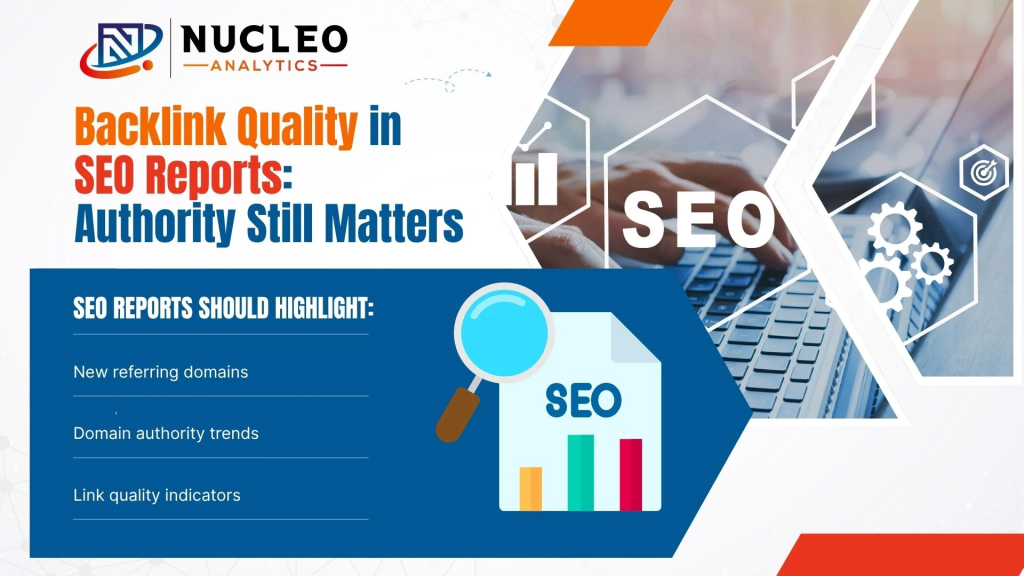
SEO reports should highlight:
- New referring domains
- Domain authority trends
- Anchor text distribution
- Link quality indicators
Ahrefs research consistently shows a strong correlation between referring domains and ranking positions. That connection still holds. However, not all links deserve celebration. Spammy links can hurt more than help. Backlink reporting inside reports should focus on credibility, not just growth numbers.
Page Level Performance in SEO Reports: Finding the Leaks
One mistake businesses make is looking only at site-wide data. SEO performance is uneven. Some pages carry most of the traffic. Others quietly underperform. Detailed reports break down performance page by page:
- Which pages drive conversions?
- Which pages rank but do not convert?
- Which pages are losing visibility?
This granular view reveals opportunities faster than broad summaries.
At Nucleo Analytics, your SEO experts page-level reporting often uncovers simple fixes. A weak call to action. Slow load time. Missing internal links. Small gaps that quietly reduce performance.
Technical Health Metrics in SEO Reports
You can’t ignore technical SEO.
- Broken links.
- Slow speed.
- Indexing errors.
- Mobile usability issues.
Google’s Core Web Vitals research confirms that faster loading pages see lower bounce rates and better engagement. Speed is not cosmetic. It affects behavior.
SEO reports should track:
- Crawl errors
- Page speed performance
- Mobile usability
- Index coverage
Technical SEO does not directly generate leads. But it creates the environment where rankings can thrive. Ignoring this section of SEO reports usually leads to a gradual decline rather than a sudden collapse.
Revenue Attribution in SEO Reports: Where Strategy Gets Real
This is where things get serious. If possible, SEO reports should connect organic traffic to revenue, not just conversions. E-commerce businesses can track direct sales. Service businesses can track closed deals from organic leads.
When revenue data enters the report, discussions shift from cost to investment. Nucleo Analytics pushes for this level of clarity whenever data allows it. It changes decision-making completely.
Metrics That Look Important But Often Aren’t
Some numbers create a distraction:
- Total impressions without click context
- Keyword volume without intent
- Raw backlink counts
- Average session duration without goals
These metrics are not useless. They just need framing. Good reports avoid overwhelming stakeholders with numbers that don’t influence strategy. More data does not equal more insight.
How Nucleo Analytics Structures SEO Reports Differently?
At Nucleo Analytics, SEO reports follow a clear hierarchy:
- Revenue or conversion impact
- Organic traffic quality
- Keyword visibility for high-intent terms
- Engagement signals
- Technical stability
This order matters. It keeps conversations focused on outcomes, not vanity statistics. Many businesses come in thinking their SEO is broken because rankings dropped slightly. Then they realize conversions are steady or even improving.
Perspective changes everything.
The Bigger Picture Behind SEO Reports
SEO is not instant. It compounds over time. The return does not come from chasing every metric. It comes from focusing on the few numbers that truly shape growth. Reports should clarify. Not confuse. They should guide decisions. Don’t overwhelm meetings. If a metric does not influence action, it probably does not deserve center stage. And that is the difference between reporting for show and reporting for strategy.
Nucleo Analytics Builds SEO Reports Around Intent-Driven Traffic
Frequently Asked Questions
What areas in SEO reports do I need to look at first?
Are keyword rankings the crux of SEO reports?
Why do my SEO reports indicate traffic growth but lead to no sales?
How frequently should you evaluate SEO reports?
Do backlinks still matter in SEO reports?
Related Posts
SEO and Web Development: Why is it Important?
A strong online presence is essential for any organization in today’s fast-paced digital environment. Web development and search engine optimization (SEO) are two main foundations […]

Why Use Quora for SEO? (And How to Use Quora for SEO
Search engine optimization (SEO) is not just about getting a site to rank on Google and then passively waiting for the visitors to come anymore. […]
What Can Competitor Analysis Reveal About Your SEO Performance?
When you look only at your own data, growth can feel unclear. Traffic changes may seem random and confusing. Rankings may move without obvious reasons. […]

Is White Hat Parasite SEO Safe? Google-Compliant Tactics Explained
SEO has never been static. What worked even a year ago may not work today, and strategies once considered risky are now being revisited in […]

What Is Search Engine Positioning & Why Does It Matter?
A few years back, having a website was the only concern for businesses. Now, that’s not sufficient. The actual question is: Are people actually able […]

Why Can’t I Find My Business on Google Maps?
Visibility is of the utmost importance in the modern digital world. You may be losing out on a great chance to attract customers if your […]