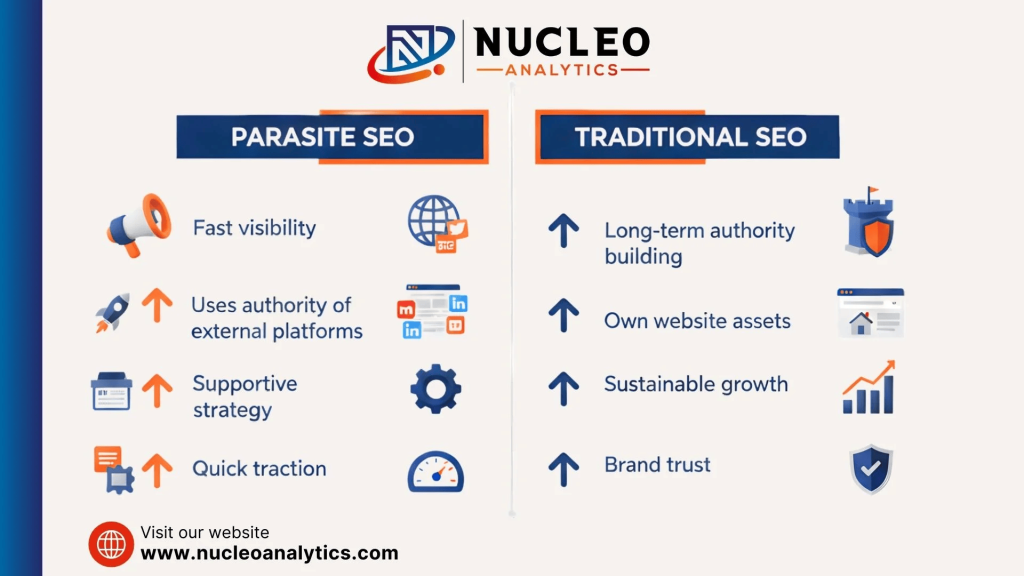


SEO has never been static. What worked even a year ago may not work today, and strategies once considered risky are now being revisited in a more refined, ethical way. One such strategy is parasite SEO, specifically, its white hat version.
For many marketers and business owners, parasite SEO raises red flags. The word itself sounds questionable. But in reality, when done responsibly, white hat parasite SEO can be both safe and Google-compliant.
The real issue isn’t whether parasite SEO works. It’s whether it’s done with intent, quality, and respect for Google’s guidelines. At Nucleo Analytics, we’ve seen this strategy help brands gain visibility without putting their websites at risk, but only when applied correctly.
What Is Parasite SEO?
Parasite SEO is an SEO method that involves publishing content on third-party sites that have a high authority rather than depending solely on the brand’s website. As the latter are already strong in terms of their domain authority, they will help content appear sooner in the search results.
Parasite SEO, rather than waiting for months to get the authority on a new website, gives the advantage of exposure right away by using reliable platforms. This method is particularly beneficial in competitive sectors where getting to the top of the search results naturally can be a time-consuming and costly process.
Some of the usual practices are writing articles for major blogs, providing expert opinion articles, improving personal pages on reliable networks, or distributing lengthy informative writings on popular domains.