









How Do Search Engine Algorithms Affect Your Website’s Rankings?
We all talk about “beating the algorithm,” but honestly, most people don’t even know what search engine algorithms actually do. They sound complicated, like some secret machine humming in a dark room, but, truthfully, these algorithms are just giant systems trying to figure out what people want online. And they’re changing constantly. Sometimes subtly, sometimes like an earthquake.
If you’ve ever wondered why your website randomly drops in rankings, yep… It’s those search engine algorithms doing their thing again.
Whether you run a small business site, an e-commerce store, a service brand, or you’re basically living inside Google Analytics all day, understanding how algorithms affect your rankings is one of the smartest moves you can make. That’s honestly where a lot of business owners mess up; they try to “guess” what’s going on instead of learning the basics.
And if you do it right? The payoff is real more visibility, more clients, more money… You get it.
If you’re looking for help mid-way through this blog, you can always check out Nucleo Analytics for real, hands-on SEO support.
What Exactly Are Search Engine Algorithms?
Search engine algorithms are like giant digital librarians. Their job is simple: read everything online, decide what’s good, what’s trash, and what solves the user’s problem fastest. They measure “quality” by checking hundreds of signals, some obvious, some sneaky.
Here’s the simplest version:
The ranking of pages is done by the use of algorithms according to relevance, trust, and usability.
That’s it. Simple to say, but the rules keep changing.
The majority of the audience believes that SEO is a magical trick. Sorry, it’s not. It is more of a long-term affair; you become regular, and the algorithm believes in you more. You use shortcuts, and it will punish you in the future.
Why Algorithms Change (And Why You Can’t Ignore It)
The search engines (primarily Google) change their algorithms because people do the same with their menus; they evolve. Expectations change. Technology changes. And yes, scammers get smarter.
Here’s the truth:
Each update of the algorithms is to provide the users with the most efficient results and not to make your website have a higher rank. You are merely making yourself conform to that purpose. Sometimes you nail it. Sometimes you don’t.
Updates usually focus on things like:
- Page experience
- Spam control
- Content quality
- Trust and authority
- Expertise on a topic
- Link patterns (good and bad)
- New ways people search (voice search, AI results, etc.)
A solid SEO agency will usually spot patterns before the average site owner even notices. But you don’t need to be a full-blown SEO expert to get the basics right.
The Big Factors Search Engine Algorithms Use to Rank Your Website
1. Content Quality (Still the King, No Debate)
Good content is not just writing more words—it’s writing useful words. Today, content consolidation plays a key role, ensuring information is clear, focused, and valuable. Algorithms can now detect fluff, keyword stuffing, empty claims, and content that rambles without offering anything real.
They look for:
- Clear answers
- Original perspectives
- Good formatting
- Natural keyword use
- Trustworthy tone
- Topical depth (not shallow summaries)
If your blog posts read like they were written to “game Google,” you will lose. That era is dead.
Need Help Crafting Content That Algorithms Actually Trust?
2. Your Website’s Technical Health
Technical SEO sounds boring, but it’s crazy important. Even the best content won’t rank if your site loads slower than a dial-up connection.
Algorithms check things like:
- Page speed
- Mobile friendliness
- Crawlability
- Broken links
- Proper indexing
- Structured data
- Clean code
Think of this as hygiene. You don’t flaunt it, but people definitely notice when it’s missing.
3. Backlinks
Backlinks used to be a numbers game, but now it’s all about quality and natural growth. Modern link building focuses on earning trust—one good backlink from a trusted site is worth more than 200 random ones.
Algorithms evaluate:
- Relevance of the linking site
- Authority of that domain
- Context around the link
- Natural placement, not forced
If your backlink profile looks unnatural, manipulative, or spammy, the algorithm flags it, and not in your favor.
4. User Behavior Signals
Here’s something most people don’t realize:
Search engines watch how users interact with your site.
Things like:
- How long visitors stay
- Whether they bounce quickly
- If they scroll
- If they click to other pages
- If they come back later
These behaviors signal to algorithms whether your content satisfies user intent—playing a crucial role in improving your search engine positioning
If people leave your website fast, the message is simple: This page didn’t help me.
And Google adjusts your ranking accordingly.
5. Search Intent Alignment
This is probably the most misunderstood piece of SEO.
Search engine algorithms don’t rank pages based only on keywords. They rank pages based on what the searcher truly wants.
Examples:
- Someone searching “best running shoes” wants comparisons.
- Someone searching for “running shoes discount” wants deals.
- Someone searching “running shoes pain relief” wants guidance or medical insight.
If your page doesn’t align with the exact intent, you won’t rank. No matter how many times you shove the keyword in there.
6. Topical Authority (The New Big Ranking Metric)
Algorithms favor websites that go deep into a subject, not just touch it once.
Meaning:
If your site publishes multiple helpful, well-structured pieces around a core niche, you build trust.
Search engines see you as a go-to source.
This is why big SEO agencies talk so much about “topic clusters” or “content ecosystems.” They work because they help algorithms understand your expertise.
How Search Engine Algorithms Can Tank Your Rankings Overnight
Ever felt that frustration of waking up, checking your analytics, and suddenly your traffic is down 40%? It’s not personal (even though it feels like it). Algorithm updates hit everyone.
Common reasons rankings drop:
- Thin or outdated content
- Weak backlinks
- Too much AI-generated fluff
- Keyword stuffing
- Over-optimization
- Slow loading pages
- Bad user experience
- Toxic backlinks
- Lack of topical authority
- Competing websites are doing SEO better
Sometimes the fix is small; sometimes it’s a full renovation.
This is why many businesses eventually hire an SEO agency; they get tired of guessing.
How to Stay Ahead of Algorithm Changes
You don’t have to obsessively track every update. Nobody expects that. But here’s what does keep you safe:
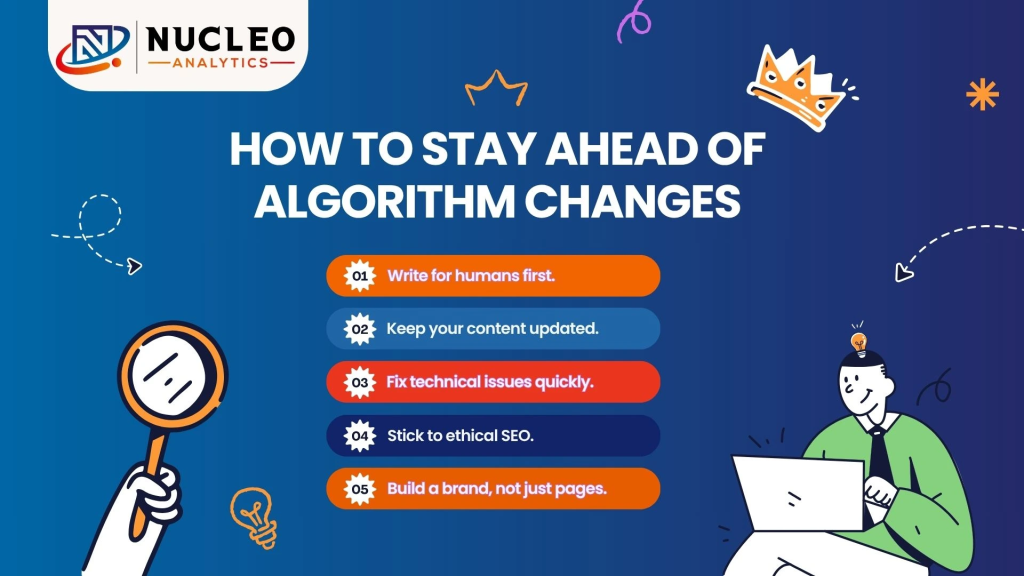
Write for Humans First
Algorithms follow people’s behavior. People don’t follow algorithms.
Keep Your Content Updated
Outdated information hurts ranking more than people think.
Fix Technical Issues Quickly
Crawling issues are silent killers.
Stick to Ethical Seo
Shortcuts feel good now, but they bite hard later.
Build a Brand, Not Just Pages
Algorithms reward recognizable, trusted brands.
Speaking of trusted brands, if you ever need expert help navigating algorithm changes, Nucleo Analytics is just a click away. We stay on top of updates so you don’t have to.
Common Myths About Search Engine Algorithms
Myth 1: “Posting daily helps you rank better.”
Nope. Only helpful content helps you rank better, not frequent content.
Myth 2: “More keywords = better ranking.”
This died years ago. Now, too many keywords make your content look desperate.
Myth 3: “Backlinks don’t matter anymore.”
They matter just differently. Quality over quantity, always.
Myth 4: “Google hates small websites.”
Not true. It hates low-value websites. Even small sites can outrank massive corporations with smart SEO.
Real Talk: SEO Isn’t About Chasing the Algorithm
Here’s the truth that most SEO “gurus” avoid saying:
SEO isn’t about beating the algorithm. It’s about aligning with it.
Search engine algorithms want:
- Useful content
- Fast websites
- Real expertise
- Good user experience
- Proper structure
- Trustworthy sources
If you give them that, you win.
If you try to trick them, you lose, maybe not today, but eventually.
And frankly speaking, attempting to work all this out and remain in business is tiresome.
This is why many brands will eventually turn to a trusted SEO firm such as Nucleo Analytics, since we would rather concentrate on growth, whilst experts do the technical work.
You should stop making guesses and ranking without fear.
Collaborate with gurus who know the workings of search engine algorithms. Get reality strategy, reality fixes, and reality growth. Visit Nucleo Analytics.
FAQs
What are search engine algorithms, and how do they influence rankings?
Why do search rankings drop abruptly?
How long does it take to recover after an algorithm impact?
Can small websites compete effectively with large competitors?
Related Posts

User-Generated Content (UGC): Best Strategies and Inspiring Brand Examples
Today, people trust other people more than ads. A photo from a real customer or a short review often convinces faster than a polished commercial. […]

What is User Intent in SEO?
If you’ve been attempting to figure out SEO in recent times, chances are that you’ve heard the phrase user intent. It’s bandied about by digital […]

Why Content Consolidation Matters for Modern SEO Success?
In the online marketing industry, they have a saying: if you want your site to be gone, simply hide it on the second page of […]

Why Your Business Needs an SEO Outsourcing Service in 2026
The online world changes fast. Many in-house teams cannot keep up. Search engines now look for what people need: helpful content and fast websites. Businesses […]

Is SEO Important for Every Business?
Did you know SEO is the secret ingredient to the success recipe of every business? Yes. it is! Ok! Just think, when did you look […]
Common Mistakes That Kill Topical Authority in SEO
If your site isn’t ranking the way it should, chances are it’s not because Google changed the rules overnight. More often, it’s because your site […]