









Top Reasons to Use Go for Backend Development
The world of backend development has transformed significantly in the last decade. The old days when an app consisted of basic request/response cycles are long gone. The modern platform needs to deal with real-time data processing, high traffic loads, multi-service integration, and consistent performance demands from the end-user.
Here comes the era of Go (also called Golang).
Go language, invented by Google, aimed to resolve common issues in software development, such as poor compile-time performance, inefficient concurrent programming, and cumbersome backend architecture design. Over the years, Go became a powerful rival for legacy backend programming languages, such as Java or Python.
Nowadays, more and more engineering companies and startups are questioning the choice of backend technology stack, especially when considering the competition between Java vs golang for backend.
So the question is no longer “What is Golang?”, but rather, why should you use it for your backend system in the first place?
Why Go Was Created in the First Place
Before understanding adoption, it helps to understand intent.
Go was created to fix real engineering frustrations:
- Slow build times in large systems
- Complexity in scaling backend services
- Difficult concurrency handling in traditional languages
- Heavy memory usage in enterprise stacks
At a time when backend systems were getting bigger and more distributed, languages like Java and Python started showing limitations in high-performance environments.
Go was built with simplicity and scalability in mind. That design philosophy still drives its adoption today.
Performance is One of the Biggest Reasons Teams Switch
One of the most common reasons developers choose Go is performance.
When discussing golang performance, the language consistently stands out due to:
- Compiled execution speed close to C/C++
- Lightweight goroutines for concurrency
- Efficient memory management
- Minimal runtime overhead
Unlike traditional threaded models, Go handles thousands of concurrent operations without significant resource strain. That makes it especially useful for backend systems like APIs, microservices, and distributed systems.
This is also why companies dealing with high-traffic workloads often evaluate Go early in their architecture decisions.
Why Use Golang Instead of Other Backend Languages?
A common comparison developers make is golang vs Python.
Python feels pretty easy to write, it’s flexible, and it gets used everywhere in data-driven apps. But if you zoom in on backend scaling and on performance-heavy systems, Go tends to do better, even if it’s a bit more deliberate to work with sometimes.
Here’s the practical difference:
Python:
- Easier for rapid prototyping
- Slower execution in high-load systems
- Requires more optimization for scaling
Go:
- Compiled and fast execution
- Built-in concurrency model
- Better suited for scalable backend systems
So when teams ask why use golang, the answer is usually tied to performance consistency and scaling reliability, not just syntax preference.
Golang Makes REST APIs Cleaner and More Scalable
One of the most common real-world uses of Go is API development.
A golang rest api is typically:
- Lightweight
- Fast under load
- Easy to deploy
- Structurally simple
Go’s standard library is solid enough that developers can create APIs without leaning too much on outside frameworks. It cuts down on stuff that tends to get messy, and somehow helps the long-term maintainability too.
For agencies and product teams, it matters since backend APIs usually shift over time. Clean architecture helps with the growing technical debt, and keeps everything more simple to maintain, rather than turning into a tangled thing later.
Need a Faster Backend System?
Backend Simplicity Leads to Lower Long-Term Costs
One overlooked factor in backend decisions is overall cost, not just development cost, but operational cost. When evaluating website development cost, backend architecture plays a huge role in long-term expenses.
Complex backend systems often require:
- More infrastructure resources
- Higher cloud computing costs
- More maintenance hours
- Larger developer teams
Go’s efficiency often reduces these overheads. Since it uses fewer resources and scales efficiently, companies can handle more traffic without proportionally increasing infrastructure costs.
That’s one reason startups and scaling companies are increasingly exploring Go as a backend choice.
Go Fits Naturally Into Modern SEO and Web Architecture
Backend development is no longer isolated from marketing or visibility.
Modern systems must support:
- Fast page loading
- Structured data delivery
- Reliable API responses
- Scalable content systems
This is where backend choices directly affect SEO and web development performance.
Search engines care about performance signals, including:
- Page speed
- Server response time
- Stability under load
Go contributes indirectly to SEO by improving backend efficiency, which then supports frontend performance.
This also ties into Technical Optimization in Web Development, where backend architecture plays a critical role in how efficiently a website performs across devices and locations.
Backend Systems Now Need Continuous Monitoring
Modern applications are not “set and forget” systems.
They require constant observation through structured Website monitoring systems, including:
- Uptime tracking
- API response monitoring
- Load performance tracking
- Error logging
- Traffic behavior monitoring
Go-based systems are often a bit easier to hook up with monitoring tools, mostly because they’re simple and show predictable performance behavior. And honestly, this gets more and more important as the whole thing scales, when user traffic turns into a surprise, not always steady, and not always the same.
SEO Monitoring Process Depends on Backend Stability
A lot of people think SEO is only about content and keywords, but backend performance directly influences rankings.
A proper SEO monitoring process often includes:
- Tracking page load speed
- Monitoring crawl errors
- Ensuring server uptime
- Checking mobile responsiveness performance
- Measuring API reliability
If the backend is slow or unstable, SEO performance suffers even if the content is strong.
Go helps reduce these risks by keeping backend systems stable under load, which indirectly supports SEO outcomes.
Go vs Java: The Practical Reality
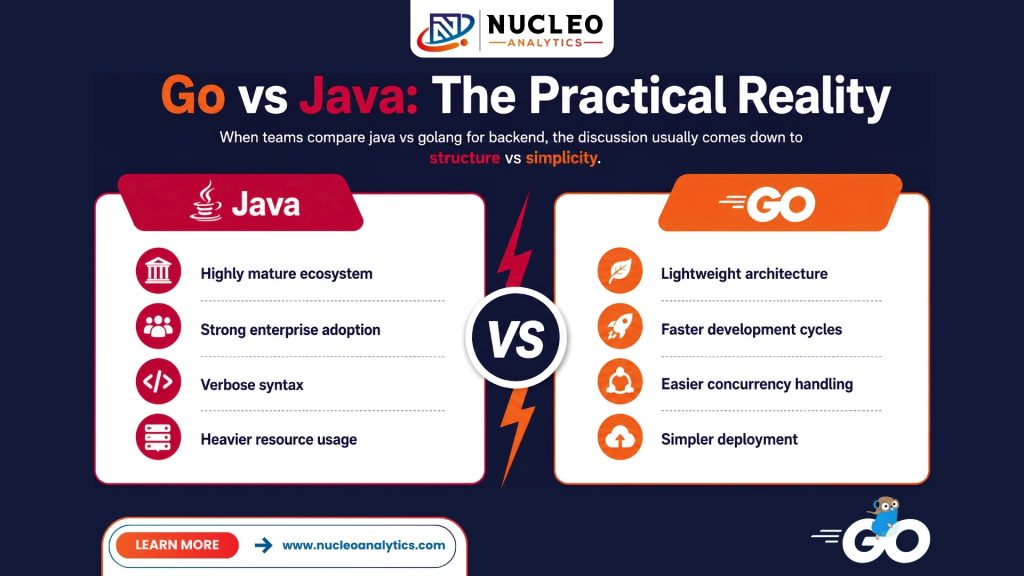
When teams compare java vs golang for backend, the discussion usually comes down to structure vs simplicity.
Java:
- Highly mature ecosystem
- Strong enterprise adoption
- Verbose syntax
- Heavier resource usage
Go:
- Lightweight architecture
- Faster development cycles
- Easier concurrency handling
- Simpler deployment
Java still kind of dominates a lot of big enterprise systems, but Go is getting picked more and more for newer cloud native apps, where speed and scalability matter way more than that old legacy compatibility thing.
Hiring Developers Has Also Become Easier in Go Ecosystem
Another growing factor is hiring.
Companies looking to hire golang developers often find:
- Smaller but highly skilled talent pools
- Strong focus on backend engineering fundamentals
- Developers familiar with distributed systems
- Easier onboarding due to language simplicity
Since Go is simple compared to older backend languages, teams often report faster ramp-up times when bringing in new developers.
That matters when scaling backend teams quickly.
Go Works Well in Microservices and Scalable Architectures
Modern backend systems are rarely one single big monolith anymore. They get built out of microservices, where each service handles some specific purpose, more or less. And honestly, it’s sort of like each piece takes care of its own role, while the whole stack still feels like it’s moving together.
Go is particularly well-suited for this because:
- It compiles into lightweight binaries
- It handles concurrency efficiently
- It performs well under distributed loads
- It integrates easily with container systems like Docker and Kubernetes
This makes it a strong choice for cloud-native environments.
Technical Optimization Becomes Easier With Go
One of the biggest advantages of Go is how it simplifies Technical Optimization in Web Development.
Instead of relying on multiple layers of optimization, Go allows teams to:
- Build efficient backend services from the start
- Reduce dependency overhead
- Avoid unnecessary abstraction layers
- Maintain consistent performance
This reduces long-term technical complexity, which becomes important as systems grow.
When Go Might NOT Be the Best Choice
Go is powerful, but not perfect for every use case.
It may not be ideal when:
- Rapid prototyping is the priority
- Heavy data science or machine learning workloads are involved
- Existing systems are deeply built on Java or Python ecosystems
In those cases, other languages may still be more practical. But for backend systems focused on performance, scalability, and reliability, Go is often a strong candidate.
How We Approach Backend Strategy at Nucleo Analytics
At Nucleo Analytics, backend technology decisions are not treated as isolated choices. They are part of a larger system involving performance, scalability, and long-term maintainability.
We often evaluate backend stacks based on:
- Project scale and expected traffic
- Integration requirements
- Long-term maintenance needs
- Performance expectations
- Development and website development cost efficiency
In many cases, Go becomes a strong option for API-heavy systems, monitoring tools, and scalable backend architectures. Our focus is not just building systems that work today, but systems that continue performing as demand grows.
Conclusion
Go has become one of the most practical backend languages for modern development, kinda. Its strengths in performance, simplicity, concurrency, and scalability make it especially relevant right now for today’s web systems, where speed and reliability are basically non-negotiable.
Whether teams are comparing golang vs Python, or evaluating Java vs golang for backend work, or building golang rest api systems, the decision usually comes down to long-term efficiency and scalability, with less fuss than people expect.
As backend systems keep evolving, Go isn’t replacing every language, not even close, but it is becoming a key part of modern engineering stacks and pipelines. In most cases, the real advantage isn’t just quickness, it’s also steadiness when things grow.
Ready to Build Scalable Applications?
Frequently Asked Questions
Q. Why Should Companies Choose Go for Backend Development?
Q. Is Go Better Than Python for Backend Systems?
Q. How Does Go Improve Website Performance?
Q. Is It Expensive to Build Backend Systems with Go?
Q. Why Do Agencies Prefer Go for Scalable Systems?
Related Posts

How to Build a High-Converting Website in 2026?
In 2026, a business website has to do far more than look modern. A high-converting website is built with one clear goal. Turn visitors into […]

What is Technical Optimization in Web Development?
In the digital era, companies trying to have a strong online presence depend on a well-performing website. Still, design of a visually appealing website is […]

How Much Does It Cost to Develop a Website?
A website is essential for any type of online presence, whether it’s a startup, an e-commerce site, or an international business. Apart from its practicality, […]

SEO and Web Development: Why is it Important?
A strong online presence is essential for any organization in today’s fast-paced digital environment. Web development and search engine optimization (SEO) are two main foundations […]

What is Go (Golang)? A Beginner-Friendly Guide
If you ask what Golang is, the simple answer is this. Go is a fast, clean, and beginner-friendly programming language made for modern software development. […]

How to Structure a Go Project Properly
Project structure defines the long-term stability of any Go application. Weak structure creates confusion during scaling and maintenance cycles, slowing teams down significantly. Proper structure […]