









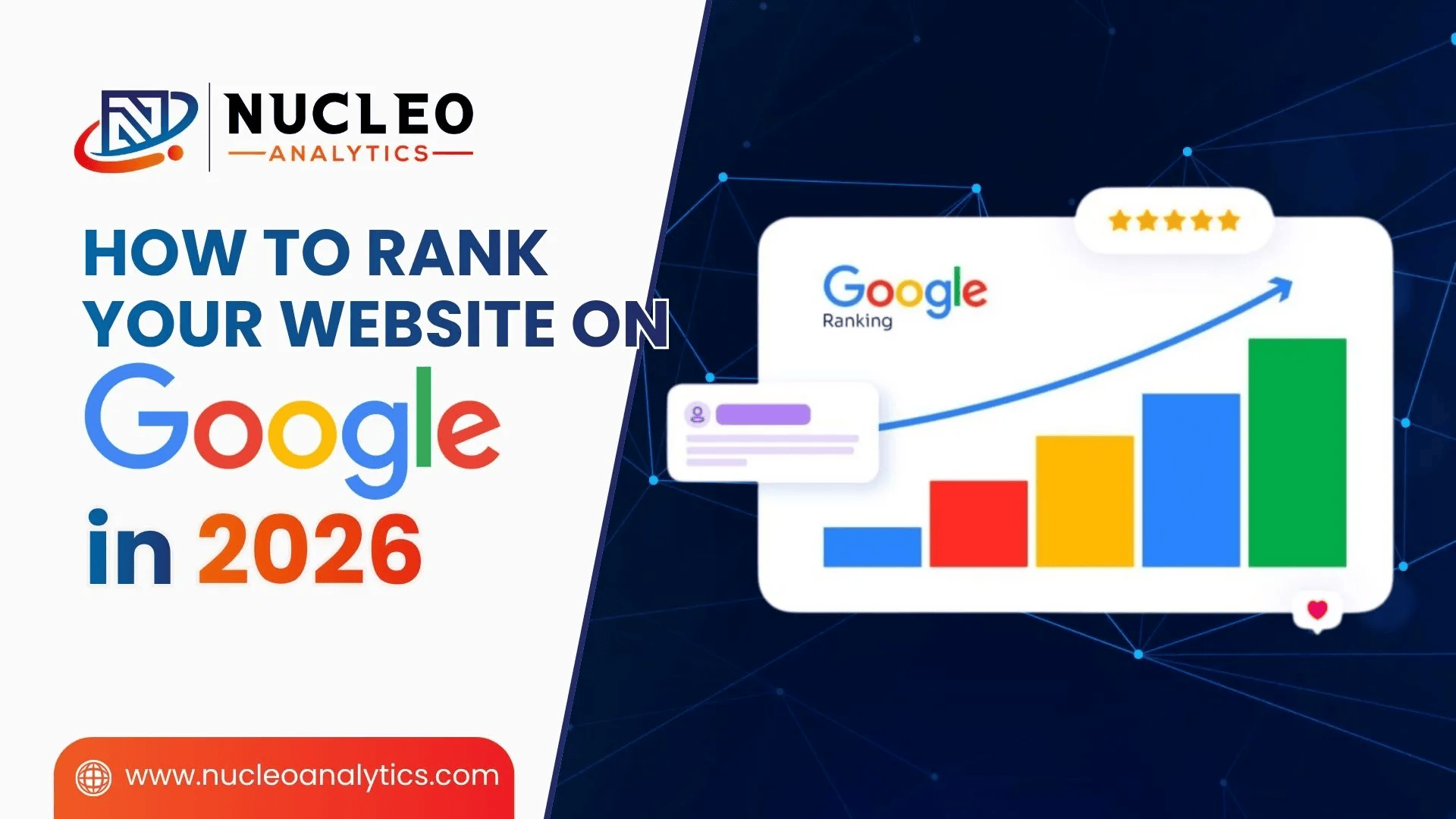
How to Rank Your Website on Google in 2026?
Ever feel like your website is invisible on Google in 2026? You’re doing the work. Publishing content. Making updates. Trying to get everything right. But somehow, your site is still stuck pages behind your competitors.
Yeah, that’s frustrating. The good part? It’s fixable.
Google rankings aren’t based on luck. They come down to clear strategies and consistent effort. If you’re wondering how to rank a website on Google, the answer isn’t one trick; it’s a system. With Nucleo Analytics, let’s break down things you can start doing to move up in search results, get more eyes on your site, and turn that traffic into something real.
Want to Rank on Google?
Then think like Google. It’s looking for three things. Always:
- Relevance – Give people exactly what they searched for.
- Authority – Be the site others trust.
- Experience – Make your site smooth, fast, and easy.
But that’s just the surface. Behind the scenes, Google checks:
- Is your content actually useful, or just noise?
- Are you getting links from real, trusted sites?
- Can Google read your site without struggling?
- Do users stay or bounce in seconds?
Help Google Find Your Content

1. Start With the Basics (Get Your Foundation Right)
Before anything else, make sure Google can even see your site.
Set up Google Search Console. Submit your sitemap. Fix any crawl errors. Sounds boring, but it matters. Then move into keyword research.
One of the best Google ranking tips? Don’t just chase big, competitive keywords. Go for specific, long-tail keywords. These are easier to rank for and usually bring in people who already know what they want. Example:
- Bad: “SEO services.”
- Better: “affordable SEO services for small businesses.”
Also, think about search intent. Is the user looking to learn something? Buy something? Compare options?
Your content should match that. Always.
2. On-Page SEO
This is where most people either overdo it or completely ignore it. You don’t need to stuff keywords everywhere. Just be smart about placement.
Focus on:
- Title tags → clear, keyword-focused, not clickbait
- Meta descriptions → write for humans, not bots
- Headings (H1, H2s) → structure your content properly
- URLs → clean and readable
Use your primary keyword naturally in key spots:
- Title
- First paragraph
- One or two subheadings
Then sprinkle in secondary keywords where they fit.
Also, don’t forget images:
- Use descriptive file names
- Add alt text (this helps SEO and accessibility)
And one underrated move? Internal linking. Link to your own pages. Guide users deeper into your site. Google notices that structure.
Get Your Business Ranking Higher on Google Starting Today
3. Content That Actually Deserves to Rank
Here’s the truth: Most content online is just average. If you want to rank, you need to be better. Not longer. Better.
That means:
- Answering the question clearly
- Giving real value (not fluff)
- Making it easy to read
Break things up. Use short paragraphs. Keep it conversational. Also, a smart move: Use Google’s “People Also Ask” section. Turn those questions into headings. Answer them directly. That’s how you win featured snippets and even show up in zero-click search results.
And don’t just publish and forget. Update your content regularly. Refresh stats. Improve sections. Add new insights. Google likes fresh, relevant pages.
4. Technical SEO + User Experience
You can have great content… but if your site is slow or broken, it won’t rank well. This is where technical SEO becomes non-negotiable.
A few non-negotiables:
- Mobile-friendly design: Most users are on their phones. If your site looks bad on mobile, you’re done.
- Fast loading speed: People won’t wait. Google knows that.
- Clean navigation: Users should find what they need in seconds.
Think of it this way: If a visitor lands on your site and gets confused or annoyed, Google notices. And it hurts your rankings.
5. Authority Building
You can’t fake authority. Google trusts websites that other websites trust. That’s where backlinks come in. This is a core part of link building for local SEO and broader SEO strategy.
Get links from:
- Industry blogs
- News sites
- Relevant directories
- Guest posts
Each good backlink is like a vote. But quality > quantity. Always. And if you’re running a local business, don’t skip local SEO. Understanding the importance of local SEO can change everything for visibility.
Set up your Google Business Profile. Keep your info consistent. Ask for reviews. Respond to them. That alone can drive serious traffic.
6. Track What’s Working And Fix What’s Not
Don’t guess. Look at the data. This is where SEO monitoring and even SEO forecasting come into play.
Use:
- Google Analytics → to track traffic and behavior
- Search Console → to see keywords, clicks, and rankings
Watch for:
- Pages getting impressions but no clicks → improve titles
- Pages with traffic but high bounce rate → fix content
- Keywords ranking on page 2 → optimize and push them to page 1
Small tweaks here can bring big results. Small tweaks here can bring big results and help improve Google ranking over time.
7. Optimize for Mobile
Look at any top-ranking site, and it works smoothly on mobile. That’s because most searches happen on phones now. Google takes this seriously and ranks sites based on their mobile version. If yours isn’t up to the mark, it shows. Fixing speed and layout can make a real difference.
8. Focus on User Experience
Your website should be easy to understand and use. Visitors should be able to find what they are looking for without any trouble. If they stay longer and return again, Google sees your site as useful and ranks it better.
How to Rank Your Website on Google Using Business Listings?
If your goal is to get on the first page of Google, don’t ignore your listings. Platforms like Google Business Profile are built to show up in search results. When your profile is complete, updated, and getting reviews, it starts working like a second website for your business, sometimes even better for local searches.
Create Your Google Business Profile
Make a Google Business Profile so people nearby can actually find you. It shows your business on Google Search and Maps. Just add your details and verify them. Once it’s live, keep it updated. It’s a simple way to build trust and get more local customers through your door.
Optimize Your Google Business Profile
Many people create a Google Business Profile and forget about it. That’s where they lose out. A complete profile with proper details stands a much better chance of showing up in searches. It also makes your business look more reliable when someone comes across it.
Obtain Customer Reviews
A few good reviews can go a long way. When your Google Business Profile has steady feedback, it tells both Google and customers that you’re active. Just ask when the timing feels right. Those small moments can turn into better visibility over time.
How does Google Search work?
Google Search runs on its own using software known as crawlers. Think of Google crawlers like visitors moving through websites. They look at pages and store that information. Later, when someone searches, Google uses that data to show results. You usually don’t need to submit your site manually—Google is pretty good at finding new pages by itself.
Final Thoughts
If you’re trying to rank, start with good content and a clean website. Make sure it loads fast and works on phones. Get some solid backlinks if you can. And if you’re local, don’t ignore your Google Business Profile; it can bring in real traffic.
Also, decide early whether you’ll handle SEO yourself or hire help. The debate between a local SEO expert vs DIY SEO really comes down to time, skill, and long-term goals.
SEO isn’t fast. And it’s not supposed to be.
But if you:
Build real authority
Target the right keywords
Create genuinely helpful content
Keep your site fast and user-friendly
You will see results. At Nucleo Analytics, this is exactly the approach we use, no gimmicks, just consistent, smart SEO that actually compounds over time.
Boost Your Website Visibility and Reach More Customers Today
Frequently Asked Questions
What is website ranking?
What are the different types of ranking systems?
How to write FAQs for a website?
How to improve the ranking of a website?
Related Posts

Why Content Consolidation Matters for Modern SEO Success?
In the online marketing industry, they have a saying: if you want your site to be gone, simply hide it on the second page of […]

Why Your Business Needs an SEO Outsourcing Service in 2026
The online world changes fast. Many in-house teams cannot keep up. Search engines now look for what people need: helpful content and fast websites. Businesses […]
Why is Google Not Indexing My Pages?
In the digital world, websites need Google visibility to attract traffic and develop an online presence. Many website owners, however, discover that a typical problem […]

Which SEO Tools Actually Perform Best in 2026? We Tested 11
There are more tools than ever in 2026. Some promise AI magic. Some promise “one dashboard to rule them all.” And some still rely on […]

How can AI Tools enhance Keyword Research for SEO?
We have seen keyword research evolve from guesswork and intuition into something more structured, data-heavy, and strategic. But even with all the structure, many teams […]
Local SEO Checklist for Small Businesses
Local searches influence how customers find nearby businesses. A strong online presence helps small businesses appear in local results. Therefore, a local SEO checklist improves […]