

Most business owners start this conversation thinking the answer will be obvious, then realize very quickly that hiring marketing help is not only about budget, because the wrong choice can quietly slow growth for months before anyone notices what went wrong.
The debate around Freelancers vs Marketing Agencies usually begins when marketing stops being something you can manage casually between meetings, emails, and daily operations, because once results matter, scattered effort usually stops working.
At first, hiring a freelancer feels practical because one person, one conversation, and one invoice sounds easier than dealing with a full agency structure that may look heavier than necessary. Then the real questions start showing up, because marketing is rarely one task for very long, and one campaign often creates another need that nobody planned for two weeks earlier.
A paid campaign needs landing pages, those pages need stronger copy, stronger copy needs search visibility, and search visibility needs technical fixes that someone has to own properly. That is usually the moment businesses realize they are not choosing between two prices, but between two ways of carrying responsibility when growth starts, depending on consistent execution.
Some companies stay lean with independent specialists for years and do well, while others hit a wall quickly because too many moving parts start competing for attention. The better choice usually depends on how much coordination your business already needs, not how attractive the cheaper invoice looks during the first month.
What Hiring a Freelancer Actually Feels Like
The moment a business needs one particular job done but does not wish to get into a more prolonged engagement with the service provider is where a freelancer steps in. This implies the business owner hires one individual for a task such as ad creation, content creation, SEO technicalities, email handling, or website troubleshooting based on immediate priorities. When comparing the options of a digital marketing agency vs freelancer, the latter typically holds early sway due to the personal interaction aspect, where the client speaks directly to the worker rather than having an intermediary.
This advantage comes into play since small companies seek prompt response times, straightforward decisions, and minimal meetings ahead of kick-off. The competent freelancer will deliver results quickly when working within defined limits and where initial expectations are communicated effectively. Less documentation, fewer approvals, and reduced bureaucracy are typical aspects that make many entrepreneurs happier than ever during peak activity weeks.
It might be refreshing to work with someone who is not part of the company’s internal team, especially considering how overwhelmed everyone may feel from the inside. But the lack of structure can turn into a disadvantage if one person becomes temporarily unavailable at a critical phase in the campaign cycle.
Where Freelancers Usually Deliver Their Best Work
Freelancers often perform best when the business already knows what needs to happen and simply needs someone capable enough to execute without much hand holding. A company with clear direction may only need one specialist for technical fixes, keyword research, or campaign adjustments that do not require bigger strategic involvement. That is why many businesses first test outsourcing digital marketing through freelance support before they consider anything larger. The lower risk makes sense because it allows experimentation without building long contracts around work that may still change next month.
Freelancers also work well when internal teams already own a strategy and only need extra hands during heavier periods. In those situations, one strong independent specialist can genuinely remove pressure without creating operational complexity. This model works especially well when deadlines stay realistic, and expectations stay limited to one area of expertise. Problems usually begin only when businesses expect one person to quietly cover three or four different marketing roles at once.
What Agencies Usually Bring That Freelancers Cannot Easily Replicate
A marketing agency will typically operate via multiple specialists, hence altering the way problems are solved since each specialist will have a unique focus when evaluating the campaign. Therefore, one individual will work on search engine visibility, while another evaluates the analytics, and another will enhance the technical performance of the website. It becomes increasingly likely for agencies to improve their services once marketing strategies begin influencing multiple channels simultaneously.
This explains why marketing agencies prefer implementing data-driven marketing campaigns, where performance is assessed from various perspectives prior to making adjustments. One person may notice traffic issues while another sees that the traffic itself is not converting properly. That shared view helps prevent situations where one metric improves while business results stay flat. Agencies also usually keep work moving even when one team member steps away because delivery is not built around one person’s availability. That kind of continuity becomes very valuable during launches, seasonal campaigns, or periods when business timing matters heavily.
Why Agency Structure Often Feels More Stable Over Time
Agencies usually think in systems because they are built to connect several tasks instead of solving one isolated request at a time. A landing page is rarely treated as only design because copy, speed, search visibility, and conversion tracking all affect whether that page actually works. That broader view usually creates stronger reporting because performance is tied to bigger decisions instead of isolated tasks.
Many agencies also organize monthly updates through tools such as a white label SEO report, especially when businesses need structured performance discussions instead of scattered updates. That reporting style matters because leadership usually wants clarity, not raw data with no explanation. A proper report should explain movement, highlight weak spots, and show what deserves attention next. That is one reason agencies often feel slower at the beginning but steadier after several months. The early process can feel heavier, yet it usually creates fewer avoidable mistakes later.
Comparison Table: Freelancers and Agencies Side by Side
Factor | Freelancers | Marketing Agencies |
Cost at Start | Usually lower | Usually higher |
Communication | Directly with one person | Structured through the team |
Skill Range | Narrower | Broader |
Availability | Depends on one person | Shared team continuity |
Reporting | Often simple | Usually structured |
Scalability | Limited by capacity | Easier to expand |
Risk | Higher dependency | Shared responsibility |
This comparison matters because businesses often focus only on cost and ignore how much operational pressure each model creates later. The real difference usually appears after campaigns become larger than originally expected.
Why Businesses Still Prefer Freelancers First
Freelancers remain attractive because they often solve immediate problems without asking businesses to change how they already operate.
- Communication feels easier because there is usually one direct point of contact.
- Costs stay lighter during short projects or temporary support periods.
- Hiring can happen quickly without long internal discussions.
- Specific expertise can be chosen for one defined task.
- Small revisions often move faster when fewer people are involved.
That combination explains why many founders still begin there before considering anything more structured. A strong freelancer can absolutely produce excellent work when the scope remains realistic and clear.
Where Freelancers Start Becoming Difficult to Scale
The challenge usually appears when one solved problem immediately reveals two new ones that need attention at the same time. A business may hire someone for search work, then realize technical fixes, content updates, and reporting also need stronger ownership.
That becomes especially clear when comparing SEO outsourcing vs in-house SEO because SEO rarely stays limited to one specialist for very long.
Search performance often depends on development, content quality, internal linking, speed, and analytics working together. One freelancer may cover some of that, but rarely all of it with equal consistency. At that stage, coordination itself becomes another task someone inside the business must manage carefully.
Not Sure If Your Website Is Ready for Ai-Driven Search Visibility?
Why Agencies Often Make Growth Easier to Manage
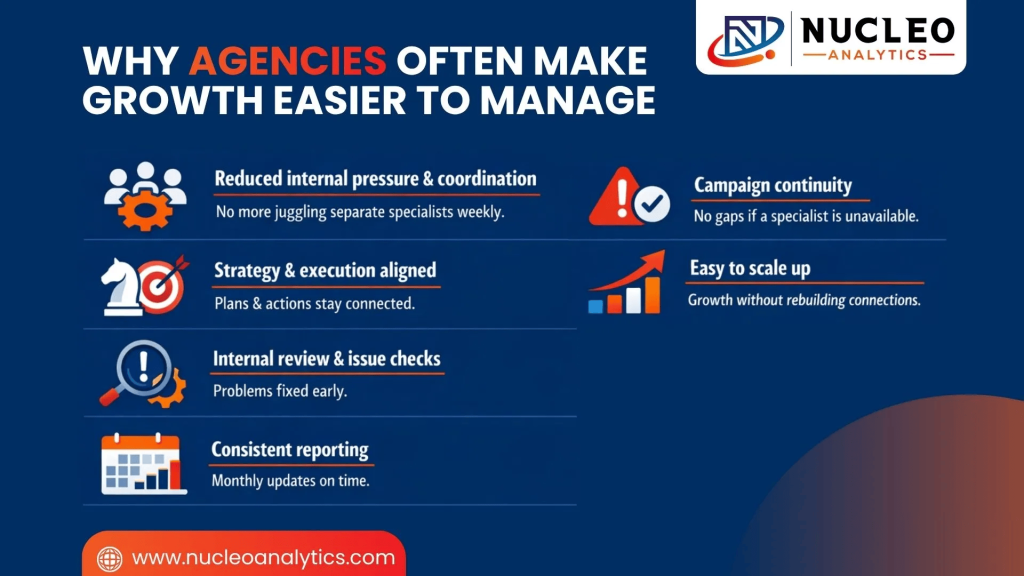
Agencies usually reduce internal pressure because businesses stop coordinating separate specialists manually every week.
- Strategy and execution usually stay connected instead of being handled separately.
- Internal review catches issues before they affect campaign performance.
- Reporting follows a predictable monthly rhythm.
- Campaigns continue even when one specialist becomes unavailable.
- Scaling happens without rebuilding external relationships.
These strengths matter more once marketing begins influencing several business goals at once. That is often when businesses realize structure has value beyond visible deliverables.
Where Agencies Can Feel Frustrating at First
Agencies are not automatically easier, especially when a business only needs one quick task completed without larger planning around it.
A simple update can feel slower because agency workflow often includes internal review, approvals, and documented communication before delivery happens. This is why some businesses hesitate when reviewing marketing agency outsourcing services during earlier growth stages.
The pricing often reflects access to systems, not just one immediate deliverable. That can feel expensive if the business only uses a small portion of available support each month. Still, those systems usually become useful once work starts affecting several channels together.
Which Option Usually Fits Startups Better
Startups usually prefer freelancers first because early priorities change quickly, and financial flexibility matters more than formal structure. One month may require ad support, while the next month suddenly becomes technical cleanup or content improvement.
Projects such as outsource WordPress development often begin with freelancers because the task stays specific and short enough to manage directly. That keeps spending tighter while the business still figures out what actually drives traction. The model works well while operations remain light and decisions happen fast. It becomes harder only when several needs begin arriving together.
Which Option Usually Fits Growing Businesses Better
Growing businesses usually hit a point where disconnected marketing support starts slowing decision making more than helping it. Paid traffic, search visibility, content planning, and technical fixes begin affecting each other every single month.
That is where the broader freelancer vs marketing agency question usually becomes impossible to ignore. Leadership often needs one system that explains what is happening instead of several contributors explaining separate pieces.
That clarity matters because growth usually increases decision pressure across departments. At that stage, coordination itself becomes part of marketing performance.
How Cost Should Be Judged Honestly
A cheaper monthly invoice looks good only until weak execution starts creating delays, repeated revisions, and missed opportunities that cost more later. Freelancers may cost less upfront, but an incomplete strategy often pushes businesses into additional spending they did not expect three months earlier.
Agencies usually charge more because planning, review, reporting, technical oversight, and execution happen through several people.
That means cost should always be judged against total business impact, not isolated monthly pricing. The lower fee does not automatically create lower long term cost. That is where many early hiring decisions quietly go wrong.
Why Some Businesses Eventually Use Both Models Together
Many businesses eventually stop treating this as one permanent choice and build a hybrid setup that uses both, where each works best. An agency may own a strategy and reporting, while freelancers support smaller, specialist work that does not require broader coordination. That model works only when ownership stays extremely clear, and nobody overlaps responsibilities carelessly.
Without clarity, duplicated effort starts appearing faster than expected. That usually creates confusion before anyone notices wasted time. A hybrid model works best when leadership already manages projects carefully.
How Nucleo Analytics Helps Businesses Choose More Clearly
Nucleo Analytics usually starts by looking at where the current friction actually exists instead of pushing one model immediately. Some businesses only need one strong specialist because the strategy already exists internally, and execution is the weak point.
Others already need broader coordination because too many marketing parts now affect each other every week. Nucleo Analytics focuses on matching support to that reality so businesses avoid paying for the wrong structure.
That usually saves more money than chasing the cheapest option first. A clearer decision early often prevents months of correction later.
Conclusion: The Better Choice Depends on What Your Business Is Carrying Right Now
There is no universal winner because both options work well when matched to the right business stage and internal reality. Freelancers work best when needs stay narrow, communication must stay fast, and internal leadership already knows what direction matters most. Agencies become stronger when growth depends on systems, reporting, and coordinated execution across several moving parts.
Nucleo Analytics helps businesses figure out that difference before money gets wasted on the wrong support model. If marketing already feels harder to manage than it did six months ago, that usually means the structure deserves another look.