










How can AI Tools enhance Keyword Research for SEO?
We have seen keyword research evolve from guesswork and intuition into something more structured, data-heavy, and strategic. But even with all the structure, many teams still feel like they are guessing. The search landscape moves too fast, user behavior changes too quickly, and competition shifts without warning. That is why modern teams are not relying only on traditional keyword research tools anymore. They are turning to AI systems that analyze patterns in ways humans cannot do manually.
At Nucleo Analytics, we have watched businesses struggle with choosing the right keywords, sorting through huge volumes of data, and deciding which insights matter. The introduction of AI to keyword research changes everything. It brings clarity to the chaos. It gives a clear picture of demand, relevance, and ranking potential. Most importantly, it reveals what users actually want rather than what marketers think they want.
The Shift From Guesswork to Intelligence
We remember when keyword research meant typing a phrase into a tool, collecting monthly volume numbers, choosing something that looked promising, and hoping traffic would follow. Those days are gone. Websites compete in environments that shift daily, and manual research is simply not enough. AI brings a different level of intelligence. It looks at patterns across millions of searches and finds what humans cannot see.
AI understands how users phrase questions, how search intent shifts during the year, which keywords rise in popularity, and which ones are fading. This level of insight helps teams finally feel confident about the keywords they choose. Instead of a long list of random terms, they get focused insights that reflect real behaviour.
What AI Really Changes in Keyword Research
Many people think AI simply automates tasks, but its value is much deeper. It not only speeds things up. It helps teams understand the stories hidden behind the data. AI can read patterns inside search queries and identify meaning. It finds connections between topics that normally appear unrelated. It sees the intent behind the search. That is what separates AI keyword research from the traditional approach.
A traditional tool might say a keyword has strong search volume. AI will tell you why people search for it, what they expect to find, and how often they convert after landing on similar content. It does not deliver raw data. It delivers interpretation.
Understanding Search Intent at a Deeper Level
Search intent is one of the most misunderstood parts of SEO. Many teams think they know the intent behind a query, but AI shows that intent often shifts across device type, location, demographics, and time of day. This matters because when you match content to intent, you increase both relevance and conversions.
AI Helps Discover Layered Intent
Users might search the same phrase with different goals in mind. For example, a search that looks transactional may actually hide informational questions or early research behaviour. AI reads these layers. It recognizes search paths over long periods and shows how one query leads to another.
AI Maps Behavioural Paths
Instead of looking at a keyword as an isolated moment, AI looks at the journey. People move through different stages as they gather information. AI observes patterns across search sessions and reveals how intent evolves. This gives teams a clearer plan for content and keyword selection.
Expanding Keyword Research Beyond Traditional Boundaries
One of the biggest advantages of AI is its ability to find keywords people never thought to look for. Traditional tools depend heavily on exact match terms or known phrases. AI explores connections, relationships, meaning clusters, and semantic variations. It gathers inputs from multiple directions and builds a larger picture.
Identifying Hidden Opportunities
AI finds phrases that have strong potential but are overlooked because they do not appear on usual lists. These often reflect new topics, emerging questions, and early-stage trends. In markets where competition grows quickly, discovering these windows early can reshape performance.
Creating Topic Clusters With Precision
AI does not produce a simple list of keywords. It creates clusters that reflect natural user behaviour. This gives teams a structure for content planning. Instead of guessing what to write next, they follow clusters that make logical sense. This deepens relevance across the entire site.
Predicting Keyword Trends With Accuracy
One of the most powerful applications of AI in keyword research is its predictive capability. Traditional tools can only show what happened in the past. AI can infer what will likely happen next. It studies patterns that would be impossible for a human to track manually and highlights changes as they start forming. This gives businesses a real advantage because they can plan content and campaigns around behaviour that is still emerging.
Seasonality and Demand Patterns
AI tracks large volumes of historical data and recognizes patterns in seasonality. It examines signals across regions and industries. Instead of reacting when trends arrive, teams can prepare content ahead of time. This works especially well in industries where buying cycles repeat each year and demand spikes at predictable moments.
Rising Keywords and Early Wave Opportunities
AI detects emerging search behavior that has not yet become competitive. These early signals are extremely valuable. They allow teams to build authority before competitors notice the opportunity. When you publish content at the early stage of a keyword’s growth, it gains traction faster and tends to hold rankings longer.
Identifying Declining Keywords
AI not only shows what is rising. It also reveals when a keyword is beginning to fall out of favour. This helps teams avoid investing in topics that are losing relevance. Instead of writing content that will fade quickly, they can shift resources into stronger opportunities or explore fresh angles.
Forecasting Related Query Growth
AI studies how clusters evolve. When people begin asking new questions related to a topic, AI notices the directional shift and predicts which related queries will gain momentum next. This helps teams build supporting content and internal linking structures before the competition catches up.
Want sharper insights powered by real behavior and predictive patterns?” text=”” btn_txt=”Start Now”]Processing Data at a Speed Humans Cannot Match
Keyword data is enormous. A person can analyze a few dozen keywords. A team can review a few hundred. AI analyzes millions and does so continuously. This scale changes the quality of decisions.
Automating the Heavy Lifting
AI does not get tired. It processes everything and returns only what matters. This gives teams more time to interpret insights instead of sorting through noise.
Connecting Data From Multiple Sources
AI learns from everywhere. It processes search engine data, user behaviour, social trends, on-site analytics, and competitor shifts. When all these signals merge, the insights become sharper.
Competitive Analysis Goes Deeper With AI
Understanding your own keywords is only half the equation. You must know what competitors are doing. AI systems make competitor analysis easier and far more accurate.
Spotting Competitive Gaps
AI highlights keywords that competitors rank for, but you do not. It uses behavioural patterns to determine which gaps are worth pursuing. It avoids sending teams after keywords that look promising but do not bring strong conversions.
Monitoring Competitor Movement Over Time
AI also shows how competitor visibility rises and falls. It identifies which topics they are investing in and where they are losing traction. This transforms competitor analysis from a static snapshot into a moving story.
Personalization Becomes Possible With AI Tools
Keyword research was once a one-size-fits-all process. AI changes that. It creates paths for different audience segments. Keywords that work for one group may not work for another. AI helps identify those differences.
Audience Segmentation
AI identifies unique behaviours across different audience types. It helps tailor content and keywords to match each group.
Localized Keyword Research
AI picks up on linguistic differences and regional patterns. It highlights terms used in different areas. For companies targeting specific regions, this is a significant advantage.
AI Simplifies Complex SEO Decisions
Many teams become overwhelmed by data. They have large keyword lists but do not know what to do first. AI simplifies the process. It organizes recommendations and suggests actions.
Prioritizing High Impact Keywords
AI ranks keywords based on opportunity, competition, user intent, and conversion potential. It reduces guesswork.
Helping Build Smarter Plans
AI organizes keyword clusters, identifies content gaps, and supports internal linking strategies. It gives teams a blueprint that feels achievable and structured.
The Role of AI in Content Creation and Optimization
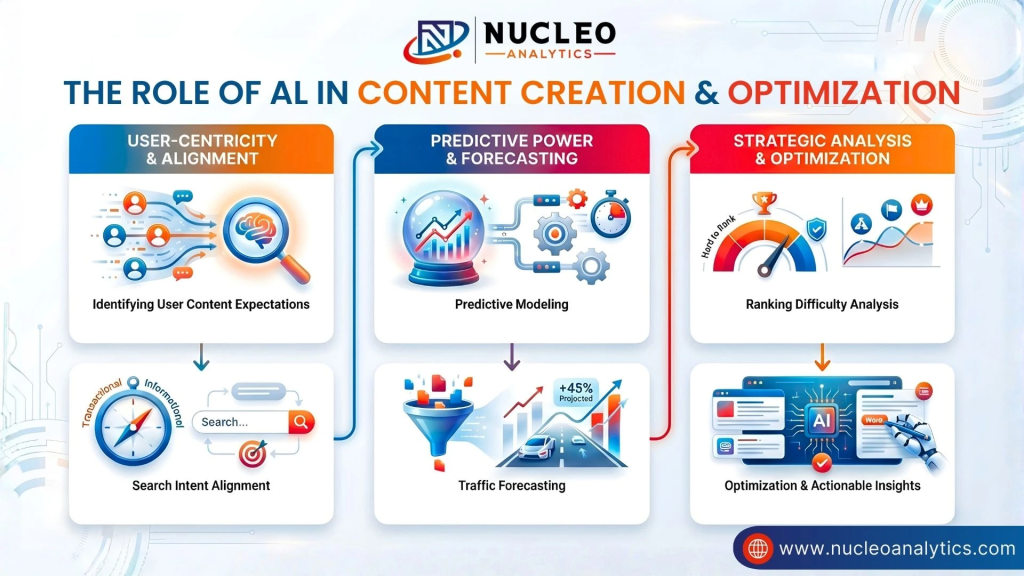
Keyword research is not only about discovering the right terms. It is also about producing content that matches those search queries. AI supports this process from multiple angles.
Identifying What Content Users Expect
AI studies the top-performing pages for a query and identifies patterns in structure, tone, and coverage. It reveals what users expect to see.
Aligning Keyword Use With Search Intent
AI analyzes how keywords appear within content that already ranks well. It helps teams avoid stuffing and instead focus on natural placement.
The Power of Predictive Modeling
Predictive modeling is one of the most useful AI capabilities in SEO. It helps teams see beyond the present moment.
Forecasting Potential Traffic
AI predicts performance based on keyword selection and content quality. This helps teams choose paths with the highest long-term value.
Estimating Ranking Difficulty
AI evaluates not only keyword difficulty scores but also the behaviour of competing sites. This allows for more informed decisions.
What AI Evaluates During Keyword Research
- search patterns over multiple years
- seasonal fluctuations in demand
- Search intent across devices.
- competitor movement in real time
- Content formats that win rankings
- Rising searches that show early signals
- behavioural differences across regions
- long tail phrases hiding inside clusters
- content depth expectations
- ranking factors linked to user experience
Integrating AI Into Existing SEO Workflows
Teams often feel intimidated by AI, but integration is straightforward. AI does not replace human insight. It enhances it. It gives teams clarity in areas that used to be uncertain.
Blending AI With Human Experience
AI handles analysis. Humans interpret. Together, they make stronger decisions.
Using AI for Maintenance and Monitoring
SEO is never static. AI keeps a constant eye on shifts. It alerts teams when trends change.
Where Data Meets Real Opportunity
AI gives keyword research something it never had before: stability. When you stop relying on guesswork and start trusting patterns, trends, and behavioral insights, decisions feel clearer, and the work becomes more strategic. That is the advantage AI brings. It helps teams see where demand is shifting, which queries are gaining strength, and how audiences are searching across different stages of their journey. At Nucleo Analytics, we see how much confidence this brings to businesses. The process becomes grounded in evidence rather than assumptions. When teams combine AI tools with human judgment, keyword research becomes a system they can trust rather than a list they hope will work.
Want to increase precision with help from the best AI SEO platforms in the industry?
Frequently Asked Questions
Q1: Do AI tools replace traditional keyword research?
Q2: Is AI reliable for identifying search intent?
Q3: Can AI help discover new keyword opportunities?
Q4: Are AI SEO platforms hard to integrate?
Related Posts

Understanding Zero Click Search: How Do They Impact SEO?
It appears that the existence of zero-click search is due to the ease with which information is currently obtainable. Users can now easily obtain the […]

Complete Guide to Local SEO for Small Businesses
Local SEO gives small businesses a strong way to grow. Customers search online every day for services near them. Appearing in local searches builds trust […]

Local Search Engine Optimization Expert vs DIY SEO: Which Is Better for Your Business?
You run a business, small or growing. You want people to find you online. Maybe you’ve tried a little SEO yourself. Maybe you’re thinking about […]

Is White Hat Parasite SEO Safe? Google-Compliant Tactics Explained
SEO has never been static. What worked even a year ago may not work today, and strategies once considered risky are now being revisited in […]

How to Use SEO Forecasting for Better Strategy Planning?
The digital world is evolving rapidly, and in fact, more rapidly than most businesses. Search trends rise and fall. Algorithms shift. What was effective last […]

Why Content Consolidation Matters for Modern SEO Success?
In the online marketing industry, they have a saying: if you want your site to be gone, simply hide it on the second page of […]