









What is inbound marketing vs outbound marketing?
People talk about inbound marketing and outbound marketing like it’s a clean choice. One or the other. That’s not how it plays out once you’re actually trying to get leads.
At Nucleo Analytics, most companies don’t come asking what inbound marketing is. They come because something stopped working. Ads cost more. Content isn’t converting. Sales says marketing leads are weak. Marketing says sales aren’t following up.
Then someone says the line. Should we focus on inbound or outbound?
It sounds smart. It’s usually the wrong question.
What is Inbound Marketing?
Inbound marketing is about being found, not forcing yourself into someone’s day.
It works when a person already has a question, a problem, or a curiosity. They search. They scroll. They read. And they land on your content because it helps them.
Common inbound channels include:
- Blog articles
- SEO focused content
- Guides and whitepapers
- Organic social media posts
- Email newsletters people actually signed up for
The idea is simple. You put out useful information. The right people come to you over time.
Inbound is slower. It asks for patience. You do the work upfront, often without immediate payoff. But once it gains traction, it tends to compound.
For many brands, inbound becomes the backbone of their digital marketing strategy, especially when trust matters.
Outbound Marketing Is the Opposite Energy
Outbound marketing does not wait for permission.
It interrupts. It pushes. It puts your message in front of people, whether they were asking for it or not.
That includes:
- Paid ads
- Cold emails
- Sales calls
- TV, radio, print
- Sponsored posts
Outbound gets attention fast. That’s its strength. You can launch a campaign today and see leads tomorrow.
But there’s a tradeoff. People are more guarded now. Ad fatigue is real. Filters exist. Spam folders are ruthless. Outbound is most effective when the message is tight, targeting right, and the offer compelling. Otherwise, it just gets lost in the ambient noise.
Inbound Marketing vs Outbound Marketing: Implementation
Here are the differences between outbound and inbound marketing. Because both work. And both fail. Often in the same company.
Inbound fails when content is written for algorithms instead of people. When it explains nothing and says a lot. When it exists just to exist.
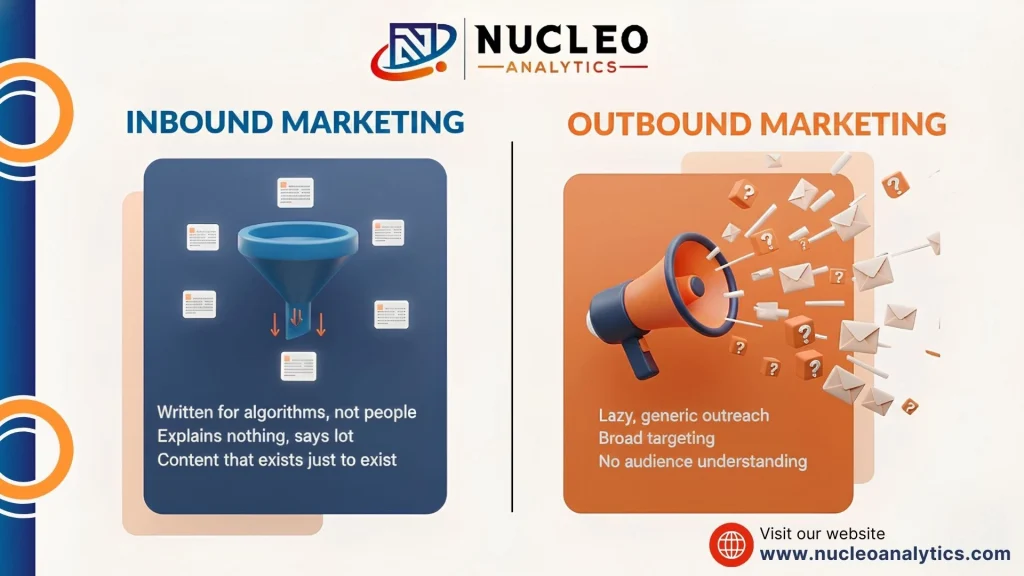
Outbound fails when it’s lazy. Generic emails. Broad targeting. No understanding of who’s on the other side.
Neither approach is broken. Execution is usually the problem.
And expectations. Inbound is expected to convert fast. It doesn’t. Outbound is expected to build trust. It rarely does.
That mismatch causes most of the frustration.
Still unsure where inbound or outbound fits your business?
Where Customer Acquisition Actually Comes From?
Customer acquisition doesn’t care how clever your approach sounds. It cares about timing.
Inbound works when people are already thinking. Researching. Comparing options. Trying to solve something. Outbound works when people are unaware, distracted, or just not looking yet.
Inbound attracts. Outbound interrupts.
One pulls. One pushes.
For customer acquisition, the best results usually come from using both at different points, not choosing one and ignoring the other.
Inbound Marketing Is Slow for a Reason
Inbound marketing asks people to make their own choice.
Read or don’t. Click or don’t. Stay or leave.
That freedom is what builds trust, but it’s also why growth feels uneven. Some days nothing happens. On other days, three leads show up from something you wrote six months ago.
Inbound doesn’t give a clean cause and effect. And that makes it hard to defend internally.
Still, inbound content doesn’t disappear when budgets change. It keeps working quietly in the background. That’s why companies stick with it, even when it annoys them.
It becomes a stabiliser inside a digital marketing strategy, not a growth hack.
Outbound Marketing Burns Fast
Outbound marketing demands attention right now.
When it works, it feels great. Leads arrive quickly. Sales get busy. Everyone relaxes for a bit.
When it stops, it stops instantly. Costs rise. Performance drops. People panic.
Outbound doesn’t forgive weak fundamentals. If your offer is unclear or your positioning is messy, outbound exposes that immediately.
That’s why outbound often gets blamed, even when it’s just revealing bigger problems.
Still, outbound remains one of the fastest ways to drive customer acquisition when timing matters.
Why Buyers Behave Differently Than Marketers Expect?
Most marketing plans assume buyers are logical. They are not.
People get distracted. They delay decisions. They change priorities mid-week. They read something, forget about it, then remember it months later.
Inbound marketing fits this behavior better than outbound. It allows space. Someone can engage when they are ready, not when you decide they should be.
Outbound tries to compress that process. Sometimes that works. Often, it creates resistance. Not because the offer is bad, but because the timing is wrong.
Understanding buyer behavior matters more than choosing channels. When marketing ignores how people actually move through decisions, both inbound and outbound struggle.
This is where many digital marketing strategy plans quietly break down.
Why Content Alone Does Not Equal Inbound Marketing?
A common mistake is thinking inbound marketing means writing content.
It does not. Content without intent is just noise sitting on your website.
Inbound works when content answers specific questions. When it reflects how people think, not how companies want to sound. When it guides someone from confusion to clarity.
Many companies publish blogs that look busy but solve nothing. They rank for terms no one cares about. They explain ideas nobody asked for.
Inbound marketing only works when content is connected to real customer problems and real decision points. Otherwise, it becomes a chore instead of a growth driver.
That disconnect hurts customer acquisition more than a lack of traffic ever will.
Why Sales Teams Feel the Difference First?
Sales teams notice inbound and outbound differences before anyone else.
Inbound leads tend to ask deeper questions. They already know the basics. They want specifics. They want reassurance, not explanations.
Outbound leads often start colder. They need context. They need clarity. They sometimes push back harder.
Neither type is better. They just require different conversations.
Problems start when marketing sends outbound-style leads but expects inbound-style conversations. Or when inbound content promises something sales cannot deliver.
Alignment matters more than channel choice. When sales and marketing expect different things, friction shows up fast.
Budget Pressure Changes How Inbound and Outbound Perform
When budgets tighten, outbound is usually the first thing questioned.
Paid campaigns stop instantly when spending pauses. That makes outbound feel risky during uncertain periods.
Inbound behaves differently. Content already published keeps working. Search traffic does not vanish overnight. Email lists remain.
This does not make inbound free or effortless. It just makes it more resilient.
That resilience is why inbound often becomes a stabilising force inside a digital marketing strategy, especially during slower quarters or market shifts.
Outbound still has a place, but budget pressure exposes how dependent it is on constant investment.
Why Measurement Confuses the Inbound vs Outbound Debate?
Inbound is harder to measure cleanly.
Someone reads three articles. Then clicks on an ad weeks later. Then converts. Which channel gets credit?
Outbound looks easier to track. Clicks, impressions, conversions. Numbers appear faster.
This difference skews perception.
Inbound influences decisions long before conversion. Outbound often captures the final action. That does not mean outbound did all the work.
When measurement focuses only on the last touch, inbound gets undervalued. When measurement ignores cost, outbound gets overvalued.
Customer acquisition improves when teams accept that influence is messy and attribution is imperfect.
The Mistake Most Teams Make
They overcorrect. Inbound feels slow, so they abandon it and go all in on outbound.
Outbound feels expensive, so they cut it and expect inbound to save them.
Both moves usually backfire. Inbound without outbound struggles early.
Outbound without inbound struggles later.
At Nucleo Analytics, the better approach is sequencing. Build inbound so people have somewhere to land. Use outbound to get them there faster.
That’s not exciting advice. It’s just what holds up over time.
When Inbound and Outbound Actually Work Together?
Outbound gets someone curious. Inbound answers their questions. Outbound creates the first touch. Inbound does the convincing.
Someone sees an ad. Then Google you. Then read. Then decide.
If what they find is thin, outbound fails.
If outbound never happens, inbound stays invisible.
This is where most digital marketing strategy plans fall apart. They treat channels like silos instead of steps.
Marketing works better when it behaves like a sequence instead of a collection.
Choosing Without Overthinking
You don’t need a perfect balance. You need awareness. Know when you’re buying attention. Know when you’re earning it.
Know what problem you’re solving this quarter, not what philosophy you’re following.
Inbound and outbound are not beliefs. They’re tools. And tools only matter when they’re used at the right moment.
When Doing Nothing Is Worse Than Choosing Wrong?
Some teams delay decisions because they fear choosing wrong.
They debate inbound vs outbound endlessly. They tweak plans. They wait for certainty.
Meanwhile, momentum dies. Marketing works through movement. Testing. Learning. Adjusting.
Inbound and outbound both require commitment to see results. Half doing either usually fails.
The worst position is not choosing the wrong channel. It is choosing nothing and calling it a strategy. That hesitation costs more than most campaigns ever will.
Conclusion
Inbound marketing vs outbound marketing is not something you make a decision on once and never have to think about again. It moves the way the business is moving. Sometimes call for distance and velocity. Others need trust and depth. The error is in treating one method or the other as a belief system, rather than a tool.
“When you hear teams arguing about which one of these is better than the other, and they start paying attention to that timing, buyer behaviour, internal alignment, usually results follow. A digital marketing strategy works best when they learn, not when they try to defend being right. Customer acquisition gets better when marketing meets people where they actually are rather than where the plan says they ought to be.
Planning your next marketing move without clear direction?
Frequently Asked Questions
Q1: Is inbound marketing better than outbound marketing?
Q2: Why does inbound marketing feel like it takes forever?
Q3: Is outbound marketing still worth the cost?
Q4: How does Nucleo Analytics approach inbound vs outbound?
Related Posts

How to Generate Leads from Your Website?
Your website isn’t just a digital brochure; it’s your most powerful lead generation tool. Yet, many businesses struggle to convert visitors into actual prospects. The […]
Why is Digital Marketing a Boon for Small Businesses?
Modern customers today rely heavily on digital means to research products and services. Hence, businesses need to reach customers where they are. Having a strong […]
What are the 7 Cs of Digital Marketing? How to Effectively Implement Them?
Businesses are continuously looking for fresh approaches to improve their online presence, draw clients, and create close bonds with them in today’s fast-paced digital environment. […]
In‑House Marketing vs Hiring an Agency
Marketing is one of those things every business needs, but nobody wants to argue about. You can build an in‑house team or hire outside help. […]

Why Your Ads Deserve More TLC (Targeted Lead Clicks)
In the fast-paced digital world, having your ad noticed isn’t enough—connecting with the proper audience is essential. With billions of adverts displayed every day, your […]
Digital Marketing Strategy for Professional Services
Do you know what exactly digital marketing is and why it is important? Digital marketing is all about employing different tools to connect with your […]