








How to Use SEO Forecasting for Better Strategy Planning?
The digital world is evolving rapidly, and in fact, more rapidly than most businesses. Search trends rise and fall. Algorithms shift. What was effective last month may already be out of date. That is where SEO forecasting comes in.
It is not about making assumptions about the future through guesswork; it is about applying real data to make intelligent, future decisions. Be it a local coffee shop or a global eCommerce brand, understanding the direction of your traffic, rankings, and leads allows you to construct better strategies to date.
And that’s exactly what separates an average agency from a top rated SEO company: the ability to plan with precision, not assumption.
Have you ever wondered how brands always appear to be a step ahead, or why certain businesses appear to know what works before it even happens? It is all thanks to SEO forecasting. Let’s break it down and show how you can use it to strengthen your own marketing strategy, especially if you’re looking for SEO services that actually deliver.
What Is SEO Forecasting, Really?
Fundamentally, SEO forecasting involves making predictions of the future effects of your SEO. It uses information, historical search, and the rank of keywords and conversion rate to forecast what may happen in the next few months.
Consider it as a weather forecast. The weather cannot be controlled, but with good data, you can prepare.
SEO forecasting helps you to:
- Estimate how much traffic your site could gain with better rankings.
- Predict which keywords are worth investing in.
- Allocate budgets more wisely.
- Set realistic goals for growth.
So instead of shooting in the dark, you’re working with numbers that actually mean something.
Why Forecasting Matters More Than Ever
Search visibility isn’t static. A keyword that’s booming today might drop next quarter. Without forecasting, you’re constantly reacting, not planning.
Here’s what happens when you skip forecasting:
- You target the wrong keywords.
- You overspend on content that won’t convert.
- You can’t explain to your team (or clients) why results fluctuate.
Forecasting fixes that. It provides you with a proper road map, so you are not caught by uneven dips or spikes.
For businesses using SEO services for local business, forecasting is especially powerful. Local search trends vary with seasons, events, and regional trends. Planning ahead keeps you visible and relevant before your competitors can catch up.
How SEO Forecasting Actually Works
Good forecasting begins with data, but not just any data. The following is what the experts examine:
- Past Traffic: The History of your site tells a story. It indicates your gained and lost organic traffic over time, as well as helps in recognizing seasonal trends.
- Keyword Data: Keyword statistics, ranking history, and keyword difficulty demonstrate which keywords grow in momentum and which ones go away.
- CTR and Conversion Data: The rate of clicking through your listings gives you an idea of how many times they are used by the user, whereas conversions are what actually generate revenue.
- External Factors: Visibility can change when there is an increase or decrease in the search algorithm, industry changes, or even events taking place in the world. Forecasting takes such potential variations into consideration.
When this information is collected, it can be visualized with AI-based tools and search optimization tools (such as Ahrefs, Semrush, or Google Data Studio) to show projections in the future. That is when revelations turn into a plan.
Turning Forecasts into Real Strategy
Data alone won’t grow your business, but using it wisely will. Here’s how to turn forecasting insights into action:
1. Prioritize the Right Keywords
Forecasting reveals which keywords will likely grow in volume. You can focus content efforts on those instead of wasting time on ones that are declining. For example, if “emergency plumber near me” spikes every winter, a smart local business can start optimizing content before that season arrives.
2. Adjust Budgets Proactively
Instead of reacting to trends, forecasting helps allocate budgets early. When you know which campaigns or pages are about to perform, you can direct resources toward high-return areas. This allows you to customize your strategies as per the required volume.
3. Create Seasonally Aligned Campaigns
Businesses offering SEO services use forecasting to plan around local seasons, events, or holidays. A landscaping company, for instance, can plan “spring cleanup” campaigns in February, not May.
4. Set Realistic KPIs
Forecasting gives measurable benchmarks. You’ll know what kind of traffic or conversions are expected, and what’s overperforming. That keeps teams focused and clients confident.
5. Prepare for Algorithm Changes
If an algorithm update is likely to hit certain industries or content types, forecasting helps predict the potential impact. This gives you time to adjust strategies early and plan out your next move.
The Tools That Make SEO Forecasting Easier
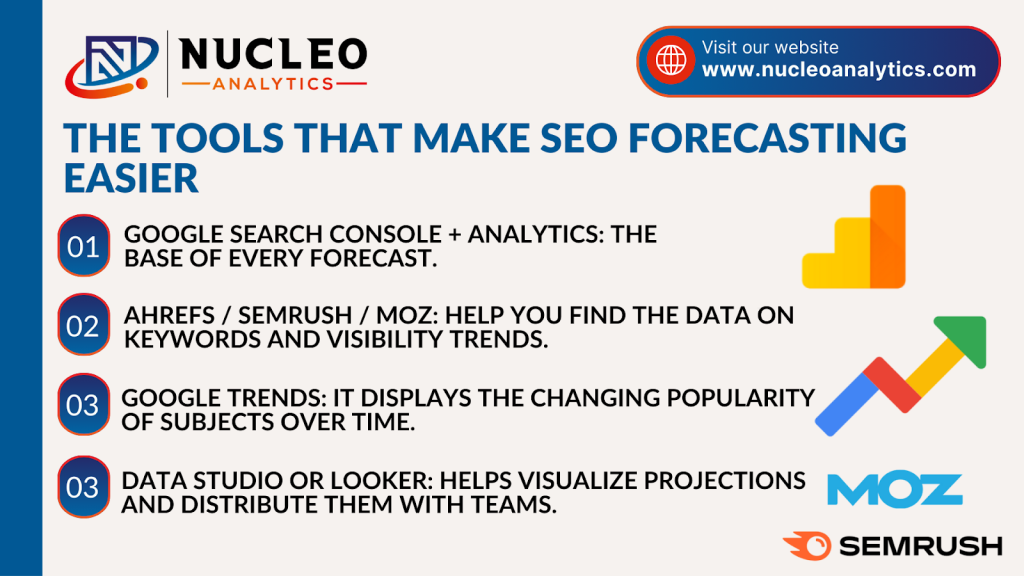
Forecasting might sound technical, but modern tools make it accessible. Some of the best include:
- Google Search Console + Analytics: The base of every forecast.
- Ahrefs / Semrush / Moz: Help you find the data on keywords and visibility trends.
- Google Trends: It displays the changing popularity of subjects over time.
- Data Studio or Looker: Helps visualize projections and distribute them with teams.
The key is not the tool itself, but how you use it. A top rated SEO company doesn’t just run reports; it reads between the numbers, finding signals others miss.
How Small Businesses Can Benefit the Most
You don’t need a massive marketing budget to use forecasting. In fact, it’s one of the most cost-effective ways to plan growth.
For small or local businesses, it helps you:
- You should target a few high-impact keywords as opposed to spreading too thin.
- Spot Local seasonal highs (such as “AC repair near me” in summer).
- Plan content calendars around real data, not guesses.
- Justify your marketing spend with numbers and projections.
When combined with smart SEO services for local business, forecasting can transform a limited budget into a long-term growth engine. You start making data-backed moves, not just hopeful ones.
Get started today with data-driven insights from experts who specialize in predictive SEO growth.
Avoid These Common SEO Forecasting Mistakes
Forecasting isn’t foolproof, but most errors come from how it’s done. Here’s what to avoid:
- Relying on short-term data: Two months of data isn’t enough to find trends. Always look at 12+ months for accuracy.
- Ignoring seasonality: A keyword might look dead in winter but boom in summer.
- Forgetting conversions: Ranking doesn’t matter if it doesn’t convert.
- Treating forecasts as guarantees: Forecasts guide strategy, not predict exact numbers.
The smarter your approach, the more reliable your forecast becomes.
How to Combine Forecasting with Other SEO Strategies
Forecasting works best when combined with ongoing optimization efforts. For example:
- Content Marketing: Use forecasted keywords to plan upcoming blog topics.
- Link Building: Focus on URLs expected to perform well in the next quarter.
- Technical SEO: Anticipate crawl or indexing issues before they affect growth.
- Local SEO: Identify months when “near me” searches peak and adjust GMB updates accordingly.
When all these layers work together, your SEO becomes proactive, not reactive.
Start with a free visibility audit from a top rated SEO company and see how future data can shape your next win.
Forecasting in the Age of AI
AI is now supercharging SEO forecasting. Machine learning models can process billions of data points to detect early signs of change, long before humans can.
They predict search intent shifts, topic fatigue, and algorithm adjustments in near real time. That means your business can adapt faster, update content sooner, and stay ahead of competitors.
For agencies and brands offering SEO services, AI-powered forecasting means:
- Smarter budget planning.
- Faster response to local search shifts.
- Continuous learning from new data.
Simply put, AI turns forecasting from a report into a living system that keeps evolving.
How Nucleo Analytics Helps Businesses Use Forecasting the Right Way
At Nucleo Analytics, we believe strategy shouldn’t be built on assumptions. Our forecasting process helps you plan smarter, not harder. We:
- Analyze long-term keywords and traffic patterns.
- Build predictive dashboards that visualize growth potential.
- Align SEO forecasts with your business goals.
- Combine AI insights with real human strategy.
The result? Clear, measurable direction for your next campaign. Our clients don’t just react to trends, they lead them.
Choose a top rated SEO company and see how future data can shape your next win.
Conclusion
SEO forecasting is not a luxury, but a game-changer in the modern approach. It allows you to see past the current moment and make less dumb decisions before the market changes. Whether it’s creating new keyword opportunities or budgeting and scheduling campaigns, forecasting helps you keep your SEO data-driven and futuristic.
So that you can be ahead of your competitors, get the services of an SEO company that can predict the growth, but not track the growth. And for small brands seeking SEO services for local business, forecasting ensures every click, keyword, and campaign contributes to meaningful, measurable growth.
Because the best strategies aren’t just luck, they’re predict.
Frequently Asked Questions
Q1: What is SEO forecasting?
Q2: How does a top-rated SEO company use forecasting?
Q3: Do local business owners understand the value of SEO forecasting?
Q4: What information is involved in SEO forecasting?
Related Posts
How is Google AI Overviews Going to Affect SEO?
Search is changing. Again. If you’ve been around SEO for more than five minutes, you already know that change is the only constant in this […]
Why Can’t I Find My Business on Google Maps?
Visibility is of the utmost importance in the modern digital world. You may be losing out on a great chance to attract customers if your […]

How ChatGPT and AI Are Changing SEO?
SEO today is not what it used to be. A few years ago, SEO required websites to focus on three main elements, which were keywords, […]
How Much Does SEO Cost in the US in 2026?
Every business wants better visibility online. More traffic, better leads, more calls, more sales, and more people actually finding the business instead of competitors. That’s […]
What Is Search Engine Positioning & Why Does It Matter?
A few years back, having a website was the only concern for businesses. Now, that’s not sufficient. The actual question is: Are people actually able […]

Master Keyword Competition Analysis with This Simple Guide
In today’s fast-paced era of online marketing, mere posting of content does not suffice. You may possess phenomenal products or services, but unless your website […]