









Is Link Stability a Signal for Google Rankings?
Backlinks have been the foundation of SEO. The sites that receive links from high-authority sources will occupy more favorable positions in the search results. However, of late a lot of talk has come up concerning link stability; the concept that long-lived links are more likely to benefit your Google rankings than temporary links.
If you’re working with an online marketing firm, it’s important to separate fact from myth. Link stability is logical, but on the other hand, Google does not consider the duration of links as a direct ranking factor. This does not imply that links are not important; it simply implies that you must pay attention to what actually moves the needle.
In this post, we’ll break down:
- What link stability is
- Why isn’t it a direct ranking signal
- What Google actually prioritizes
- How to improve rankings using strategies that truly matter
By the end, you’ll know exactly how to allocate your SEO efforts without falling for misconceptions.
What Is Link Stability?
Link stability is simply how long a backlink to your site remains live on another website.
For example:
- If a blog links to your article today and keeps it for five years, that’s a stable link.
- If the link disappears in a month, that’s an unstable link.
The concept is appealing because stable links feel trustworthy. They show that your content is consistently valuable and referenced over time.
Many people assume that Google rewards this longevity. It makes sense on the surface: if other sites keep your link for years, it must be high-quality, right?
However, SEO is rarely that simple. While link stability can signal credibility indirectly, it is not an official ranking factor. Google’s algorithms are far more sophisticated, evaluating the quality, relevance, and context of a link rather than how long it has existed.
Why Link Stability Is Not a Direct Ranking Signal
Let’s unpack why link stability is more of a myth than a fact when it comes to SEO.
1. Google Looks at Link Quality, Not Age
A brand-new link from a high-authority site can have a huge impact on rankings immediately. Conversely, an old link from a low-quality directory site may contribute almost nothing. Google cares about the trustworthiness and relevance of the linking site, not how long the link has existed.
2. Link Churn Is Normal
Websites constantly update, migrate, or remove content. Links naturally appear and disappear all the time. Penalizing a site because some links disappeared would be unreasonable. Link churn is a normal part of the web, and Google’s algorithm accounts for this.
3. Trust Comes From Multiple Signals
While stable links might feel trustworthy, Google evaluates trust through a combination of factors:
- Domain authority
- Content quality
- Relevance of linking pages
- Natural link patterns
- User engagement metrics
A link that lasts five years doesn’t automatically indicate quality. A link that disappears after a month might still have provided significant value if it came from an authoritative source.
4. Evidence from Google
Google representatives and patents have clarified multiple times that link quantity and quality matter, but there is no mention of link duration as a ranking signal. Many SEO studies confirm this as well. Sites with high-quality but short-lived links often perform just as well, if not better, than sites with old links from lower-quality sources.
The Risks of Obsessing Over Link Stability
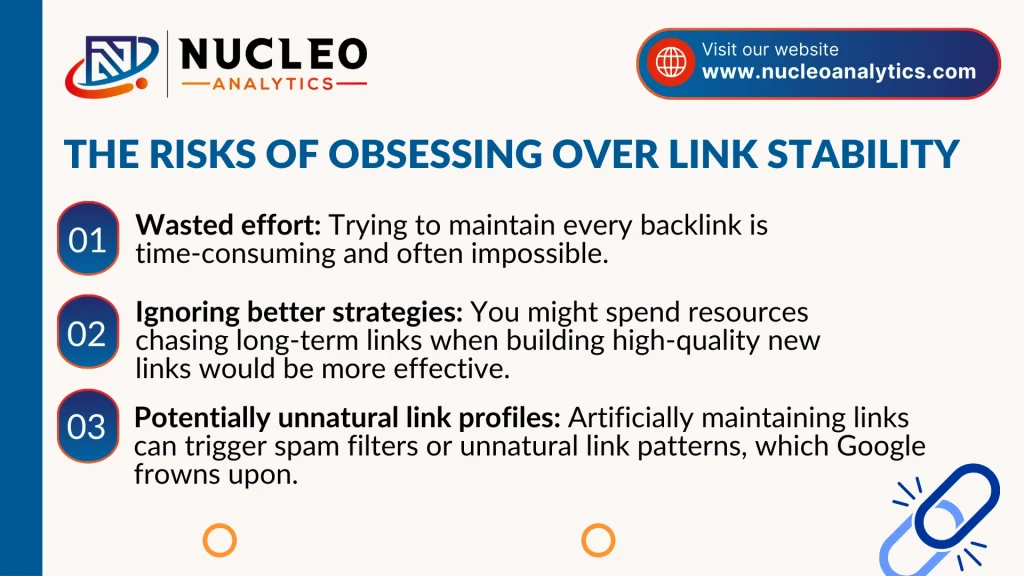
Focusing too much on link stability can actually hurt your SEO strategy. Here’s why:
- Wasted effort: Trying to maintain every backlink is time-consuming and often impossible.
- Ignoring better strategies: You might spend resources chasing long-term links when building high-quality new links would be more effective.
- Potentially unnatural link profiles: Artificially maintaining links can trigger spam filters or unnatural link patterns, which Google frowns upon.
Instead, your energy is better spent on the factors that directly influence rankings, which we’ll explore next.
What Google Prioritizes Instead
While link stability isn’t a ranking signal, other link-related factors do matter. Here’s what to focus on:
1. Link Quality
Links from authoritative websites carry the most weight. Think educational domains, respected publications, or well-known industry blogs.
The more trustworthy the source, the more Google values the link.
2. Link Relevance
A backlink is stronger if it’s contextually relevant to your content.
For example, a tech blog linking to your software review page is far more valuable than a cooking blog linking to the same page.
3. Anchor Text
Anchor text still plays a role. It helps Google understand what your page is about.
Avoid over-optimization; natural anchor text performs best.
4. Content Quality
Naturally, popular pages tend to be ranked higher. Concentrate on the development of content that addresses real questions, resolves issues, or contains something new.
5. User Experience
Google takes into account such UX signals as speed of page loading, mobile friendliness, and engagement.
A webpage that has a fantastic UX tends to get links by itself, and the links would be more stand-out.
6. Internal Linking
Internal linking assists in the dispensing of authority on your site.
External links may vanish, but good internal linking will make sure that your important pages will not go outdated.
How to Build a Strong Link Profile Without Worrying About Link Stability
To obtain the results of SEO, you should do the following:
Put emphasis on quality links.
Authorize, write relevant areas in your niche.
Create evergreen content
Guides, tutorials, and comprehensive resources tend to attract links that last.
Diversify link sources
Mix blogs, news sites, social mentions, and industry directories.
Use natural anchor text
Avoid stuffing keywords. Keep anchor text descriptive and relevant.
Focus on user intent and engagement
The better your content is to the reader, the better chance you have of attracting and retaining links naturally.
These measures will make a picture of the links Google is fond of, without the concern about whether the link will be a five-year affair or a five-week affair.
Wish you could make sure that your link-building plan is focused on what really moves the needle? Get our professionals to analyze your backlink profile and help you get actual SEO results.
Where an Online Marketing Firm Fits In
Even though link stability isn’t a ranking factor, a professional online marketing firm can help you focus on what actually matters.
A strong marketing partner will:
- Identify authoritative link opportunities
- Create content that attracts links on its own.
- Make sure your on-page search engine optimization is in place, along with your technical configuration.
- Measure the performance and participation of monitors.
You need not be concerned about the age of individual links, but you should focus on establishing true authority and relevance, which have always been good for improving rankings.
How Nucleo Analytics Can Help?
This is where Nucleo Analytics comes in. Many businesses waste time chasing myths like link stability. We focus on strategies that truly impact Google rankings:
- Obtaining good-quality backlinks from reputable and relevant sources.
- Optimizing the content to the interest and purpose of the user.
- Organizing the pages with proper headings, schema and metadata.
- Providing customized SEO services tailored to your business goals and industry
Nucleo Analytics can help clients rank and become visible in a more sustainable way by prioritizing what matters. We make your SEO efforts targeted, quantifiable, and productive.
Ready to boost your rankings with strategies that actually matter? Contact Nucleo Analytics today and let’s create a customized SEO plan for your business.
Common Misconceptions About Links
Here are a few myths we see often:
Myth 1: Older links are always better
Truth: Age doesn’t matter if the link comes from a low-quality source.
Myth 2: Losing a few links hurts rankings
Truth: Google expects some churn. Focus on overall quality and relevance.
Myth 3: Paid links can be maintained for stability
Fact: Paid links are against the rules of Google. They may be a short-lived measure, though it may result in punishment.
Knowing these myths can also enable businesses to concentrate on the actual SEO priorities, rather than pursuing vanity metrics
Conclusion
So, is link stability a signal for Google rankings? The honest answer: no.
While it feels logical, Google does not use the duration of a backlink as a direct ranking factor. What matters more is:
- Link quality and relevance
- Anchor text
- Content value and engagement
- Internal and external authority signals
To achieve practical, quantifiable results, it is advisable to engage an online marketing company you trust and to focus on the factors that directly affect rankings.
We provide businesses with the ability to focus on the things that matter at Nucleo Analytics. Our customized SEO services are designed to produce authoritative content, build natural links, and make your site visible in the long term.
Let Your Business Focus on What Matters Most
Nucleo Analytics' customized SEO services are designed to produce authoritative content, build natural links, and make your site visible in the long term.
Frequently Asked Questions
Q1: How can I improve my position in the Google ranking?
Q2: What are the Google ranking social indicators?
Q3: What is the number of links that I should have at the top of search results?
Q4: Does the speed of the site influence Google ranking?
Related Posts

How to Generate Leads for Your Business Online
Unless you get regular leads in your business, its growth becomes erratic. You may have a fantastic site, good branding, and an amazing offer, but […]

Master Keyword Competition Analysis with This Simple Guide
In today’s fast-paced era of online marketing, mere posting of content does not suffice. You may possess phenomenal products or services, but unless your website […]

Common Mistakes That Kill Topical Authority in SEO
If your site isn’t ranking the way it should, chances are it’s not because Google changed the rules overnight. More often, it’s because your site […]
What Is a White Label SEO Report and How Does It Work?
A white label SEO report is a detailed SEO performance document created by a third-party provider and delivered under your agency’s brand name. It shows […]

Data-Driven Marketing Campaigns: Step-by-Step Blueprint
In 2025, the brands that win are the ones making smart, informed moves. Not because they are lucky. But because they make all decisions through […]

Why Your B2B Strategy Needs These 5 AI-Friendly Content Types
It is more critical than ever to comprehend the significance of content marketing for business-to-business (B2B) organizations in the current digital environment. You’re missing out […]