Marketing in 2025 is fast-paced. Your customers are demanding real-time responses, customized content, and seamless experiences on every platform.
Trying to keep up by hand? This is a burnout recipe. This is where social media marketing firms can assist you most. It enables you to stay ahead while keeping your sanity intact.
Trying to keep up by hand? This is a burnout recipe. This is where social media marketing firms can assist you most. It enables you to stay ahead while keeping your sanity intact.
But let’s make one thing clear. Automation is not about just saving time. It’s about building intelligent processes that guide your audience, engage your leads, and deliver real results. It only occurs with the proper marketing automation plan.
When you are willing to cut through the clutter, better reach your customers, and grow your business with confidence, it is time to educate yourself about marketing automation.
Why Marketing Automation Is Critical in 2025
Marketing today is competitive, fast, and multi-channel. One minute you’re writing a newsletter, the next you’re checking out Instagram insights to see if you followed up with that warm lead from yesterday.
Marketing automation cures that. It allows you to:
- Automate routine tasks (hello, free time!)
- Send personalized, targeted content
- Score and nurture leads on autopilot
- Track what’s working, all in one place
Imagine if your email campaigns, social posts, lead nurturing, and reporting all happened automatically, with smarter, better results. That’s the magic of a solid marketing automation strategy.
The Core Benefits of Marketing Automation
Consider marketing automation as your best worker, someone who never forgets a task, works around the clock, and consistently meets deadlines. It begins altering your results in the background as soon as you set it up.
Here’s how:
- Free your time – Twenty times writing the same email is not why you became a marketer. Follow-ups, lead nurturing, and welcome sequences are handled by automation so that you can focus on strategy and growth.
- Create experiences that matter – Today’s customers look for content that addresses them personally. Sending the right message to the right person at the right time is easier with automation.
- Turn interest into revenue – From initial website visit to ultimate conversion, automation pushes individuals through to pursue them constantly.
- Keep everything on track – No more anxiety about lost messages or human error. Your campaigns are on autopilot with accuracy and consistency.
- Work with data that actually tells a story – With integrated analytics, you have real-time visibility into what’s performing and what requires a change. No more guessing.
- Align sales and marketing – Sales teams know when to step in when marketing is responsible for automating lead scoring and qualification. That means there are more deals closed and fewer opportunities lost.
Ready to put a marketing automation strategy into action? Nucleo Analytics helps you choose the right tools to save time and drive real results.
Top Marketing Automation Tools to Know in 2025
It’s hard to know where to start with so many options out there. These are the leading social media marketing agencies, corporate brands, and startups that rely on these marketing automation platforms, which remain at the forefront of the market in 2025.
- HubSpot – The favorite among so many emerging companies. It combines CRM, email, content, and automation in one sleek, easy-to-understand platform.
- ActiveCampaign – Don’t let its friendly interface fool you. ActiveCampaign is a powerful engine for small teams looking to punch above their weight with deep automation features.
- Marketo (Adobe) – This one’s built for the big leagues. If you’re in B2B or enterprise marketing, Marketo offers advanced features for serious lead nurturing and segmentation.
- Pardot (Salesforce) – Already using Salesforce? Pardot is your automation partner. It’s perfect for managing complex funnels, especially for longer sales cycles.
- Sendinblue (Brevo) – Simple to use, affordably priced, and packed with features. Great for consolidating chat, SMS, and email into one lightweight platform.
The right tool is a big decision. Many businesses rely on Nucleo Analytics to help find the right platform for their goal, target audience, and operations process.
Choosing the right marketing automation tools is easier with expert guidance. See how Nucleo Analytics can help.
Creating a Marketing Automation Strategy That Converts
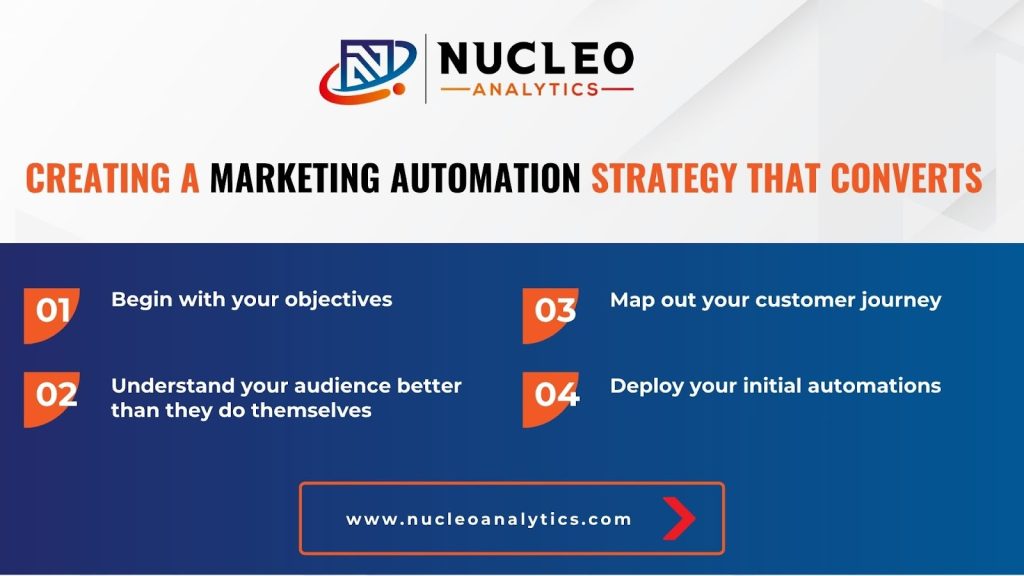
Here’s how to create a strategy that doesn’t merely read well on paper, it actually converts:
- Begin with your objectives – What are you trying to accomplish? More qualified leads? Improved engagement? Increased sales? Your plan should be based on your objectives, not vice versa.
- Understand your audience better than they do themselves – Do not assume you know what your customers desire. To better understand them and their buying behaviors, apply data, surveys, and behavior insights.
- Map out your customer journey – From initial ad click to last sale (and after that), when are the touchpoints where your message is important? These are the times when automation can have a gigantic effect.
- Select tools that suit you – Not all companies require a complete enterprise suite. Select marketing automation tools that play well with your CRM, website, and sales process.
- Deploy your initial automations – Keep it simple. Begin with workflows that provide instant value, such as:
- A welcome series to get your brand known
- An abandoned cart series to salvage lost sales
- Behavior-based lead nurturing flows
- Post-purchase emails to boost lifetime value
- Re-engagement campaigns to re-activate dormant users
- Monitor and refine – You need not get it right the first time around. Monitor your figures and tests, and try to adjust accordingly.
Do you need help building a data-driven strategy that actually works? This is one of the places where Nucleo Analytics shines.
How Social Media and SEO Experts Use Automation
Want to know what the pros are doing? Top social media marketing firms and SEO marketing service providers use automation every single day to deliver consistent results, and so can you.
Here’s a peek at how they’re doing it:
- Smarter social posting – To plan content for when their audience is most engaged, teams utilize automation. Some of the tools even reshare the most popular posts automatically to expand their reach.
- Behavior-based email triggers – A series of email messages is also sent when some actions are taken, such as opening a blog post, downloading a guide, or visiting a product page.
- Instant lead alerts – Sales receive notification the moment a form is submitted or a key page is typed: there is no need to wait hours or days before following up.
- Reputation management – Automation software monitors review websites, marks negative reviews, and triggers remedial action. Even when you are offline, you have control over your online identity.
- Easy content repurposing – A blog article transforms into an email, then a LinkedIn carousel, and subsequently a Twitter snippet. Automation converts one content item into multiple with effort.
- Automated reporting – These teams allow automation to do the data pulling rather than wasting hours on it. With no human effort, they get monthly reports and real-time information.
You don’t require an agency-sized team to implement these strategies. You only require the proper setup and some imagination.
Common Automation Mistakes to Steer Clear of
Let’s spare you some headaches. Here are the most common automation errors, and how to stay clear of them:
- Sending too much too soon – Sending a huge number of emails to your audience on a daily basis is not helpful. Be thoughtful and time-gap-based in your communication.
- Neglecting personalization – The whole point of automation is wasted if your emails still begin with “Dear Customer.” Personalization should come across as sincere, not fake.
- Avoiding segmentation – Not all individuals on your list share the same wants. To get even more, divide your audience into groups according to their location, behaviour or the goods they have bought before.
- Not verifying the data – Automation is not set-it-and-forget-it. Check open rates, click rates and conversion paths regularly to improve your flows.
- Lack of integration – Things get messy when your tools can’t talk to each other. Make sure your automation integrates with your site and CRM smoothly.
Would you rather have another person review your setup? Overlooked opportunities and sneaky wins await with regular auditing from a group such as Nucleo Analytics.
How Nucleo Analytics Can Assist
Automation is a great resource, but it takes time and experience to properly install and make sure that it gets better and better. Nucleo Analytics can assist with that.
They make companies transform automation from a bewildering to-do list into a profit-generating machine.
Here’s how:
- Customized strategy that works for your business model
- Improved customer insights from actual behavior
- Intelligent workflows that lead users to conversion
- Monthly reports you can use
- Seamless integration across all your platforms
- Clean, simple systems that save time and drive ROI
If you’re serious about making automation work, working with a partner like Nucleo Analytics can be the shortcut to results.
A Smarter Way to Start
Don’t be overwhelmed. Dozens of workflows are not the first step in the best marketing automation strategies.
Use this simple approach:
- Know your goal
- Understand your customer
- Choose the right marketing automation tools
- Launch one or two essential workflows
- Measure what matters
- Improve one thing at a time
Doing it all at once isn’t the secret. It’s begin small, stay sharp, and expand upon that.
In 2025, the smartest marketing will be more successful than the most ostentatious. When you use digital marketing automation, you’re saving more than just time. You’re creating a system that will work for you no matter what.
You can have clarity, control, and trust in everything from social media sequences and conversion tracking to lead nurturing and customized emails with the correct marketing automation plan.
When you’re prepared to advance your systems, Nucleo Analytics can assist you. Start wisely. Intentionally automate. And turn 2025 into the most successful and productive year of your life.