






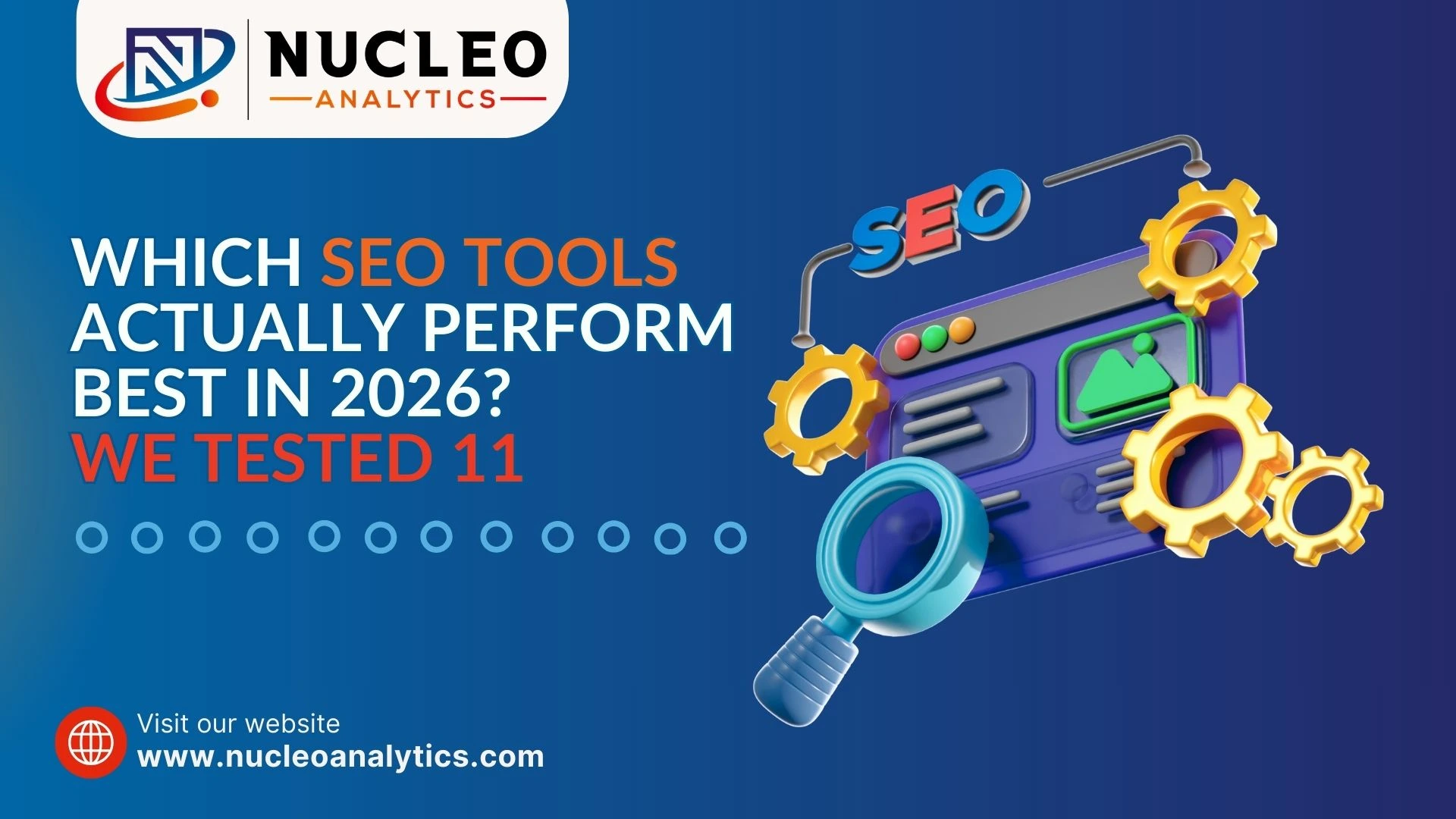
Which SEO Tools Actually Perform Best in 2026? We Tested 11
There are more tools than ever in 2026. Some promise AI magic. Some promise “one dashboard to rule them all.” And some still rely on the same core data they built years ago.
So we tested 11 platforms across real campaigns. Not demo accounts. Not screenshots. Real sites, Real rankings. Real traffic.
The goal was simple: figure out which SEO tools actually perform best when you’re doing serious work.
We tested:
- Keyword data accuracy
- Backlink coverage and freshness
- Technical audit depth
- AI content assistance
- Rank tracking reliability
- Ease of use
- Pricing vs value
We ran these tools on three live sites — a local service business, a mid-size eCommerce store, and a national brand. Thirty days. Same conditions.
Here’s what we found.
Top 11 AI SEO Tools in 2026
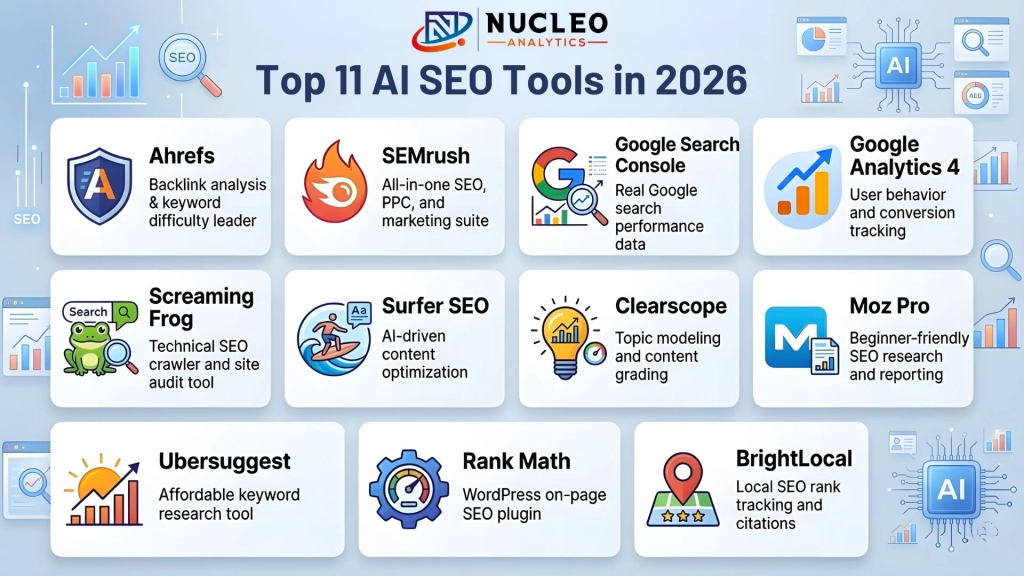
1. Ahrefs
What It Does Best
Ahrefs still dominates backlink analysis. The link index is massive. When we compared link counts against other platforms, Ahrefs consistently showed deeper coverage.
Its keyword explorer is strong too. The “Keyword Difficulty” score felt realistic compared to actual ranking difficulty.
What has Improved
The AI-based keyword clustering is better. It now groups similar terms more accurately and saves time during content planning.
Rank tracking has also become more stable, especially for large keyword sets.
Where It Struggles
Pricing. It’s expensive. And if you only need light keyword research, it may feel like overkill.
Best For
Agencies, link builders, and technical SEO professionals.
Final Take
If backlinks matter to your strategy, Ahrefs is still the benchmark.
2. SEMrush
What It Does Best
SEMrush offers a comprehensive suite of digital marketing tools as its primary product. The platform combines local keyword research with auditing capabilities and PPC tools, content development tools, and reporting functions into a single interface.
Its site audit tool is detailed and easy to present to clients.
What has Improved
The AI recommendations inside audits are more actionable. Instead of generic advice, you get clearer steps.
The reporting dashboards are smoother and more customizable.
Where It Struggles
Backlink depth still slightly trails Ahrefs. Also, the interface can feel crowded.
Best For
Teams that want SEO and paid ads data together.
Final Take
If you want one dashboard to manage everything, SEMrush is hard to beat.
3. Google Search Console
What It Does Best
It shows you real Google data. Impressions. Clicks. Indexing errors. That’s not estimated, that’s direct from Google.
It’s the truth source for performance tracking.
What has Improved
Better indexing insights and more transparency around AI-generated search results.
Where It Struggles
No competitor data, No keyword difficulty. No backlink depth.
Best For
Everyone. No exceptions.
Final Take
If you’re not checking this weekly, you’re guessing.
4. Google Analytics 4
What It Does Best
GA4 tracks behavior. Bounce rates are gone, but engagement data is stronger.
It tells you what happens after traffic arrives.
What has Improved
Attribution modeling is cleaner. Event tracking feels less confusing than early GA4 days.
Where It Struggles
Still not beginner-friendly.
Best For
Businesses that care about conversions, not just traffic.
Final Take
SEO without GA4 is incomplete.
5. Screaming Frog
What It Does Best
Technical crawling. Broken links. Redirect chains. Duplicate titles. Missing metadata.
It pulls raw data. Fast.
What has Improved
Better memory handling for large sites. API connections feel smoother.
Where It Struggles
It’s not beginner-friendly. The interface is plain.
Best For
Technical SEOs and developers.
Final Take
Still the gold standard for deep technical audits.
6. Surfer SEO
What It Does Best
Content optimization. It analyzes top-ranking pages and gives clear recommendations.
The editor highlights missing phrases and structural issues.
What has Improved
AI content guidance now considers search intent better than before.
Where It Struggles
Over-optimization risk. Chasing a “perfect score” can hurt readability.
Best For
Content marketing teams publishing regularly.
Final Take
Use it as guidance, not a rulebook.
7. Clearscope
What It Does Best
Topic modeling and content grading. It produces clean, focused briefs.
Writers love it because it’s not overwhelming.
What has Improved
AI-assisted brief generation is faster and more accurate.
Where It Struggles
High cost compared to Surfer.
Best For
Mid-sized teams focused on content depth.
Final Take
If quality matters more than volume, Clearscope delivers.
8. Moz Pro
What It Does Best
Simple keyword research and easy reporting.
The interface is clean. Beginners adapt quickly.
What has Improved
Keyword Explorer feels more responsive. Reporting is smoother.
Where It Struggles
Backlink data depth lags behind Ahrefs and SEMrush.
Best For
Freelancers and smaller agencies.
Final Take
Moz is steady. Not flashy. Still useful.
9. Ubersuggest
What It Does Best
Affordable keyword ideas and light audits.
It’s beginner-friendly.
What has Improved
Keyword freshness improved slightly. Interface feels faster.
Where It Struggles
Limited depth. Serious campaigns will outgrow it.
Best For
Startups and solo founders.
Final Take
Good starter tool. Not enterprise-ready.
10. Rank Math (WordPress Plugin)
What It Does Best
On-page optimization inside WordPress. Schema setup is easy.
It gives live content feedback.
What has Improved
More AI hints and expanded schema templates.
Where It Struggles
It’s not a replacement for a full platform.
Best For
Bloggers and WordPress site owners.
Final Take
A helpful layer, not a full solution.
11. BrightLocal
What It Does Best
Local rank tracking and citation management.
It clearly shows local map rankings.
What has Improved
Multi-location tracking is smoother.
Where It Struggles
Not designed for national SEO campaigns.
Best For
Local businesses and agencies.
Final Take
If local search matters, this tool earns its spot.
Comparison Table: How the 11 Tools Stack Up
| Tool | Best For | Data Accuracy | Ease of Use |
| Ahrefs | Backlinks | 5/5 | 4/5 |
| SEMrush | All-in-one | 4.5/5 | 3.5/5 |
| Search Console | Google data | 5/5 | 4/5 |
| GA4 | Conversions | 5/5 | 3/5 |
| Screaming Frog | Technical audits | 5/5 | 3/5 |
| Surfer | Content | 4.5/5 | 4/5 |
| Clearscope | Content depth | 4.5/5 | 4/5 |
| Moz | Simplicity | 3.5/5 | 4.5/5 |
| Ubersuggest | Budget | 3/5 | 4/5 |
| Rank Math | On-page | 3.5/5 | 4.5/5 |
| BrightLocal | Local SEO | 4/5 | 4/5 |
When comparing SEO tools side by side, the clear winners depend on use case, not hype.
Not Sure Which Tool Stack Fits Your Business Goals?
Best Tools by Category
- Backlinks: Ahrefs
- All-in-one: SEMrush
- Technical audits: Screaming Frog
- Content optimization: Surfer or Clearscope
- Budget option: Ubersuggest
- Local SEO: BrightLocal
- WordPress optimization: Rank Math
The truth is, no single platform dominates every category. The strongest SEO tools each solve a specific problem very well.
Best Tool Stacks for Different Users
Beginner Stack
Search Console + GA4 + Ubersuggest + Rank Math
Freelancer Stack
Ahrefs + Surfer + Screaming Frog
Agency Stack
SEMrush + Ahrefs + Surfer/Clearscope + BrightLocal
Enterprise Stack
Ahrefs Enterprise + SEMrush Enterprise + Screaming Frog + Custom GA dashboards
Combining SEO tools is smarter than relying on just one.
What Most People Get Wrong in 2026
Thinking AI replaces thinking.
Obsessing over scores instead of results.
Paying for features they never use.
Ignoring technical issues while chasing keywords.
Data is helpful. Strategy wins.
Why Smart Agencies Don’t Rely on Tools Alone
Tools show opportunities. Humans prioritize them.
At Nucleo Analytics, we don’t just pull reports. We test assumptions. Our team compare data between platforms. We look for patterns, not just numbers.
We use Ahrefs for backlink intelligence. SEMrush for campaign reporting. Screaming Frog for audits. Surfer and Clearscope for content. But the real difference is interpretation.
Tools assist. Experience decides.
Final Verdict: Which SEO Tools Actually Perform Best in 2026?
After testing all 11, here’s the honest answer.
- Ahrefs leads in backlinks.
- SEMrush wins for breadth.
- Screaming Frog owns technical audits.
- Surfer and Clearscope improve content performance.
- Google tools remain essential foundations.
The best SEO tools in 2026 are not the flashiest ones. They’re the ones that give reliable data and save time.
Pick based on your needs. Combine smartly. Focus on outcomes.
Because tools don’t rank websites. People do.
Ready to Turn Data into Real Rankings and Measurable Growth?
Frequently Asked Questions
How does Nucleo Analytics evaluate which SEO tools perform best in 2026?
Do most businesses need expensive enterprise-level platforms to succeed with SEO?
Are AI features inside modern optimization platforms enough to replace human strategy?
What should local businesses prioritize when selecting an SEO platform?
Related Posts

How to Do AEO?
Unless you have been living under a rock, you might have heard that search trends have changed: people are not clicking through several pages of […]
How can AI Tools enhance Keyword Research for SEO?
We have seen keyword research evolve from guesswork and intuition into something more structured, data-heavy, and strategic. But even with all the structure, many teams […]
Local Search Engine Optimization Expert vs DIY SEO: Which Is Better for Your Business?
You run a business, small or growing. You want people to find you online. Maybe you’ve tried a little SEO yourself. Maybe you’re thinking about […]
Complete Guide to Local SEO for Small Businesses
Local SEO gives small businesses a strong way to grow. Customers search online every day for services near them. Appearing in local searches builds trust […]
Master Keyword Competition Analysis with This Simple Guide
In today’s fast-paced era of online marketing, mere posting of content does not suffice. You may possess phenomenal products or services, but unless your website […]

How to Use SEO Forecasting for Better Strategy Planning?
The digital world is evolving rapidly, and in fact, more rapidly than most businesses. Search trends rise and fall. Algorithms shift. What was effective last […]