









How Content Marketing Trends Are Evolving in the AI Era?
The evolution of content marketing is quite rapid, and AI tools are not just limited to experimental use anymore; they are already incorporated into the daily routine of several teams. This situation indicates both new chances and new challenges: the production of faster content, the possibility of more personalised communication, but still the same problems like quality control, changes in SEO, and ethical dilemmas. The blog explains the major changes, the easy tactics that can be applied from the next day, and the requirements for teamwork to create content that is still useful and humanlike. No fluff. Just straight talk, real examples, and hands-on tips so you can actually use this stuff, not just read about it.
Let’s get one thing out of the way: AI content marketing is here to stay. It’s not a headline or a hype cycle anymore; it’s baked into tools marketers use for ideation, drafting, editing, and even repackaging content for other formats. Some teams swear by it. Others are cautious. Either way, if you want to play in the content game, you need to know how the rules are changing and how to use AI without losing your voice.
The Big Picture: Adoption and what it actually looks like
AI isn’t one thing. It’s a cluster of features: writing drafts, editing videos, sorting content, SEO prompts, and analytics. Marketers use AI for quick first drafts, headline tests, image variants, and even video cuts. A lot of teams start with small wins, repurposing blogs into short posts or trimming videos, then scale. That’s because the tools are fast and tempting. But tools don’t replace judgement.
Why it matters: AI speeds up repetitive work and makes experimentation cheaper. That means more content gets made. But more content doesn’t equal better results unless you measure and iterate.
Content formats that are winning now
Short-form stuff and video keep climbing. People want quick answers and entertaining visuals. Long-form still matters for deep topics and SEO, but it’s being rethought: long pieces that also feed multiple short Twitter-style posts, short clips, and carousels win more attention now.
What to try: when you write a 1,500–2,500-word piece, plan 6–8 social posts, a 60–90 second video, and a downloadable checklist. Build the kit first. That saves time later.
(Stat context: top formats in recent industry surveys: short articles, videos, case studies, and long articles remain common picks.)
The human + Machine blend (How to keep things real)
People panic: “AI will make everything robotic.” That’s not the full story. The better approach is “AI helps, humans decide.” Use AI for the grunt: outlines, research pulls, variant headlines. Keep humans on strategy, examples, tone, and accuracy checks.
Practical rule: if a piece gives advice, a human with real experience should validate it. If you’re using AI to summarise studies, always link and check sources. If you’re making claims, add citations or first-hand quotes.
This blend keeps your brand voice alive and makes content trustworthy.
Personalisation at scale
Personalisation used to mean name tokens in emails. Now it’s about dynamic content that people click, read, or ignore completely. AI helps by predicting what content a person needs next, product-run videos, how-to checklists, or case studies based on behaviour.
Why this matters: You get big wins when content is relevant, and the team reports better conversion and engagement, but personalisation must be done ethically and transparently. Use aggregated signals and let people opt out.
Using AI, but unsure if it’s working?
SEO changes Google, and AI content guidelines
The search landscape shifted. Google keeps reminding us: write for people first. Their guidance on helpful, people-first content is the baseline. What changed in the AI era is that search engines are building smarter ways to answer questions directly, sometimes without sending a user to your page.
That means: Content must prove value beyond what a raw AI summary provides. Show experience, cite sources, include transparent authorship and timestamps, and structure pages for clarity. If your content looks like thin “AI-sprayed” filler, Google is more likely to downgrade it.
Practical SEO move: In long-form posts, add a “real-world experience” box: short bullets showing experiments, dates, tools used, or client examples. That signals authenticity.
Speed vs. quality: The old tradeoff with a new twist
AI content marketing is incredibly fast. What once took hours can now be done in minutes. That sounds like a win, but there’s a catch. When content becomes easy to make, many brands start publishing too much without thinking it through. They focus on speed and forget about clarity, accuracy, and usefulness.
Checklist before publish:
- Was any AI-generated claim checked by a person?
- Are sources linked and verifiable?
- Is the tone consistent with the brand voice?
- Did we plan distribution for 3 platforms?
If you skip validation, you risk reputation and SEO penalties.
Tools and where they fit
There are hundreds of tools. Some are general-purpose (AI writing tools), others are vertical (video editors that use AI to find highlights). Don’t fall for FOMO. Pick tools that solve a clear bottleneck: ideation, caption generation, transcription cleanup, or multi-format repackaging.
How to choose:
- Start with one team problem (e.g., “We can’t create enough social snippets”).
- Test tools for one campaign.
- Measure time saved + lift in engagement.
Tip: keep a simple “tool audit” doc list cost, output quality, and real-world time saved. Replace tools that don’t move the needle.
Workflow changes people and roles shift
AI changes roles more than it replaces them. Junior writers will produce first drafts faster; senior editors will pivot into quality, strategy, and coaching. Expect new roles: AI prompt engineers, content ops managers, and content validators.
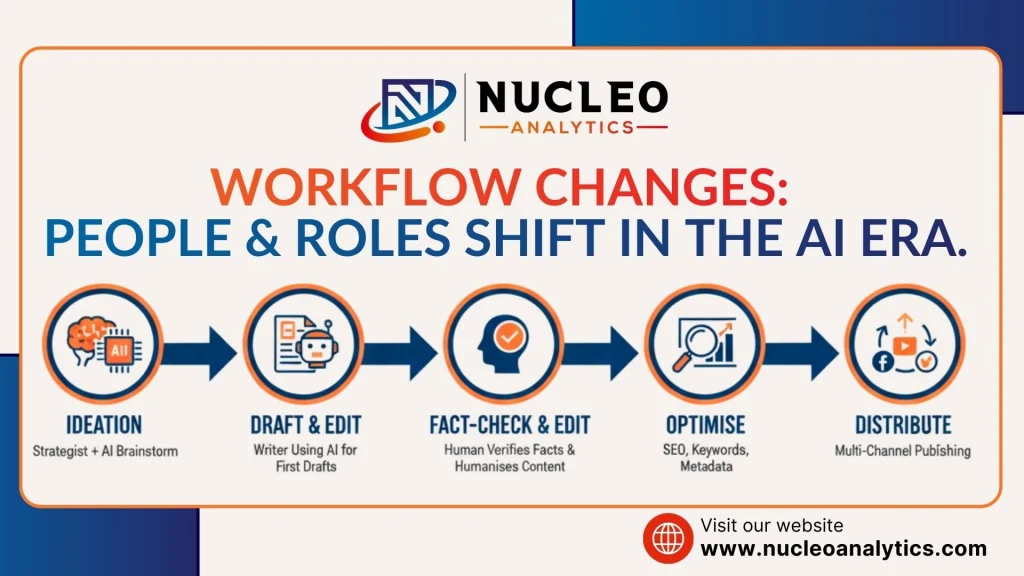
Build a human-in-the-loop workflow:
- Ideation: strategist + AI brainstorm
- Draft: writer uses AI to draft
- Fact-check & edit: human verifies and humanises
- Optimise: SEO + metadata
- Repackage: content ops repurposes
This workflow keeps speed but adds safety checks.
Authenticity and brand voice remain premium
Automated content marketing tends to lose the little quirks that make a brand human. Those quirks are trust currency. Keep them: a signature sign-off, recurring analogies, or a plain-spoken FAQ style. AI can mimic voice, but real lived experience is harder to fake.
Tactic: create a short brand voice doc with 6 examples of “do” and “don’t.” Feed it as context for every AI prompt.
Data and measurement in the AI era
You must measure different things now:
- Time to produce per asset
- Output quality score (editor rating)
- Engagement per asset type
- Content ROI (lead, MQL, revenue attribution)
AI also helps in measurement: topic clustering, content gap detection, and predicted performance scoring. Use predictions as guidance, not gospel.
Metric to add: “Content Accuracy Incidents” track how often a piece required a correction after publication. Keep it low.
Ethics, transparency, and legal stuff (don’t sleep on this)
AI throws up legal and ethical questions: copyrighted training data, deepfakes, and undisclosed AI use. Be transparent. If content used AI for drafting, state it where relevant (transparency builds trust).
Also, don’t claim research you didn’t do. If you summarise a study, link it. If you quote a person, get permission.
Policies: formalise an internal AI usage policy. It should cover:
- Who can use which tools
- Required review steps
- Data privacy
- Disclosure rules
This keeps legal and trust risk manageable.
Creativity and originality are where humans still win
AI is great at patterns and combinations. Humans are still far better at fresh, unexpected takes that come from lived experience or deep domain knowledge. Use AI for structure and repetition; humans for storytelling and real insight.
Practical exercise: run a weekly “weird idea” session, humans only, where the goal is deliberately odd angles. Then test the best ideas with AI to create rapid prototypes.
Pricing and resource allocation: How to budget for AI
AI changes the cost structure. You might spend less on drafting hours and more on tooling, validation, and training. Rebalance budgets:
- Tools & subscriptions
- Human validation (editing, expert review)
- Measurement & analytics
- Training and change management
Don’t cut editorial headcount just because you bought a tool. The wrong cuts worsen the quality.
Replicability and brand safety guardrails to set
Set guardrails in prompts and templates: banned phrases, mandatory citations, and rules AI must follow. Use templates to maintain quality and save time.
Example template rule: every “how-to” post must include a “What I tried” box and one real screenshot or link.
Guardrails help maintain brand safety at scale.
Quick Tactical Playbook (Actionable checklist you can use this week)
- Pick one pain point (e.g., lacking social snippets).
- Choose one AI tool and train 2 people on it.
- Create one long-form pillar piece and create 6 repurposed assets.
- Add a 3-step validation: facts, links, tone.
- Track time saved and engagement uplift for the campaign.
Small experiments beat big guesses.
What will content teams look like in 12–24 months?
Expect more hybrid roles. Content ops becomes central. Brand editors will manage human verification. Data people will sit closer to content teams. And experimentation becomes a daily habit, not a quarterly sprint.
The winners will be teams that move faster but stay curious and sceptical.
Don’t forget channels and distribution
AI is useful in content creation, but the muscle that counts is distribution. Create channel-specific formats: short videos on Reels/TikTok-like apps, carousels on LinkedIn, and your blog or newsletter.
Calculate channel-specific ROI, and do not think all channels are appropriate to all brands.
A couple of real-life examples (short and sharp)
- In one example, a SaaS company used AI to segment a technical whitepaper into eight social clips, leading to a 30% rise in demo conversions from social traffic.
- An e-commerce brand used AI to auto-generate product descriptions, but after human review and localisation, conversion rose because humans caught nuances the AI missed.
These aren’t fairy tales they’re the kinds of wins teams report when they do the human work too.
The Future: What to expect next
Expect AI to get better at combining multiformat content: write a script, get an edited video, and short captions. Search engines will keep evolving E-E-A-T, and human verification will rank higher. Regulation and platform rules will tighten, making transparency more important.
If you plan for adaptability, you’ll survive and win.
A quick word from Nucleo Analytics
We’ve been in the trenches with brands as they adapt to AI. At Nucleo Analytics, we focus on practical work: pairing human strategists with AI workflows that actually save time and improve results. We help teams set guardrails, create reproducible templates, and measure the real impact of content, not vanity metrics. Our goal is simple: help clients get more meaningful outcomes from content without losing authenticity.
Conclusion
The world of AI content marketing is a fast, messy, and opportunity-rich place. Use AI for scale, but keep humans on the helm. Measure everything. Add guardrails. Stay honest and useful. Do that, and you’ll get the speed without selling your brand’s soul. If you want help mapping a practical AI + human content playbook for your team, Nucleo Analytics can help you build it.
Want AI content that actually converts?
Frequently Asked Questions
Q1: What is AI content marketing?
Q2: Is AI content bad for SEO?
Q3: How can I personalize content with AI?
Q4: Should I inform users that AI was involved in the content creation process?
Q5: Which content types benefit most from AI?
Q6: How do I keep brand voice when using AI?
Q7: Can AI replace writers?
Related Posts
How Digital Marketing Accelerates Your Business Growth?
The synergy between evolving modern business infrastructure and technologies is revamping traditional marketing strategies with digital approaches. The transition is evident as the conventional marketing […]

Why Your B2B Strategy Needs These 5 AI-Friendly Content Types
It is more critical than ever to comprehend the significance of content marketing for business-to-business (B2B) organizations in the current digital environment. You’re missing out […]

What Is Content Decay and How To Fix It
With the rapid evolution in digital marketing, companies tend to put all their resources into producing quality content, but then again no content lasts forever. […]

What Services Do Digital Marketing Agencies Offer?
In today’s hyper-competitive digital era, traditional marketing strategies have evolved into the more targeted and dynamic realm of digital marketing. The materialization of the internet […]

How AI Is Reshaping the Future of Digital Marketing?
In the fast-paced world of digital marketing, marketers are always changing with the times to stay ahead of the competition. Among the most transformative technologies […]

Maximize Your Digital Strategy: How Nucleo Analytics Delivers 360° Marketing for Brand Success
In the digital era, a strong online presence is crucial. Companies that fail to use digital marketing will lag, while those who use data-driven tactics […]