









Email Marketing Optimization Metrics You Should Actually Be Tracking
Email marketing shows up in every marketing plan.
But the way it’s measured? That’s where things fall apart.
Dashboards look busy. Metrics climb. Reports get shared. Yet when it comes to real outcomes, qualified leads, conversions, and revenue, the impact often feels unclear. Not because email isn’t working, but because the wrong signals are being watched.
The majority of teams are engaged in shallow metrics that are easy to monitor and pleasant to report. In the meantime, the figures that truly display the user intention, purchasing activities, and consumer value in the long run are neglected. Optimization becomes guesswork that way.
To have email marketing that actually works, you must follow metrics with a story other than opens and clicks. Measures that relate campaigns to growth and decisions with results.
This guide cuts through the noise and focuses on the email marketing optimization metrics that actually matter.
Let’s break this down properly.
Why Email Marketing Metrics Get So Messy
Email platforms throw a lot of data at you. Open rates. Click rates. Bounce rates. Heat maps. Engagement scores. It feels productive to track all of it.
But more data doesn’t equal more clarity.
Most email reports fail because they answer the wrong questions. They show activity, not impact. They tell you what happened inside the inbox, but not what happened after.
And that’s where optimization falls apart.
In order to use email marketing to assist with SEO, content marketing, lead generation, or sales, your metrics should align with those objectives. Otherwise, you are simply sending emails for the sake of sending emails.
Open Rate: Useful, But Not the Star of the Show
Open rate is usually the first metric people look at. Sometimes the only one. And yes, it still matters. But not in the way most people think.
An open rate tells you:
- Whether your subject lines are doing their job
- If your sender name feels trustworthy
- If your list is relatively healthy
What it does not tell you:
- Whether people cared about the email
- Whether they took action
- Whether the email made you any money
Apple Mail Privacy Protection and similar changes have also made open rates less reliable. Some opens are real. Some are automated. Some are… who knows.
Still, don’t ignore it. Just don’t worship it.
If your open rates suddenly drop, something is wrong. If they’re stable, move on and look deeper.
Click-Through Rate: Where Interest Actually Shows Up
It is at this point where things begin to get real.
The click-through rate indicates that people were interested in your content and took an action. It makes one number that relates to your email copy, design, CTA, and relevance.
A healthy CTR usually means:
- Your message matched the audience
- Your content delivered on the subject line
- Your CTA was clear and visible
Low CTR often points to:
- Weak or confusing CTAs
- Too many links are competing for attention
- Good content that did not work in practice.
CTR is essential in case you are dealing with an SEO agency or controlling inbound traffic. This measure will tell you that email is either supporting your content ecosystem or it is not being opened at all.
Want help improving CTR across campaigns?
Nucleo Analytics focuses on performance, not surface-level metrics.
Click-to-Open Rate: The Quietly Powerful Metric
This one gets overlooked, and that’s a mistake.
Click-to-open rate measures how many people clicked after opening your email. It removes subject line performance from the equation and focuses purely on content.
This is gold for optimization.
A low open rate but high CTOR means:
- Subject lines need work
- Content is solid
A high open rate but low CTOR means:
- Subject lines are overpromising
- Content isn’t delivering
When you are testing layouts, messaging or CTA placement, CTOR gives you the real resonating information. It comes in particularly handy on occasions when you are conducting A/B tests and do not want subject lines to bias your findings.
Conversion Rate: The Metric That Pays the Bills
This is where email marketing stops being a “nice to have” and becomes a revenue channel.
Conversion rate tracks how many recipients completed a desired action after clicking. That action could be:
- Filling out a form
- Downloading a resource
- Booking a demo
- Making a purchase
Clicks are good. Conversions are better.
If your conversion rate is low, the problem usually isn’t the email itself. It’s what happens after the click. Landing pages, load speed, messaging mismatch, or friction in the form.
This is where email marketing optimization overlaps heavily with CRO, SEO, and UX. A good SEO agency understands that email traffic should convert just like organic traffic does.
If it doesn’t, something is broken downstream.
Bounce Rate: A Silent List Killer
Bounces don’t get enough attention until it’s too late.
Hard bounces occur when an email address is not in existence. Soft bounces occur when the inboxes are full or when servers are non-coercive towards receiving your message.
High bounce rates:
- Hurt deliverability
- Signal poor list hygiene
- Increase the risk of spam filtering
If you’re still emailing old lists, scraped data, or unverified contacts, bounce rate will quietly ruin your campaigns before you notice anything else.
Clean your list. Regularly. Always.
Unsubscribe Rate: Feedback You Shouldn’t Ignore
People hate seeing unsubscribes. They feel personal. They’re not.
A small, steady unsubscribe rate is normal. In fact, it’s healthy. It means people who aren’t a fit are removing themselves instead of ignoring or marking you as spam.
What matters is why people unsubscribe.
Spikes in unsubscribe rates often come from:
- Sending too frequently
- Content that drifted from the original promise
- Overly salesy messaging
Instead of panicking, look at the emails that caused the spike. There’s always a lesson hiding there.
Spam Complaint Rate: The Line You Don’t Want to Cross
This is one metric you absolutely cannot ignore.
Even a small number of spam complaints can damage your sender’s reputation. Email providers don’t care how good your content is if users keep flagging it.
If spam complaints increase, ask yourself:
- Did people actually opt in?
- Are expectations clear?
- Is your content relevant to this segment?
Email marketing works best when permission and relevance are respected. Everything else is noise.
Engagement Over Time: The Long Game Metric
Single-campaign metrics are useful, but trends tell the real story.
Track:
- Engagement over 30, 60, 90 days
- Active vs inactive subscribers
- Click behavior by segment
If engagement steadily declines, it’s not a fluke. It’s a signal. Either your list has gone stale, or your content has.
Many SEO agencies and digital marketing teams forget this and keep blasting the same list with the same message. That’s not a strategy. That’s laziness.
Re-engagement campaigns exist for a reason. Use them.
Revenue Per Email: The Metric Executives Actually Care About
If you want buy-in from leadership, this is the number that matters.
Revenue per email connects effort to outcome. It answers one simple question: was this campaign worth it?
This measure is particularly relevant to e-commerce, SaaS and service-based companies that operate lead nurture sequences.
Although the emphasis of brand-building campaigns is placed on tracking the revenue impact, budgets and enhancements can be justified.
List Growth Rate: Growth Without Quality Is Useless
Growing your email list feels good. Until engagement drops.
List growth rate should always be paired with engagement metrics. If your list grows but opens and clicks fall, you’re attracting the wrong people.
SEO agencies often drive email signups through content. That’s great. But if the content attracts low-intent users, email performance will suffer.
Quality beats quantity every time.
Attribution: Email’s Role in the Bigger Picture
Assisted Conversions and Attribution
Email rarely works alone.
Someone might:
- Read a blog via organic search
- Sign up for emails
- Click a newsletter weeks later
- Convert after a retargeting ad
If you only credit the last click, email looks weaker than it is.
Use attribution models that demonstrate how email helps in conversions. This is the convergence point of email marketing, SEO, paid media and content strategy.
Need clarity across channels, not just email?
Nucleo Analytics helps brands understand what’s actually driving growth.
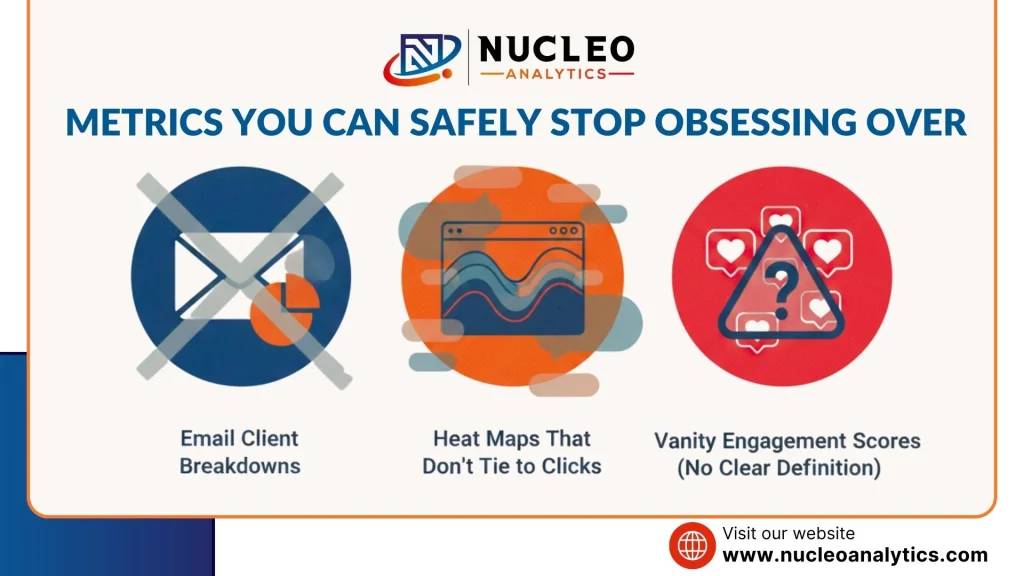
Metrics You Can Safely Stop Obsessing Over
Let’s be blunt.
You don’t need to panic over:
- Email client breakdowns
- Heat maps that don’t tie to clicks
- Vanity engagement scores with no definition
If a metric doesn’t inform a decision, it’s just decoration.
How to Actually Optimize Using These Metrics
Tracking metrics is easy. Using them well is harder.
A few rules that work:
- Optimize one variable at a time
- Tie every test to a metric that matters
- Look for patterns, not isolated wins
- Always connect email data to business outcomes
Email marketing optimization is less about clever copy and more about disciplined analysis. That’s why SEO agencies with strong analytics foundations consistently outperform those chasing trends.
Final Thoughts: Email Is Still a Power Channel
Email marketing isn’t flashy. It’s not viral. It doesn’t come with instant gratification.
But when you track the right metrics and optimize with intention, it quietly becomes one of the highest ROI channels you have.
Not because of hacks.
Not because of tricks.
But because it respects the audience and measures what actually matters.
If your current email reports feel busy but not useful, that’s your cue. Strip it back. Focus on metrics tied to growth. Everything else can wait.
Ready to turn email data into real results?
Work with Nucleo Analytics, a performance-focused SEO agency that cares about outcomes, not dashboards.
Frequently Asked Questions
Q1: What is the most important email marketing metric to track?
Q2: Are open rates still reliable in email marketing?
Q3: How does email marketing support SEO efforts?
Q4: How often should email marketing metrics be reviewed?
Q5: Can an SEO agency help with email marketing optimization?
Related Posts

Instagram & TikTok SEO: How to Make Your Content Discoverable
When you’ve spent hours crafting what you envisioned as the ultimate Reel or TikTok just to have it flop with barely a few views, you […]

How to Plan an App Store Optimization Strategy?
App store success is the result of coordinated work across product, marketing, and analytics. This is not guesswork: it’s research, prioritized experiments, and continuous measurement. […]

Why Your B2B Strategy Needs These 5 AI-Friendly Content Types
It is more critical than ever to comprehend the significance of content marketing for business-to-business (B2B) organizations in the current digital environment. You’re missing out […]

8 Types of Digital Marketing Explained with Pro Tips (2026)
Digital marketing in 2026 is not about doing more. It’s about doing the right things with clarity. Most businesses don’t fail because digital marketing doesn’t […]

How to Rank for Voice Search Queries Using Google SEO
Voice search has become the present-day scenario rather than being a futuristic concept. It is already influencing the method of information acquisition by people over […]

How Content Marketing Trends Are Evolving in the AI Era?
The evolution of content marketing is quite rapid, and AI tools are not just limited to experimental use anymore; they are already incorporated into the […]