









Best Digital Marketing Strategies for Small Businesses
Most small businesses don’t fail because they lack effort. They fail because their marketing is scattered. A bit of SEO here, a few ads there, some social posts when there’s time. Nothing connects. Nothing compounds.
That’s why focusing on the right digital marketing strategies matters more than ever. A strategy is not just a channel. It’s a repeatable way to attract, convert, and retain customers.
In this blog, we’ll not simply tell you to invest in SEO or just post on social media; you probably already know that. We’re breaking down how to use these things in a way that actually brings results.
Intent-Based SEO Strategy
Most small businesses approach SEO by picking keywords and creating pages around them. The method succeeds on some occasions, but it fails to address the main objective, which is understanding user intent.
People who create content should focus on solving actual problems instead of pursuing specific keywords. This is where effective digital marketing strategies for small businesses demonstrate their greatest strength. They focus on matching content with real user needs, not just search terms.
For example, someone searching “best CRM for small business” is not looking for a definition. They want comparisons. If your page doesn’t match that, it won’t rank well or convert.
Here’s how to execute this properly:
- Group keywords by intent (informational, comparison, buying)
- Create separate pages for each intent type
- Study top-ranking pages before writing content
- Answer the main query within the first few lines
The importance of this matter increases for organizations that operate in the business-to-business sector. B2B SEO strategies need long-form content, case studies, and thorough content explanation because decision-makers require time to reach their final decisions.
Create Offer-Driven Landing Pages
A lot of businesses drive traffic to their homepage and expect conversions. That rarely works. People don’t convert because your homepage exists. They convert because they see a clear offer.
This strategy is simple but powerful: every campaign should lead to a dedicated landing page with one goal.
Instead of saying “contact us,” give users a reason to act now. This could be a free audit, consultation, or limited-time deal. Strong offers make decision-making easier.
To make this work:
- Use one clear headline that explains the benefit
- Keep the page focused on one action only
- Add proof (testimonials, results, numbers)
- Reduce distractions like unnecessary links
This is one of the most practical lead generation ideas for businesses, and it works across almost every industry.
Struggling to Turn Your Traffic into Actual Leads and Sales?
Build Local Authority Through Your Content
The value of local authority development for service-based small businesses exceeds the benefits of international ranking efforts.
The strategy aims to achieve complete control over local search results by developing content that matches the specific needs of your community. The system achieves optimal performance through its combination with local SEO because it establishes both relevance and trustworthiness for search engines.
The content should not include generic information; instead, you should find out what people in your area search for. The study covers three types of searches, which include location-based inquiries, service comparisons, and local area guides.
Execution looks like this:
- Create pages targeting specific cities or neighborhoods
- Write blogs answering local-specific questions
- Highlight case studies from nearby clients
- Keep your Google Business Profile active and updated
Over time, this builds strong visibility in your local market, which is often enough to sustain steady growth.
Create a Paid Ads Funnel
Running ads without a funnel brings businesses to their fastest point of financial loss. The majority of businesses focus on obtaining clicks while they fail to consider what occurs after users click their advertisements.
A better approach is to build a simple funnel:
Ad → Landing Page → Follow-Up → Conversion
The structure helps you achieve two objectives because it directs users toward making decisions while you generate website traffic.
Modern platforms use smart bidding strategies to optimize campaigns automatically, but these systems depend heavily on your funnel quality. The weak landing page structure prevents any bidding strategy from achieving success.
To improve results:
- Match ad copy with landing page messaging
- Use retargeting to bring back visitors
- Track conversions properly from day one
- Test small changes before scaling budgets
This approach turns paid ads from an expense into a system.
Repurpose Your Existing Content
The ongoing need for new content development proves to be an exhausting task. Small businesses lack both the necessary resources and available time to complete such work.
The process of content repurposing establishes itself as a highly effective digital marketing technique. You can use your existing materials to create new content instead of starting from nothing.
The content from a single blog post can be transformed into different forms of material, which can be used on various platforms.
Here’s how to do it:
- Turn blogs into short social media posts
- Convert key points into videos or reels
- Use FAQs as email content
- Break long content into smaller insights
This approach saves time while increasing reach, without constantly starting from zero.
Trust-Based Social Media Strategy
Businesses use social media as their advertising platform which they treat like a permanent billboard. The companies follow this cycle of posting and advertising their content, which they repeat. They build trust through this method, according to the evidence.
Businesses should establish their market presence through ongoing brand development and building customer relationships with their audience. People don’t follow brands just for offers. They follow brands they recognize and feel connected to.
The process of effective social media marketing requires businesses to create useful or interesting content while maintaining regular posting schedules.
To make this work:
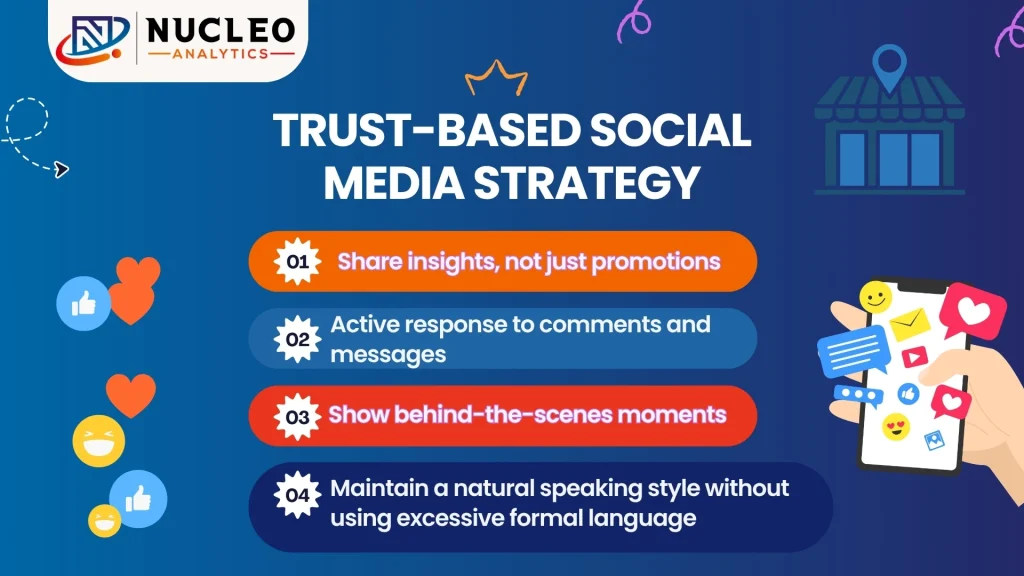
- Share insights, not just promotions
- Active response to comments and messages
- Show behind-the-scenes moments
- Maintain a natural speaking style without using excessive formal language
If your company needs to expand, you should partner with a social media advertising agency because they will help you reach a bigger audience while your business requires authentic content.
Email Nurture Sequence Strategy
Most leads don’t convert immediately. They need time, reminders, and trust.
Instead of sending random emails, build a structured sequence that gradually moves leads toward a decision. The marketing strategy serves as an effective yet commonly underappreciated method that small businesses use to advertise their products.
A simple email sequence could include:
- A welcome email explaining your offer
- Educational content that builds trust
- Case studies or success stories
- A final call-to-action email
This keeps your business in front of potential customers without being pushy.
Market Expansion Strategy (Local to Global)
Businesses begin their development process through local expansion, but they eventually extend their operations to international markets. The process of expansion requires businesses to change their current marketing strategies.
Local marketing methods focus on reaching customers who live near the business. In contrast, international businesses must develop methods to serve diverse customer groups who display different digital shopping and online searching patterns.
The need for international SEO reaches its peak at this point. Translating content requires more than direct translation because it needs to become suitable for various international customer bases.
To approach this correctly:
- Start with one new market at a time
- Adapt messaging for local culture
- Research region-specific keywords
- Build local backlinks gradually
Scaling too fast without understanding the market usually leads to poor results.
How Nucleo Analytics Helps You Build Real Marketing Systems
Most small businesses don’t struggle because they lack effort. They struggle because everything feels disconnected. SEO is handled separately, ads are run without a clear funnel, and content is created without a defined goal. The result is activity, but not growth.
At Nucleo Analytics, we don’t look at marketing as isolated tasks. We build complete systems where every part supports the other. Our focus is simple — create a structured approach that consistently brings in qualified leads, not just traffic.
We begin our process by getting complete knowledge of your business operations. The process requires us to study your market sector, evaluate customer behavior, assess your value propositions, and determine your current brand engagement methods. This method enables us to pinpoint the specific points where operations are failing. In many cases, the issue is not visibility, but conversion. In others, it’s targeting or messaging.
Once we have clarity, we build a system around it. That includes:
- SEO strategies focused on user intent and long-term growth
- Paid ad funnels that are designed to convert, not just generate clicks
- Landing pages built specifically to capture and qualify leads
- Content that supports both visibility and trust across channels
What really makes the difference is how we approach optimization. We don’t just set things up and move on. We track performance closely, test variations, and refine campaigns based on real data. Every improvement is intentional and tied to results.
We’re not here to run campaigns for the sake of activity. We build systems that scale with your business. That’s how we turn inconsistent results into predictable growth.
Conclusion
Marketers have access to numerous digital marketing strategies, but most recommendations remain superficial. Many small businesses experience ongoing experimentation because they fail to achieve stable outcomes.
The actual path to business expansion requires organizations to complete the essential activities in their correct sequence until they achieve success. Digital marketing success comes from structured systems that continue to evolve through testing and development.
The main point you should take away from this material is that you should make your process more straightforward. Create a few operational strategies that you will implement and then measure their actual performance. The point at which you achieve actual development.
People who want to accelerate their pace should collaborate with teams that possess both strategic and operational knowledge. Your marketing system functions as a complete framework that delivers stable performance results. That’s when growth becomes consistent.
Ready to Build a Marketing System That Drives Consistent Growth?
Frequently Asked Questions
What are the most effective digital marketing strategies for small businesses today?
How long does it take to see results from digital marketing?
Should small businesses invest in SEO or paid advertising first?
Why do many small businesses struggle with digital marketing results?
Related Posts

10 Red Flags Clients Should Watch Out for in a Digital Marketing Agency
In the latest, fast-paced, virtual global environment, corporations mainly depend on being online to attract interactions, build trust, and boost income. But with so many […]

Master Keyword Competition Analysis with This Simple Guide
In today’s fast-paced era of online marketing, mere posting of content does not suffice. You may possess phenomenal products or services, but unless your website […]
The Rise of the LLM in Digital Marketing
Digital marketing did not change overnight. It crept up in small, uncomfortable ways. One week, it was new tools for writing ads faster. The next […]
What Is Content Decay and How To Fix It
With the rapid evolution in digital marketing, companies tend to put all their resources into producing quality content, but then again no content lasts forever. […]
Benefits of White Label Digital Marketing Services
Growing a digital agency sounds exciting, until it isn’t. At first, things move fast. New clients come in. Revenue climbs. You’re saying yes to everything. […]
8 Key Strategies Businesses Should Keep an Eye On
Did you know that 97% of marketers think their business has success with content marketing? Content marketing is no longer a necessary strategy for businesses. […]