The foundational architecture of digital discovery is undergoing an irreversible transition. For nearly three decades, looking up information online meant typing fragmented phrases into a blank box and scanning a list of blue links.
The foundational architecture of digital discovery is undergoing an irreversible transition. For nearly three decades, looking up information online meant typing fragmented phrases into a blank box and scanning a list of blue links.
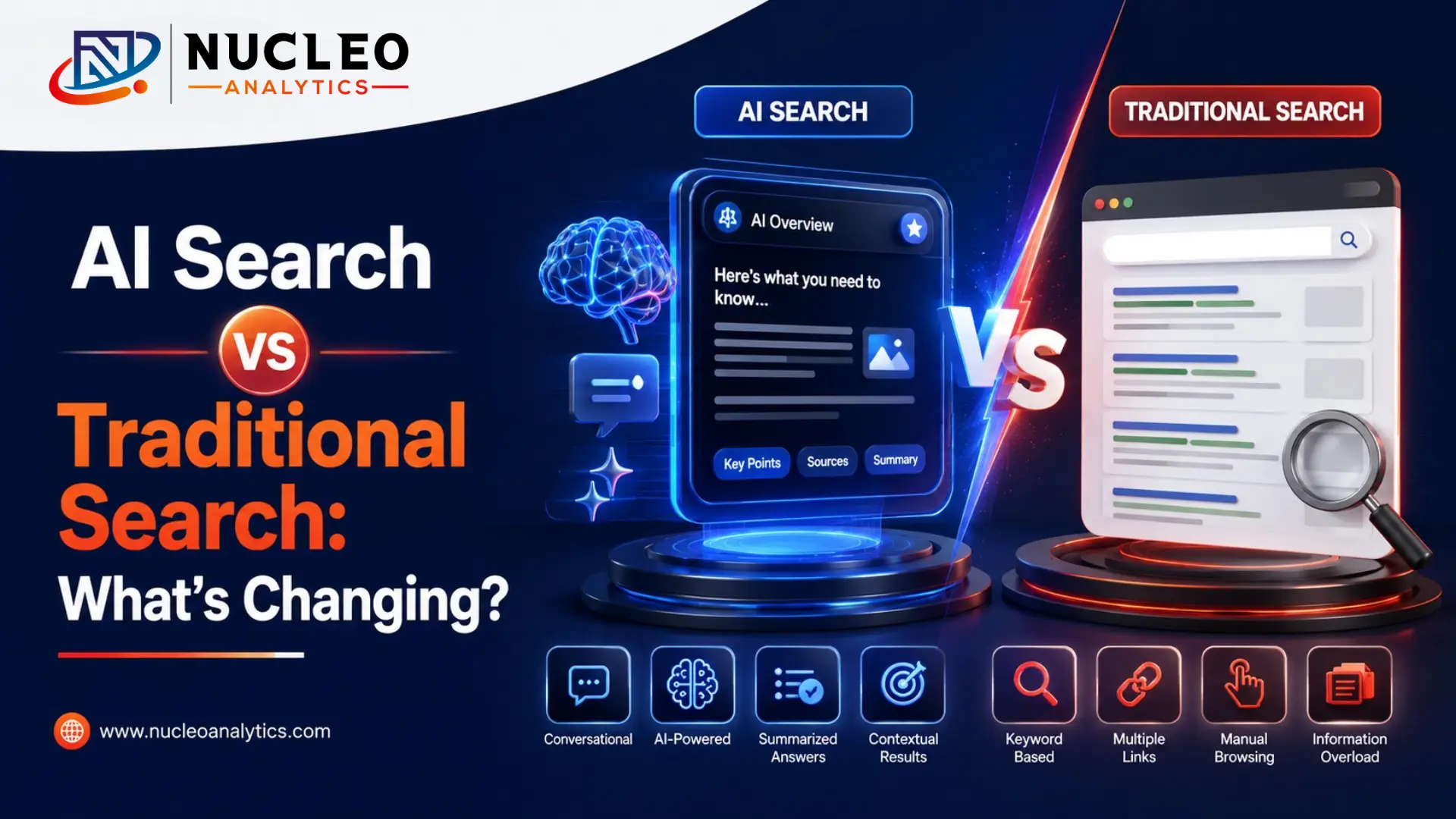
Today, that behavior is being replaced by computational engines that synthesize answers in real time. This profound shift between AI search vs traditional search alters how websites attract, engage, and convert audiences.
Recent industry studies confirm this massive behavioral realignment. The average AI search visitor is worth 4.4 times more than a traditional organic search visitor from a conversion perspective.
Additionally, tracking indicates that 37% of consumers now start their informational inquiries directly with AI tools instead of conventional directories. This changing baseline requires businesses to completely rewrite their visibility playbooks.
How to Distinguish: Difference Between AI Search and Google Search
To navigate this changing landscape, you must understand the exact technological mechanics that separate conversational synthesis from classic index retrieval. The user experience may seem similar, but the backend operations are completely different.
The primary difference between AI search and Google search lies in the transition from index mapping to semantic intent decoding. Classic search uses specialized crawlers to build an inverted text catalog of the web.
When you type a query into a traditional engine, an algorithm checks its index for exact keyword matches, evaluates backlink authority, and lists the URLs it determines are most relevant to those words.
Conversely, generative engines do not simply point you to a page that contains your keywords. They break down your prompt, analyze the user intent behind it, pull data from multiple web nodes, and generate a customized text response.
- Traditional search acts as a directional directory pointing to external documents.
- Generative search functions as an automated research assistant that reads the web for you.
- Classic inputs rely on short keyword fragments like "best project management tool."
- Modern inputs utilize long, multi-layered paragraphs detailing specific business constraints.
Understanding this technical variance helps you see why standard content optimization is losing efficiency. When an engine synthesizes an entire answer on its own screen, the purpose of a web page changes from generating direct clicks to serving as verified training data.
Technical Mapping: Comparing the Two Frameworks
Because these systems handle data differently, we can map their operational characteristics across key performance areas. This structural breakdown highlights how visibility paths are diverging.
The following data table outlines how information processing, result formatting, and success metrics differ between the two major systems.
Operational Criteria | Traditional Search Engines | Generative AI Search |
Data Processing | Matches keywords against a static database index. | Tokenizes text and maps concepts into vector spaces. |
Output Format | Delivers pages of ranked, clickable external links. | Generates a mirrored text summary with selective references. |
Query Structure | Short, disjointed keyword fragments (3-4 words). | Long, natural language conversational prompts (10+ words). |
Success Metric | Focuses on SERP ranking position and raw click-through rate. | Focuses on citation frequency and source inclusion. |
User Journey | Requires users to open multiple tabs to gather facts. | Delivers complete answers directly within the interface. |
Is Your Site Code Stuck in the Traditional Link Era?
How to Contrast: AI Search vs SEO
This technical divergence changes how marketing teams must approach digital visibility. Attempting to apply legacy traffic acquisition playbooks to automated synthesis blocks will yield diminishing returns.
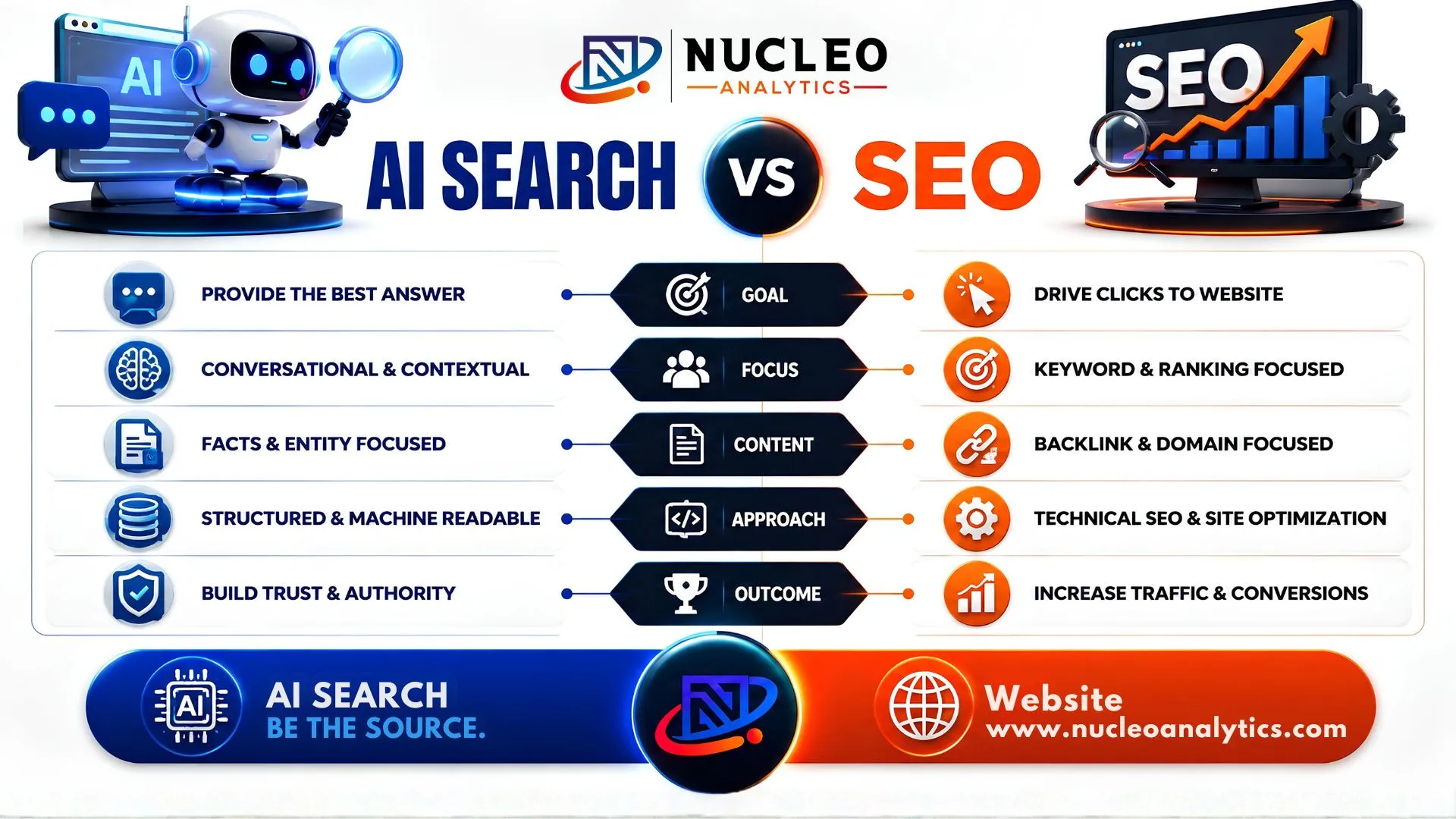
Analyzing AI search vs SEO reveals a fundamental shift in how content authority is measured. Classic technical optimization focuses on keyword frequency, technical site health, internal link distribution, and domain backlink profiles.
The goal of classic optimization is to convince a search bot that your specific URL is the single best destination for a specific phrase, driving maximum raw click traffic back to your landing pages.
- Classic optimization prioritizes high search volume keywords to scale raw impressions.
- Conversational optimization values clear entity definitions and absolute fact density.
- Standard technical setups focus heavily on crawl budget and code optimization.
- Modern setups focus on making data structures easy for language models to extract.
In conversational systems, AI search engines evaluate your content based on explanation clarity, factual accuracy, and topic completeness. These models scan the web to find consistent answers that answer a prompt directly.
As a result, your optimization metrics must evolve. Instead of obsessing over keyword ranks, your team must track your brand’s citation frequency, inclusion share, and recommendations within automated summaries.
How to Adapt: How AI Search is Changing Search Engines
The introduction of machine learning into consumer discovery platforms is completely reshaping user expectations. Consumers no longer have the patience to sift through sponsored advertisements and thin affiliate blogs.
Observing how AI search is changing search engines shows that user sessions are moving from quick, single-interaction actions to deep, multi-step conversations. Users expect the system to maintain contextual memory across a session.
When a consumer searches for a solution today, they expect the engine to remember constraints mentioned five prompts ago. This conversational continuity changes the required layout of your web pages.
- Users frequently ask follow-up questions to narrow down broad options.
- Multi-modal interactions involving images and voice notes are rising rapidly.
- Informational search queries are growing longer and more conditional.
- Search interfaces are embedding direct action buttons like booking or purchasing tools.
Because modern AI search engines can handle highly complex prompts, your articles must abandon generic introductions and vague storytelling. You must structure your pages so bots can extract answers instantly.
When you understand how AI search is changing search engines, you stop writing for superficial keyword counts. You begin engineering highly structured informational hubs that serve as undeniable sources of truth for algorithms to safeguard the future of search.
Structural Content Engineering for Machine Visibility
Securing consistent citations in conversational answer blocks requires changing how your editorial team drafts text. You must align your writing style with the extraction habits of modern retrieval bots.
Large language models prioritize text blocks that deliver maximum informational density with zero structural fluff. Your content layouts must use an answer-first approach to remain competitive in the future of search.
- Position a precise 40-word summary directly below your section headers.
- Use clean Markdown tables to present comparative technical specifications.
- Frame your secondary headers as specific, natural language user questions.
- Ensure your subject-verb-object sentence structures remain direct and clean.
This disciplined approach ensures that when an automated crawler analyzes your page, it can parse your conclusions without consuming excessive computational budget. Clean layouts translate directly into higher citation rates.
Aligning Brand Footprints Across the Digital Ecosystem
Conversational engines do not evaluate your business based solely on your corporate website. They cross-reference information across hundreds of independent external nodes to verify your market authority.
To win recommendations when users ask for product suggestions, your brand must maintain a highly consistent narrative across the entire web. Contradicting facts across profiles will trigger algorithmic distrust.
- Monitor and optimize your brand mentions on public discussion forums.
- Secure authoritative references in specialized, vertical-specific media outlets.
- Keep your product catalogs accurately structured on trusted industry registries.
- Publish unique, primary research data that external sites frequently reference.
When retrieval models find matching descriptions of your expertise across multiple external platforms, their confidence in your brand increases. This widespread authority ensures your business is prioritized during the automated synthesis phase.
Strategic Navigation with Nucleo Analytics
Transitioning your digital assets to thrive across this dual-path discovery environment requires deep technical expertise. At Nucleo Analytics, we specialize in re-engineering enterprise web architectures to satisfy both classic indexers and conversational engines.
Our data optimization teams build advanced content systems that align perfectly with modern retrieval patterns. At Nucleo Analytics, we focus on eliminating technical code bottlenecks, maximizing concept density, and implementing advanced schema integrations.
We help your organization construct highly citable knowledge hubs that automated systems trust and reference. Partnering with Nucleo Analytics ensures your enterprise maintains a dominant share of voice across the entire conversational landscape.
Don't Let the Search Evolution Phase Out Your Brand
Conclusion
The ongoing transition of the global media landscape highlights the critical nature of modern digital transformation. Embracing a comprehensive framework for AI search vs traditional search is no longer an optional project for forward-thinking enterprises.
As the industry experiences this rapid search engine evolution, the businesses that rely strictly on legacy keyword practices will find themselves completely cut off from modern buyer consideration sets.
By structuring your content for clear machine extraction while protecting your foundational domain authority today, you ensure your business remains the definitive answer through every stage of this generational search engine evolution.