








How Long Does SEO Take to Show Results?
A lot of businesses start SEO expecting magic in 30 days. That’s usually where frustration begins.
Someone hires an SEO agency, publishes a few blogs, fixes some website pages, and then waits for leads to flood in. A month passes. Nothing major happens. Then comes the question every business owner eventually asks:
“How long is this supposed to take?”
Fair question, honestly.
The problem is, SEO isn’t paid advertising. It’s not like running ads and seeing clicks the same day. Search engine optimization works more slowly because Google needs time to trust your website, understand your content, evaluate competition, and decide whether your business deserves visibility.
And if we’re being real… most websites are starting from behind anyway.
Many websites have technical issues. Others struggle with weak content. Some have never done local SEO properly. Others have terrible site structures or outdated designs that hurt rankings before SEO even begins.
That’s why timelines vary.
But SEO does work when it’s done correctly. The businesses that stay patient usually end up winning long-term because organic traffic compounds over time. One solid page can bring leads for years.
Let’s break this down properly.
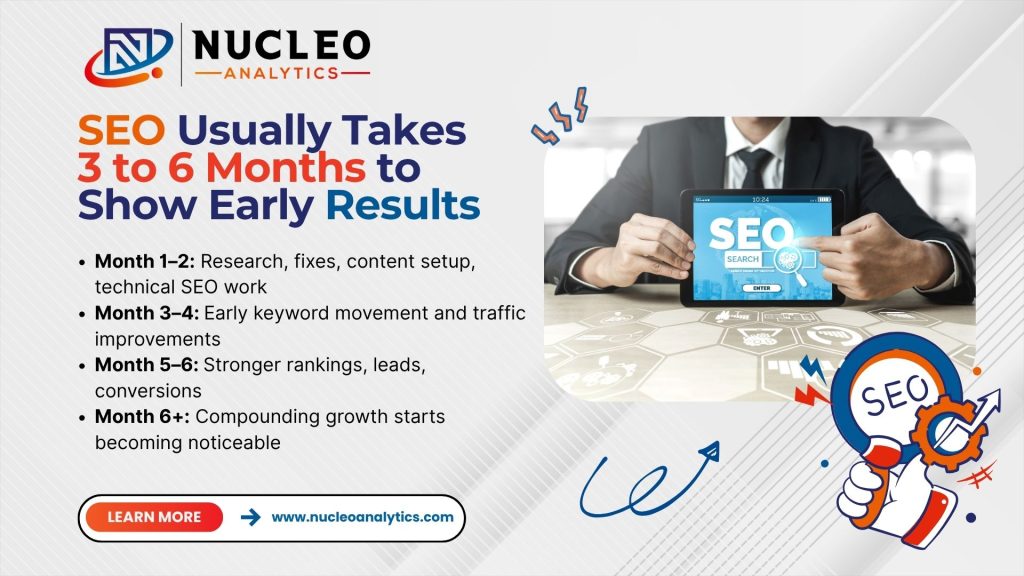
The Short Answer: SEO Usually Takes 3 to 6 Months to Show Early Results
That’s the realistic range for most businesses.
Not overnight. Not two weeks.
Usually:
- Month 1–2: Research, fixes, content setup, technical SEO work
- Month 3–4: Early keyword movement and traffic improvements
- Month 5–6: Stronger rankings, leads, conversions
- Month 6+: Compounding growth starts becoming noticeable
Now obviously this depends on competition, website condition, industry, location, and budget.
A local plumbing company targeting a smaller city will rank faster than a national e-commerce SEO campaign competing against massive brands.
Huge difference there.
Still, SEO is one of the few marketing channels where results continue growing without paying for every click forever.
That’s why businesses still invest heavily in SEO services for small businesses, technical SEO, and local optimization.
Why SEO Takes Time in the First Place
Google doesn’t trust websites instantly.
Think about it like hiring someone for an important job. You wouldn’t trust them after one conversation. You’d look at consistency, reputation, experience, and reliability first.
Search engines work similarly.
Google evaluates things like:
- Website quality
- Technical performance
- Content depth
- User behavior
- Backlinks
- Local signals
- Website structure
- Mobile experience
- Authority within the niche
That process takes time.
Especially now.
SEO used to be easier years ago. You could stuff keywords everywhere and rank somehow. That doesn’t work anymore. Modern SEO is far more connected to user experience, trust, and relevance.
A good SEO company for startups understands this. The goal isn’t just rankings. It’s sustainable visibility that actually converts into business.
Your Website’s starting point changes everything.
Some businesses already have a decent foundation.
Others… honestly don’t.
If a website has:
- Slow loading speed
- Broken pages
- Poor mobile design
- Thin content
- Zero local optimization
- Weak technical SEO
- No backlinks
- Bad navigation
Then SEO starts with repairs first.
Local SEO Usually Shows Results Faster
This is important for small businesses. Local SEO often works more quickly than national SEO campaigns because competition is narrower geographically.
For example:
A bakery in Dallas only competes locally. An e-commerce brand selling skincare nationally competes with thousands of websites across the country.
Big difference.
That’s why local SEO services for small businesses are often one of the smartest investments for service-based businesses.
Things like:
- Google Business Profile optimization
- Local citations
- Customer reviews
- Location pages
- Local keyword targeting
- Maps optimization
Especially when paired with a proper local SEO checklist.
A Simple Local SEO Checklist That Actually Matters
Some businesses overcomplicate local SEO. The basics still matter most.
Here’s what should be handled first:
Fully Optimize Your Google Business Profile
This alone impacts visibility heavily.
Include:
- Accurate business information
- Service categories
- Updated hours
- Real photos
- Business description
- Service areas
- Products/services
- Regular posts
Incomplete profiles hurt rankings.
Build Location-Specific Pages
If you serve multiple cities, create pages for those areas naturally. Not spammy pages stuffed with city names. Real helpful pages.
Get Reviews Consistently
Reviews matter more than many businesses realize. They impact:
- Trust
- Local rankings
- Conversion rates
And yes, Google notices review activity.
Improve Website Speed
A slow website damages both SEO and conversions. People leave fast-loading competitors more quickly than ever now.
Add Local Keywords Naturally
Use phrases naturally, like:
- local SEO services for small businesses
- best SEO agency for local businesses
- SEO agency near me
- digital marketing agency for small business
Don’t force them awkwardly.
Google understands context better now.
Technical SEO Often Delays Results If Ignored
A lot of websites struggle because technical SEO gets ignored. Content alone isn’t enough anymore. You can write amazing blogs, but if your site structure is broken, rankings may stall.
Technical SEO includes:
- Crawlability
- Site speed
- Core Web Vitals
- Mobile optimization
- Indexing issues
- Structured data
- URL structure
- Internal linking
- Redirect management
This stuff matters. Good SEO agencies usually audit technical issues first because it directly affects search performance.
B2B SEO Campaigns Usually Take Longer
B2B SEO campaigns often require more patience.
Why?
Because:
- Search volumes are lower
- Decision cycles are longer
- Competition is tougher
- Buyers research more carefully
A B2B SEO campaign targeting enterprise clients may take 6–12 months before producing major lead flow.
Still worth it though. One qualified B2B lead can be worth thousands. That’s why long-term SEO becomes valuable for SaaS companies, consultants, agencies, manufacturers, and professional services.
E-commerce SEO Can Be Even More Competitive
E-commerce SEO is its own beast, honestly. Ranking product pages takes serious effort now.
You’re competing against:
- Amazon
- Walmart
- Big retailers
- Established e-commerce brands
And product SEO requires:
- Category optimization
- Product descriptions
- Technical SEO
- Structured data
- Internal linking
- Content marketing
- Page speed improvements
SEO timelines for e-commerce websites often stretch longer because competition is brutal in many niches.
Still, when e-commerce SEO works, the traffic potential becomes huge.
Content Quality Affects SEO Speed More Than People Think
Thin AI-generated blogs aren’t helping much anymore.
Google’s becoming smarter at identifying shallow content.
Businesses that publish genuinely useful content usually perform better long-term.
That means:
- Real expertise
- Clear explanations
- Helpful structure
- Proper keyword usage
- Strong readability
- Useful examples
Not robotic keyword stuffing.
A good SEO company for startups focuses heavily on quality because poor content slows everything down.
Backlinks Still Matter.
People love pretending backlinks don’t matter anymore. They absolutely do. Google still uses links as trust signals.
If respected websites mention your business, search engines see that as credibility. Now, obviously, buying spammy links is risky.
But:
- PR mentions
- Guest content
- Industry citations
- Local directories
- Useful resources
Websites with stronger backlink profiles generally rank faster.
SEO Results Happen in Stages
This part confuses businesses sometimes. SEO growth usually doesn’t happen all at once.
It happens gradually.
Stage 1: Indexing & Technical Cleanup
Google starts understanding your site better. This includes:
- Crawling pages
- Processing changes
- Fixing technical issues
Not very visible yet.
Stage 2: Keyword Movement
You’ll start noticing:
- Rankings climbing slowly
- Some impressions increasing
- Small traffic bumps
This stage feels encouraging.
Stage 3: Traffic Growth
Now pages begin ranking consistently, getting more clicks, and gaining more visibility. Usually where businesses finally feel momentum.
Stage 4: Lead Generation & Conversion Growth
This is where SEO becomes valuable financially.
Traffic alone means nothing if conversions stay weak.
Good SEO should eventually generate:
- Calls
- Form submissions
- Purchases
- Consultations
- Local visits
Want Real SEO Growth Instead of Random Traffic?
SEO Works Better Alongside Other Marketing Efforts
Instead of working in isolation, SEO delivers the best results when combined with
- Content marketing
- Website optimization
- Social media
- PPC campaigns
- Email marketing
- Conversion optimization
That’s why many businesses outsource digital marketing services entirely instead of managing disconnected freelancers separately. A strong digital marketing agency for small businesses creates systems that support each other.
- SEO brings visibility.
- Website design improves conversions.
- Content builds authority.
- Paid ads support short-term traffic while SEO grows.
Everything connects.
Website Design Directly Impacts SEO
This gets overlooked constantly.
A poorly designed website hurts:
- Bounce rates
- User engagement
- Mobile experience
- Page speed
- Conversion rates
Search engines notice these signals.
That’s why businesses often invest in:
- affordable website design services
- website redesign services for businesses
- website design services for small business
Better user experience usually supports better SEO performance too.
Startups Need SEO Early, Not Later
Many startups delay SEO too long. Big mistake sometimes, because of SEO compounds. The earlier the content starts aging and building authority, the better.
A smart SEO company for startups focuses on:
- scalable site structure
- keyword strategy
- technical SEO
- authority building
- conversion-focused content
Waiting years before investing in SEO usually means competitors gain a huge head start.
How to Know If Your SEO Campaign Is Actually Working
Not every improvement shows up as rankings immediately.
Good signs include:
- Increased impressions
- Better keyword positions
- More organic clicks
- Longer session durations
- Higher local visibility
- More inquiries
- Better conversion rates
SEO progress often appears quietly before explosive growth happens.
That’s normal.
Common SEO Mistakes That Slow Results
Honestly, businesses sabotage SEO constantly without realizing it.
- Expecting Instant Results: SEO is long-term; patience matters.
- Publishing Weak Content: Quantity without quality rarely works now.
- Ignoring Technical SEO: Broken websites struggle to rank.
- Constantly Changing Strategy: SEO needs consistency. Restarting every month delays momentum.
- Choosing the Cheapest Agency: Usually creates bigger problems later.
Final Thoughts
So… how long does SEO take to show results?
Usually, a few months for noticeable movement. Longer for highly competitive industries. But the better question is probably this: Would you rather keep paying endlessly for temporary traffic or build long-term visibility that keeps generating leads over time?
Because that’s really what SEO offers. If done correctly, SEO becomes one of the most cost-effective growth channels available for startups, local businesses, e-commerce brands, and B2B companies.
Ready to Build Long-Term SEO Growth?
Frequently Asked Questions
How Long Does Local SEO Take for Small Businesses?
Why Does Technical SEO Matter for Rankings?
Is SEO Better Than Paid Advertising for Startups?
What Affects SEO Services Cost in the Us?
Can a Website Redesign Improve SEO Performance?
Related Posts
SEO vs PPC: Which Strategy is Better
Getting attention online sounds simple until you actually have to choose where your effort goes. One path takes patience. The other moves fast and starts […]
Why Can’t I Find My Business on Google Maps?
Visibility is of the utmost importance in the modern digital world. You may be losing out on a great chance to attract customers if your […]

How to Optimize Google Business Profile in 2026?
If you run a local business, your Google Business Profile is not just “nice to have.” It is one of the first places people look […]

What Elements Are Foundational for SEO with AI?
SEO isn’t what it used to be. The days of just stuffing keywords and chasing backlinks are fading fast. Now, it’s about intent, context, and […]
How to Get Google Rankings Back if Your Positions Dropped?
If your Google ranking dropped dramatically, relax. Thousands of webmasters wake up in the morning to discover their pages floating away from Page 1 to […]
What Is Search Engine Positioning & Why Does It Matter?
A few years back, having a website was the only concern for businesses. Now, that’s not sufficient. The actual question is: Are people actually able […]