The quick uptake of conversational engines and answer-generation systems has completely revolutionized the way audiences find information on the internet. Millions of potential customers are now getting immediate brand recommendations on AI chat windows as opposed to browsing search engine results pages.
It has therefore become an absolute necessity to have AI traffic analytics in place for any modern-day marketing team. Failure to do so may mean you are underestimating your content performance and misappropriating your acquisition budget.
Generative platforms generate over a billion external referral visits every month across diverse sectors. Furthermore, visitors arriving from conversational AI recommendations convert at significantly higher rates compared to traditional organic search links.
Ignoring these high-intent visitors leaves your business blind to its most profitable customer segments. Learning how to properly isolate, measure, and analyze conversational referrals guarantees that your organization captures full credit for its generative visibility efforts.
How to Measure AI Traffic
Traditional analytics configurations fail to capture the full scope of generative search activity because web traffic from large language models does not follow standard search engine referral protocols. Default reporting dashboards frequently bundle these visits under generic referral categories or unassigned direct traffic.
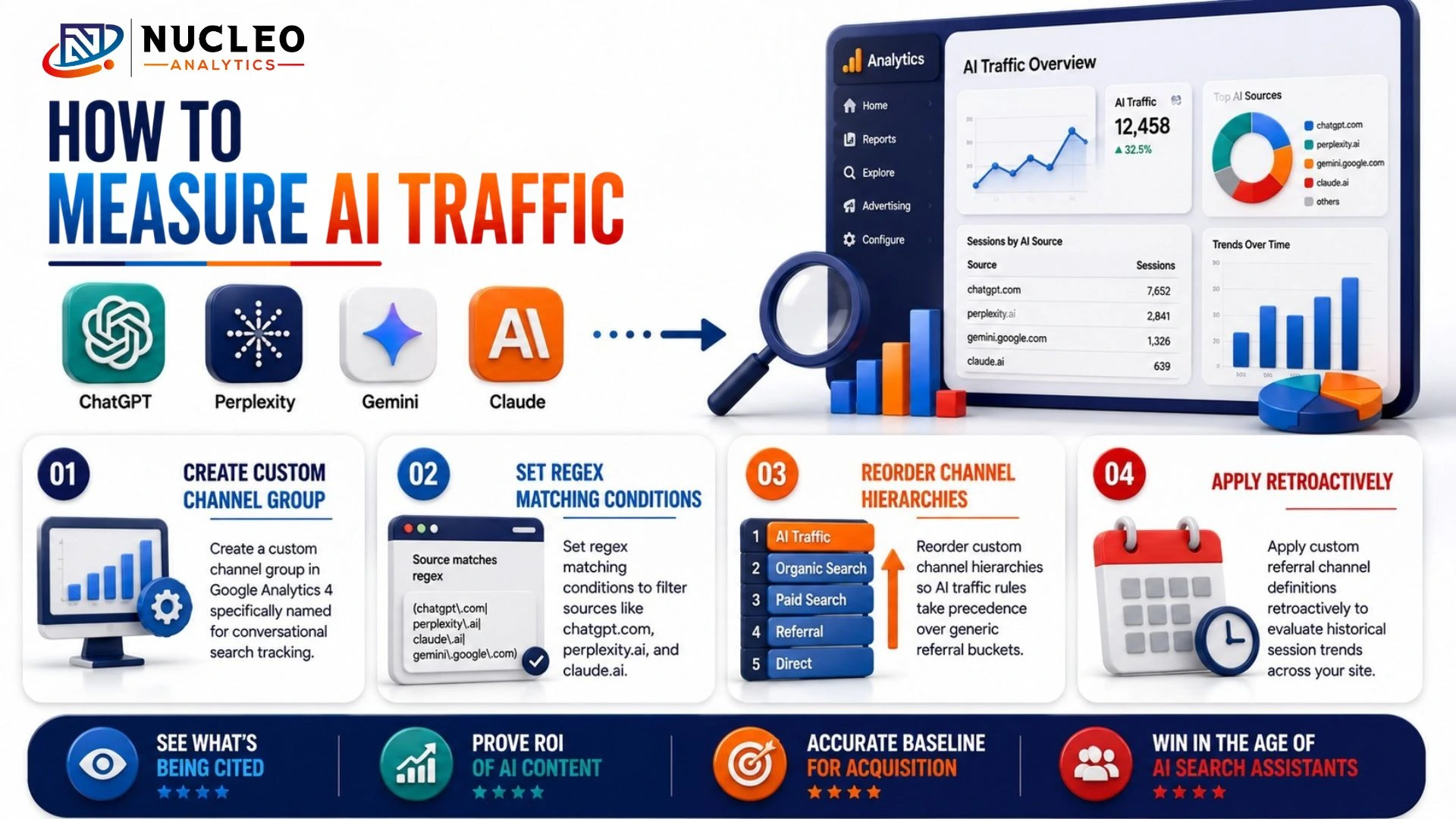
When learning how to measure AI traffic, web analysts must configure specialized referral tracking rules within Google Analytics 4 and custom data environments. Isolating these distinct data streams requires updating your session source dimensions to recognize incoming requests from conversational engines.
Generative platforms like ChatGPT, Perplexity, Gemini, and Claude pass specific domain signatures in their HTTP referrer headers when users click embedded link citations. Without custom channel groupings, these valuable user interactions remain hidden inside general web traffic reports.
To capture these interactions cleanly, your analytics administrator must construct custom channel definitions using precise regex parameters. Grouping these AI domains into a dedicated tracking category ensures that your executive reports reflect real-world user acquisition channels accurately.
- Create a custom channel group in Google Analytics 4 specifically named for conversational search tracking.
- Set regex matching conditions to filter sources like chatgpt.com, perplexity.ai, and claude.ai.
- Reorder custom channel hierarchies so AI traffic rules take precedence over generic referral buckets.
- Apply custom referral channel definitions retroactively to evaluate historical session trends across your site.
Establishing a dedicated framework for AI traffic analytics transforms raw log data into actionable commercial intelligence. You gain immediate visibility into which content assets are being cited and clicked across major conversational platforms.
This structural clarity allows your team to prove the return on investment of your generative content initiatives. You build an accurate baseline for measuring customer acquisition in an era dominated by automated search assistants.
How to Track ChatGPT Traffic
As the dominant conversational interface globally, OpenAI's platform drives a significant portion of all generative search referrals. However, mastering how to track ChatGPT traffic requires addressing unique attribution challenges inherent to its technical infrastructure.
When users interact with ChatGPT across desktop browsers, native mobile applications, or embedded web tools, referrer headers can occasionally be stripped or altered. This technical behavior causes a portion of ChatGPT-driven visits to appear as direct unassigned site traffic.
To minimize attribution loss, your marketing team should deploy clean UTM tracking parameters across all content assets shared across public channels. When ChatGPT crawls and indexes tagged URLs, it frequently preserves those parameters when rendering live link citations for end users.
Furthermore, auditing your landing page acquisition reports reveals unique behavioral fingerprints characteristic of AI users. Visitors arriving from ChatGPT typically display higher engagement rates, longer session durations, and faster conversion times than standard search visitors.
- Filter session source reports specifically for chatgpt.com and chat.openai.com domain variants.
- Tag public outbound marketing links with consistent utm_source=chatgpt and utm_medium=ai_referral conventions.
- Build custom exploration reports in GA4 to segment ChatGPT sessions by specific landing pages.
- Monitor sudden spikes in direct traffic landing on deep, informational blog resources to identify untagged AI citations.
Implementing dedicated ChatGPT traffic analytics ensures that your organization captures every touchpoint generated by this massive discovery engine. You gain a granular understanding of how conversational users navigate your conversion funnels. Accurate tracking protects your acquisition strategy against sudden shifts in search user behavior. By monitoring ChatGPT referrals separately, you can refine your content assets to better serve high-intent conversational audiences.
How to Measure Traffic from AI Search Engines
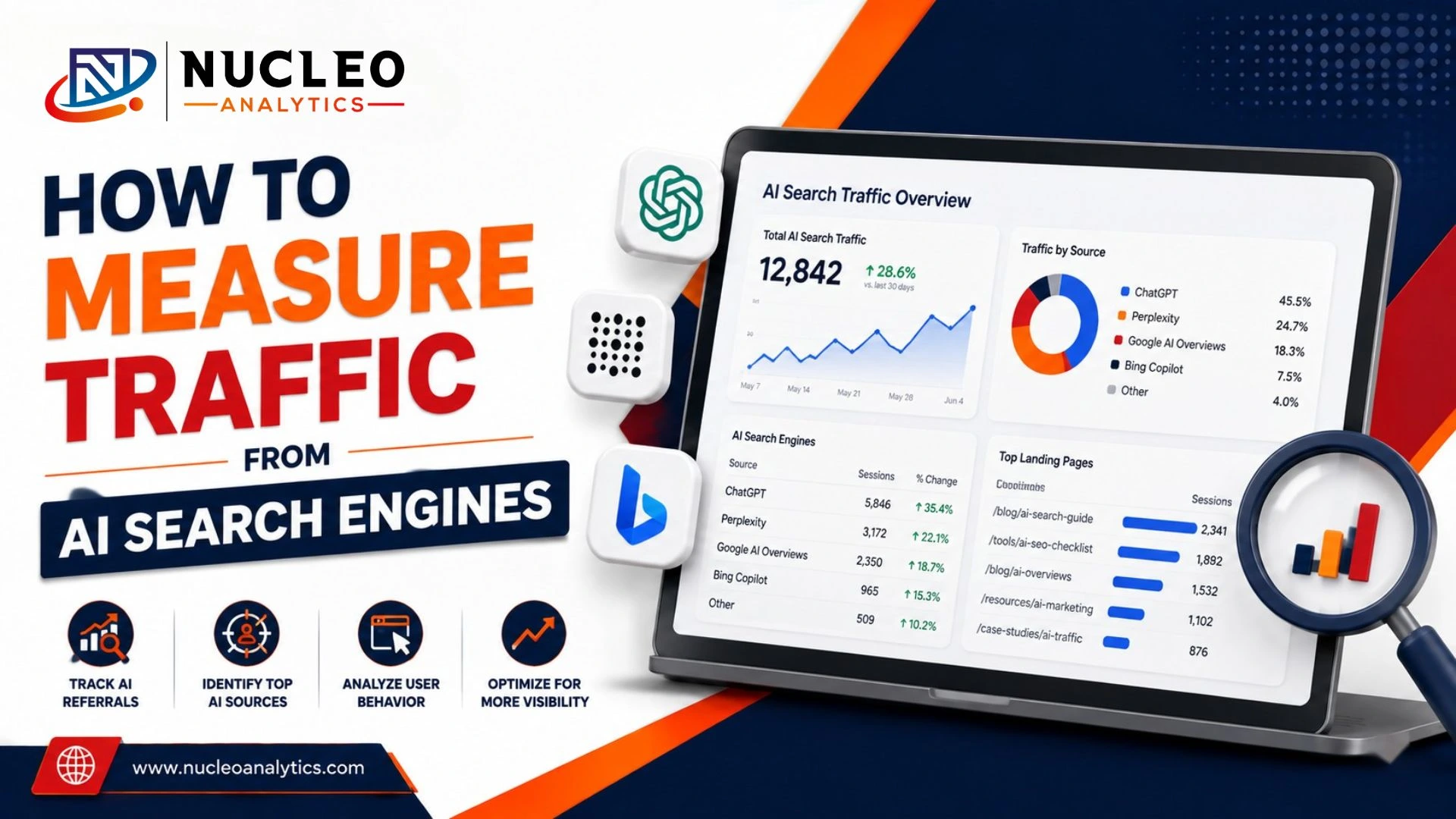
Developing a comprehensive strategy to measure traffic from AI search engines requires going beyond simple session counting. Modern analytics practices must connect generative referral streams directly to backend revenue pipelines and customer conversion metrics.
Language models synthesize information differently than traditional search crawlers, often sending users to deep, highly specific landing pages rather than broad category homepages. Measuring this traffic effectively requires evaluating page-level performance metrics alongside top-level channel totals.
Your team should establish custom event tracking to measure how conversational visitors interact with on-page conversion elements. Tracking form submissions, resource downloads, and product purchases by traffic source reveals the true financial value of your AI citations.
Integrating advanced AI traffic analytics into your weekly reporting cadence allows your leadership team to compare generative traffic efficiency against paid acquisition channels. This cross-channel analysis highlights cost-effective growth opportunities across your digital ecosystem.
- Segment landing page metrics to identify which specific technical articles earn the highest AI referral volume.
- Track key conversion events like form fills and demo requests specifically for conversational session segments.
- Calculate average order value and lifetime value for users arriving from conversational search platforms.
- Monitor server log files to track how frequently conversational search crawlers access and index your site content.
When you systematically track AI search traffic, it ensures that your marketing organization stays ahead of evolving search behavior. You transform raw traffic figures into a strategic advantage that drives continuous revenue growth.
As conversational interfaces continue to capture market share from traditional search engines, organizations with sophisticated measurement frameworks will make faster, smarter investment decisions than their competitors.
Is your AI traffic hiding in plain sight?
Technical Attribution and Referrer Header Management
Understanding the technical mechanics of referrer headers is critical for resolving attribution gaps in conversational traffic reporting. When a user clicks a link inside a generative chat interface, the application sends a request to your web server containing HTTP header data.
If your server or security configuration strips these headers prematurely, the request loses its origin signature. This loss forces analytics platforms to default to direct traffic, obscuring the true origin of your prospective customer.
To preserve attribution data, your engineering team must verify that your Cross-Origin Resource Policy and referrer policy settings allow incoming header preservation. Configuring your server to accept full referrer paths guarantees cleaner reporting across all analytics dashboards.
- Configure your web server's Referrer-Policy header to strict-origin-when-cross-origin to maintain source data.
- Audit Content Security Policy directives to ensure incoming referral data from AI domains is not blocked.
- Use server-side analytics environments to catch raw user-agent strings that client-side scripts might miss.
- Monitor HTTP server logs directly to identify traffic patterns originating from AI application user-agents.
Optimizing your technical infrastructure for accurate attribution reinforces the accuracy of your broader AI traffic analytics framework. You eliminate blind spots caused by misconfigured server security settings.
Maintaining clean technical attribution provides your data analysts with reliable, high-confidence data sets. This accuracy empowers your team to present clear, undeniable performance reports to executive stakeholders.
Behavioral Segmentation of AI Search Visitors
Visitors originating from conversational platforms demonstrate markedly different browsing behaviors compared to users arriving from standard search engine results. Understanding these behavioral nuances is essential for optimizing on-page user experiences and maximizing conversion rates.
Conversational users have usually engaged in multi-turn Q&A sessions before clicking a link. Consequently, they arrive at your website with deeply refined intent, seeking specific verification or transactional execution rather than general exploration.
Analyzing session replay logs and click maps for conversational traffic segments typically reveals minimal page scrolling and immediate interaction with primary call-to-action elements. They consume content rapidly because the generative engine has already answered their preliminary questions.
To capitalize on this high-intent behavior, your UX design team should ensure that landing pages cited by AI platforms feature immediate, context-relevant conversion opportunities. Removing friction for these prepared buyers dramatically increases overall conversion rates.
- Compare bounce rates and session durations between traditional search visitors and conversational referrals.
- Analyze on-page click paths to determine how quickly AI-referred users reach checkout or contact forms.
- Optimize high-performing AI landing pages by placing direct action buttons above the fold.
- Conduct A/B testing on landing pages specifically for cohorts arriving from conversational engines.
Deploying specialized ChatGPT traffic analytics at the behavioral level allows your team to design tailored conversion pathways. You transform qualified AI traffic into high-value commercial customers efficiently.
Tailoring the experience to match the precise expectations of conversational search users will ensure optimal returns from your content investments and improve your market position in general.
Customized Dashboards for Conversational Search Reporting
Collecting fragmented data into organized dashboards ready for analysis is the last stage in the development of your measurement strategy. Your busy stakeholders will need timely insights on the contribution of conversational search to the bottom line.
Using data visualization tools like Looker Studio, you can create customized dashboards based on data pulled from Google Analytics 4, server logs, and CRMs. This approach helps you avoid time-consuming data harvesting.
Your customized reporting system should feature critical key performance indicators such as the number of conversations, month-to-month growth rates, top citation platforms, and assisted revenue totals. Having them all presented together will give you an accurate assessment of your digital presence.
- Connect GA4 custom channel data directly to Looker Studio reporting templates.
- Display monthly traffic trends broken down by individual AI search platforms.
- Build top landing page tables filtered exclusively for conversational referral sources.
- Chart total conversion value and ROI generated by AI search referrals over time.
Establishing a formal process for AI search reporting keeps your organization focused on the metrics that matter most. Executive dashboards ensure that marketing leaders can defend their AI visibility budgets with hard data.
Automated, real-time reporting transforms complex attribution data into clear strategic direction. Your leadership team can confidently allocate resources toward the specific channels driving tangible business results.
Enterprise Analytics Engineering with Nucleo Analytics
Navigating the complexities of modern search attribution requires advanced technical capabilities, custom data engineering, and specialized analytics architecture. At Nucleo Analytics, we help enterprise organizations build robust, future-proof measurement frameworks that capture every touchpoint across the generative search ecosystem.
Our analytics specialists eliminate tracking blind spots by configuring custom server-side data pipelines, advanced regex channel groupings, and comprehensive attribution dashboards. We transform unstructured referral data into actionable, executive-level business intelligence.
- Custom GA4 AI Integration: At Nucleo Analytics, we construct specialized channel groupings, custom dimensions, and regex filters that isolate incoming traffic from all major conversational platforms.
- Server-Side Attribution Setup: We deploy advanced server-side tagging and header preservation protocols to prevent loss of attribution data caused by browser security updates and referrer stripping.
- Behavioral Cohort Analysis: At Nucleo Analytics, we design custom event-tracking architectures that segment AI-referred users, measuring their specific conversion rates, session depth, and lifetime value.
- Executive Looker Studio Dashboards: We build real-time, automated reporting suites that connect web traffic directly to your CRM revenue metrics, providing full pipeline visibility.
- Crawler Log Monitoring: At Nucleo Analytics, we implement automated log analysis tools that track how frequently AI search bots crawl, parse, and index your enterprise assets.
Working with Nucleo Analytics ensures that your company is fully aware of its digital customer acquisition strategies. We give your team the information it needs in order to conquer the world of conversational search and optimize marketing ROI.
Ready to master AI search reporting?
Conclusion
The shift toward conversational search has permanently altered digital analytics and traffic attribution. Establishing a sophisticated framework for AI search reporting is no longer optional for organizations seeking to defend and grow their market share.
By configuring custom channel groups, resolving referrer header issues, tracking behavioral cohorts, and building automated dashboards, you ensure complete visibility over your digital acquisition channels. The brands that master AI attribution today will lead their industries in commercial performance tomorrow.