

The evolution of digital search has transformed how information is synthesized and presented to users worldwide. Traditional lists of search results are increasingly supplemented by automated generative snapshots that answer complex queries immediately at the top of the screen.
Understanding the mechanics of Google AI overviews SEO has become critical for enterprises aiming to preserve their organic search visibility. When search engines generate direct answer blocks, web properties included in those citations capture high-intent audiences and build immense brand authority.
Data tracking confirms that 64.82% of all digital searches now resolve without a single click to an external website. This massive shift means that appearing inside the primary summary box is often more valuable than holding a classic link position lower on the page.
Analysis reveals that pages cited in Google's AI Overviews experience an average 20 to 35% increase in traffic compared to similar pages that are omitted. Securing these citations requires a deliberate structural shift from basic keyword targeting toward clear, high-density data engineering.
How to Get Cited in Google AI Overviews
Generative search engines evaluate web pages using advanced retrieval-augmented generation frameworks. To earn citations, your published text must be easily parsed, logically structured, and factually undeniable for real-time automated scrapers.
When learning how to get cited in Google AI overviews, business leaders must realize that automated systems do not read web pages like human visitors. Instead, algorithms break text into distinct semantic passages and evaluate their factual density.
If your web page contains long, rambling introduction paragraphs filled with vague marketing claims, language models will ignore your content. Search engines prefer concise, direct answers that immediately satisfy the underlying intent of a user's prompt.
To position your content for maximum extraction potential, structure every primary section with a clear question or topic heading. Immediately follow that heading with a direct two-sentence summary that answers the core query completely.
- Front-load essential definitions and direct answers in the first forty words of every section.
- Organize complex operational data into clean semantic HTML tables that crawlers process efficiently.
- Maintain strict heading hierarchies using logical H2, H3, and H4 tags to group related concepts.
- Eliminate filler words and dramatic adjectives to increase the overall information density of your text.
Integrating these publishing standards across your core content library fundamentally improves your Google AI Overviews SEO performance. You create an ideal environment for automated systems looking to extract reliable, citable facts.
When search engines attempt to synthesize complex topics, they favor sources that reduce computational processing friction. Clean, direct formatting makes your domain the path of least resistance for generative answer engines.
How to Rank in AI Overviews
Earning visibility inside automated summaries requires mastering the concept of information gain. Search algorithms evaluate whether your document provides unique, original insight or merely repeats common knowledge already available across the web.
When evaluating how to rank in AI overviews, published resources must offer proprietary data, original expert commentary, or specialized case studies. Standard commodity guides that rephrase general industry definitions will rarely earn prominent citation links.
Generative models rely on real-time web crawlers to gather information from high-authority sources across the open web. If your server infrastructure blocks these specialized scrapers or responds slowly, your content is immediately disqualified from summary selection.
Your technical development team must audit server configurations to ensure unhindered crawler access. Furthermore, your primary body text must render cleanly on the initial server response without requiring complex client-side JavaScript execution.
- Ensure your web server delivers full-page HTML within two seconds to prevent crawler timeouts.
- Verify that robots.txt files permit indexing by modern generative search crawlers and scrapers.
- Use explicit JSON-LD schema markup to define entities, organizations, author credentials, and FAQs.
- Publish primary industry data, original survey results, and documented technical case studies.
Applying these technical standards allows your site to rank in Google AI overviews consistently across competitive commercial queries. Technical accessibility ensures that your unique insights are properly analyzed during search synthesis.
Mastering these technical requirements protects your digital investment against future search layout updates. By aligning your site with modern machine requirements, you maintain continuous access to valuable organic search traffic.
How to Implement Google AI Overview Optimization
A successful strategy for Google AI overview optimization requires restructuring your existing content assets into modular answer blocks. Each block must function as a standalone piece of information that makes complete sense out of context.
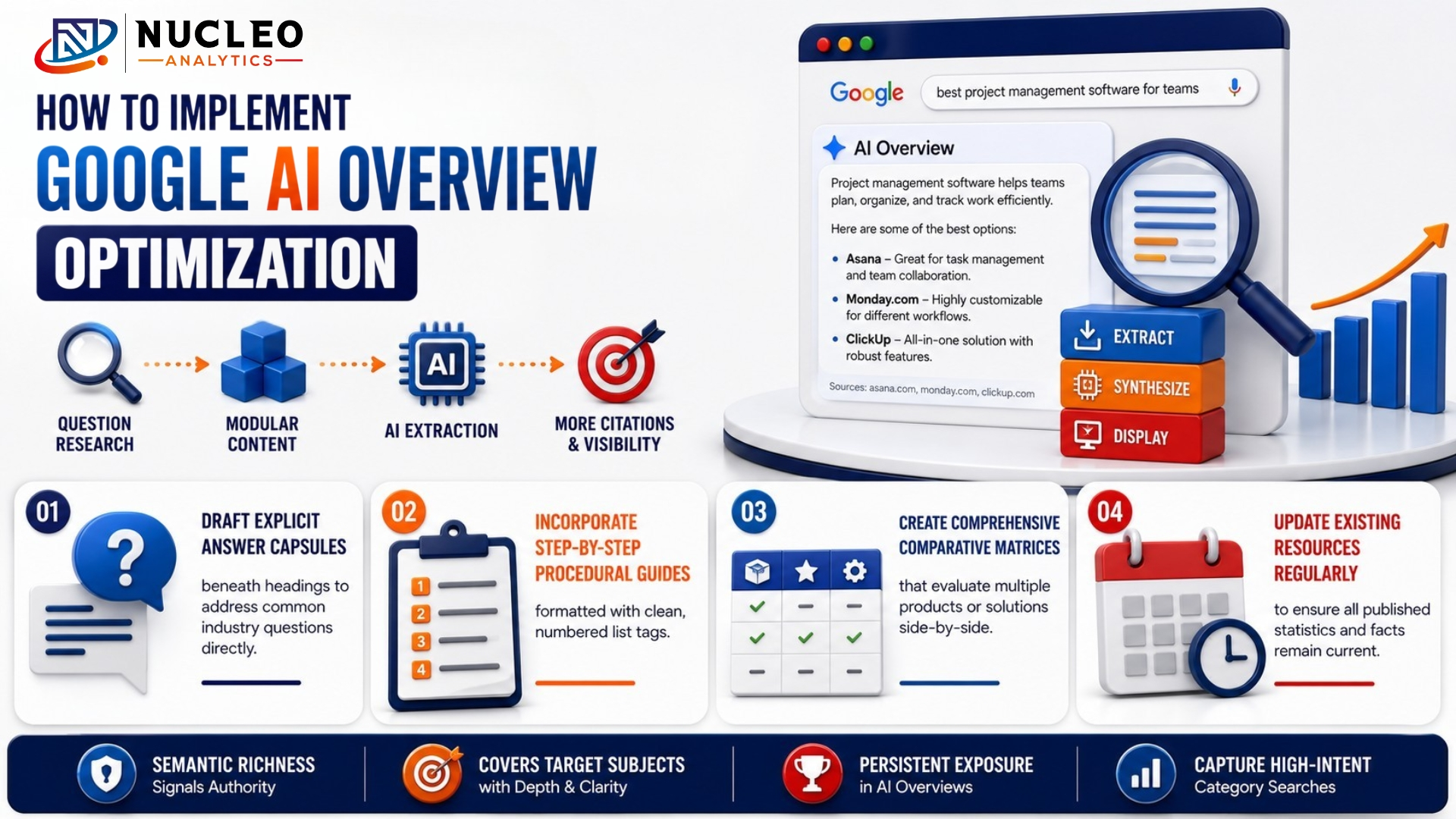
Language models frequently pull single paragraphs, bulleted lists, or structured tables from different sections of a web page to construct a unified summary. Designing modular content modules makes extraction effortless for automated bots.
When you optimize for AI overviews, focus heavily on optimizing for conversational, long-tail search queries. Modern search users type full sentences and complex follow-up questions into search bars rather than short, fragmented key terms.
Your editorial workflow should incorporate comprehensive question research to identify the specific operational challenges your customers face. Addressing these specific scenarios directly on your web pages dramatically increases your citation probability.
- Draft explicit answer capsules beneath headings to address common industry questions directly.
- Incorporate step-by-step procedural guides formatted with clean, numbered list tags.
- Create comprehensive comparative matrices that evaluate multiple products or solutions side-by-side.
- Update existing informational resources regularly to ensure all published statistics and facts remain current.
Executing systematic Google AI overview optimization ensures that your domain covers target subjects with unparalleled depth and clarity. This semantic richness signals to search algorithms that your brand is an authoritative category leader.
As search engines continue to refine their generative models, modular content architectures will remain the most reliable method for securing persistent on-screen exposure and capturing high-intent category searches.