
A lot of people still think search works the same way it did a few years ago, but that is no longer the case. Today, it is common to search on Google and receive a complete AI-generated answer before even visiting a website. In many cases, people find the information they need without clicking on any search result.
That is one of the main reasons generative engine optimization is receiving so much attention. Businesses are beginning to realize that ranking on Google is only part of the equation because AI systems are increasingly deciding which content appears in generated responses.
The challenge is that many websites still create content as though they are writing for traditional search engines. Their pages are often built around keywords first and real users second, making the content feel overly polished, repetitive, and difficult to read naturally.
That is where AI search optimization changes the approach. Content needs to be clearer, more natural, and easier to follow because AI systems break information into smaller pieces before rebuilding it into answers that people actually read.
The companies that understand this shift early are likely to have a significant advantage because search is evolving rapidly, and many brands have not yet adapted to where it is heading.
What Generative Engine Optimization actually is
Generative engine optimization is the process of structuring and writing content so that AI systems can understand it clearly and use it when generating answers. Instead of focusing only on ranking pages in search engines, the emphasis shifts toward becoming part of the answer itself.
AI systems do not always send users directly to websites because they often summarize information from multiple sources and present a single response. As a result, the question is no longer only about how to rank higher but also about how to make content usable within an AI-generated explanation without losing its meaning.
This is why generative engine optimization is becoming a core part of modern content strategy. It sits between SEO, content marketing, and AI-driven search behavior, while placing a stronger emphasis on clarity than anything else.
Why search is changing so fast
The way people search has changed because their expectations have changed. Users no longer want to open ten different tabs when they can get one clear answer instead. AI search tools are built around this behavior by combining information from multiple sources and generating a single response that feels complete.
This changes the way content creators need to think about visibility. Even if a page is not clicked, it can still influence what users see because content is now used in two ways: generating direct traffic and helping AI systems interpret information.
That is why AI search optimization has become so important. Visibility is no longer only about rankings but also about becoming part of the information layer that AI systems rely on.
How AI systems actually process content
AI systems do not read content the same way humans do because they break information into smaller meaning units before rebuilding those pieces into complete responses. They look for patterns, clarity, and consistency throughout the content. If the information is confusing, repetitive, or overly complex, it becomes more difficult to reuse, whereas clear and well-structured content is easier to include in generated answers.
This process explains why writing style has become so important. It is not about writing for machines but about writing in a way that continues to make sense even after the content has been broken apart and recombined.
Why authority matters more in AI-driven search
AI systems are getting better at filtering weak content because pages that rely on recycled explanations or bloated SEO writing are beginning to blend together without adding anything useful. As a result, content that lacks originality or clarity is becoming less effective.
This is changing how authority works online. It is no longer just about publishing more pages or stuffing keywords into content because AI systems are paying closer attention to clarity, consistency, and whether the information genuinely helps explain a topic.
That is why generic content struggles today. When every article sounds the same, none of them stand out. Strong content usually feels more grounded, more focused, and easier to trust because it explains ideas directly instead of circling around the point.
For businesses, this changes the strategy completely. Winning in AI search is becoming less about producing more content and more about publishing content that genuinely deserves to be used.
GEO strategy and how it works in practice
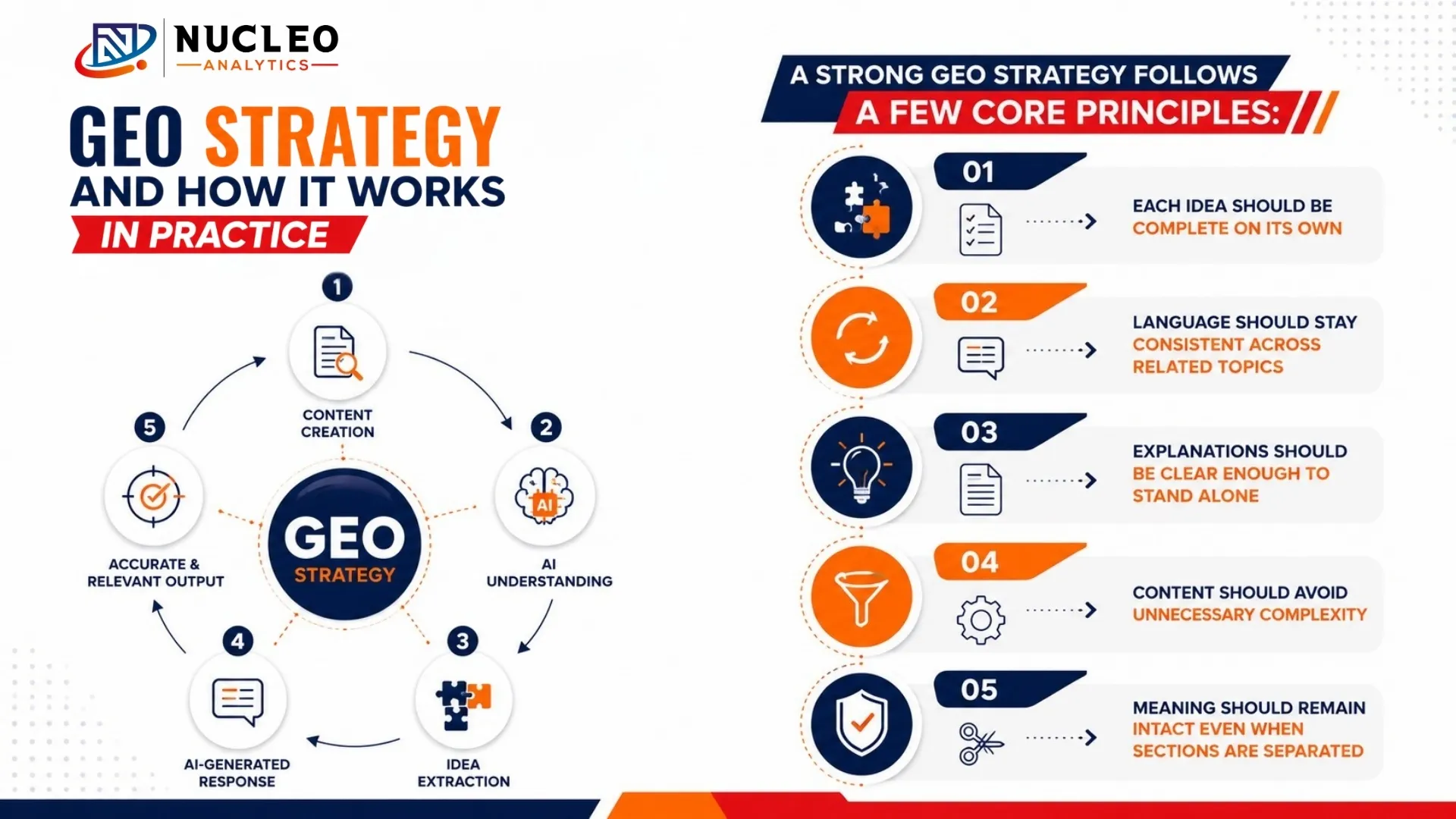
A generative search optimization strategy focuses on making content usable in AI-generated environments. Instead of optimizing only for search rankings, it focuses on how ideas are understood when extracted from their original context.
A strong GEO strategy usually follows a few core principles:
- Each idea should be complete on its own
- Language should stay consistent across related topics
- Explanations should be clear enough to stand alone
- Content should avoid unnecessary complexity
- Meaning should remain intact even when sections are separated
These principles sound simple, but they require discipline in writing. Most content online is not built this way, which is why a lot of it gets ignored or diluted in AI-generated responses.
How GEO changes content structure
Is your B2B content helping buyers decide or just trying to sell?
Integrating AEO with SEO
AEO and SEO overlap, but they are not the same thing. SEO focuses on helping content rank in search engines, while AEO focuses on providing direct answers to user questions. When combined, they create content that is both discoverable and reusable across different search experiences.
For example: when someone searches for “how to do AEO,” the content should do more than simply mention the concept. It should explain the topic clearly enough that the answer can be extracted and used directly. This means providing complete explanations instead of relying on partial references.
This approach improves how content performs in AI-generated environments because it aligns with the way AI systems construct answers.
Why B2B content is changing with AI search
B2B buyers are already using AI tools during the research process. They compare solutions, summarize different options, and understand product categories before speaking with sales teams. This shift is changing how B2B content works because it is no longer focused only on driving traffic. Instead, it is about becoming part of the research layer that AI systems rely on.
A strong B2B content strategy for AI search focuses on clarity and trust rather than promotion.
It usually includes:
- Clear explanations of complex topics
- Honest comparisons between solutions
- Straightforward language without marketing exaggeration
- Educational content that helps decision-making
- Consistency across related topics
When content is written this way, it becomes more likely to be included in AI-generated summaries that users see during research.
Micro influencers vs AI influencers in content ecosystems
You can usually tell when content comes from someone who has actually used something versus someone who is simply generating words around a topic. That difference has become much more noticeable in recent years because authentic experience is often reflected in the way information is explained.
Micro influencers continue to hold attention because their content feels personal. Their examples tend to be more specific, their opinions feel genuine, and their recommendations usually come from real experience rather than recycled talking points.
AI-generated influencers and automated content systems take a different approach. They produce content quickly and at scale, but over time, much of it begins to sound similar because the wording changes while the depth often remains the same.
That is why human perspective continues to matter so much. AI can certainly improve speed, but trust still comes from people who sound like they genuinely mean what they are saying.
GEO best practices that actually matter
A lot of people make GEO sound more complicated than it really is, but most of the time, the problem is not the strategy. The real issue is that the content itself is often difficult to follow.
When AI systems scan a page, they try to understand what the page is actually saying and whether the explanation remains consistent from beginning to end. If the writing jumps between ideas too often or attempts to cover several topics at once, the overall meaning becomes weaker very quickly.
Good GEO content usually feels simple to read because each section explains a single idea clearly, the wording remains consistent throughout the site, and the explanation feels complete rather than unfinished.
That shift matters more than many people realize because AI search is pushing content toward greater clarity. Pages that genuinely explain something useful are beginning to hold more value than pages written primarily to sound optimized.
How to optimize a website for AI search
The future of generative engine optimization
Conclusion
Generative engine optimization is changing how content works online. It is not replacing SEO, but it is expanding it into a system where clarity, structure, and usability matter as much as rankings. As AI search continues to grow, content that is easy to understand and reuse will naturally perform better across both search engines and generative systems. This is exactly where a strong generative AI SEO strategy becomes important, because it pushes content to work in both traditional search and AI-driven results without losing meaning.
The shift is already happening. The only real difference now is how fast businesses adapt to it. Nucleo Analytics works with this shift by helping brands build content that fits both traditional SEO and modern AI search systems.