
That is exactly where the confusion around DIY marketing vs hiring experts starts to show up in real life. At first, doing it yourself feels manageable because there is control and no extra cost sitting on your books. You post when you can, run small campaigns, try a few ideas, and hope something starts to click. For a while, it feels like progress, even if the results are not really moving in a strong direction.
But as things get more competitive online, that early freedom starts turning into pressure you don’t really notice at first. You are still running the business, but now marketing keeps pulling attention in different directions and never really slows down. When that starts happening, the whole in-house marketing vs agency
question hits differently. Keeping everything internal sounds good until the workload keeps growing and nobody really has the time or depth to stay consistent with it anymore. At some point, it stops being about whether marketing is being done and starts being about whether it is actually doing anything meaningful for growth.
DIY Marketing in Real Conditions, Not Theory
Nobody really explains DIY marketing honestly at first. It gets sold as simple, flexible, and low-cost. And technically, that is true in the beginning.
You don’t need approvals. You don’t need agencies. You don’t need big budgets. You just start. But what nobody tells you is how quickly it expands into something that eats your time in small pieces every single day. You end up managing content ideas, captions, creatives, ads, analytics, keyword research, competitor tracking, website updates, and then trying to figure out why nothing is consistent even though you are “doing everything.”
And that is the real problem with DIY marketing vs hiring experts. It is not an effort. It is direction. Most DIY setups don’t fail because people stop trying. They fail because the system never existed in the first place. Everything is reactive. Something stops working, you fix it. Something else breaks, you fix that. Nothing is built to scale smoothly. There is also another thing people don’t talk about enough. Mental load.
Marketing decisions are not light decisions. Even small choices like where to spend ad money or which keyword to target can affect performance. When those decisions are made after a long day of running the actual business, quality drops without you noticing it. So even though DIY marketing looks like control, it slowly turns into scattered execution without structure.
What Actually Changes When Experts Enter the Picture
When you hire marketing experts, the biggest change is not just skill. It is structure. Suddenly, things are not random anymore. There is a plan. There is sequencing. There is a reason behind each action instead of guessing what might work this week. A proper team does not start with “let’s try ads.” They start with understanding the business, the audience, the competition, and the actual conversion path. Only then do campaigns even begin.
That alone removes a huge amount of wasted effort that most DIY setups deal with daily. Another shift is consistency. Marketing stops depending on how busy your week is. It runs on systems instead of mood or availability. And this is where in-house marketing vs agency decisions usually become very real. In-house teams can give you control and closeness, but they often lack breadth unless heavily built out. Agencies bring multi-channel experience, faster iteration cycles, and deeper specialization across SEO, paid ads, and analytics. But the biggest difference is something simple. You stop guessing.
Instead of wondering why something worked or didn’t, you actually know. Because tracking is set up properly. Because data is being read correctly. Because decisions are not emotional anymore.
DIY Marketing vs Hiring Experts Comparison Table
Factor | DIY Marketing Reality | Hiring Experts Reality |
Strategy Formation | Built through trial, error, and guessing cycles | Built through structured planning and tested frameworks |
Execution Speed | Slow due to multitasking and learning curve | Faster due to experience and defined systems |
SEO Implementation | Partial understanding of local SEO for small business | Full structured execution, including technical optimization |
Decision Making | Based on assumptions and limited data reading | Based on analytics, patterns, and performance history |
Consistency | Irregular due to workload and distractions | Stable and system-driven execution cycles |
Ad Performance | Experimental with inconsistent targeting depth | Optimized continuously based on conversion data |
Skill Coverage | Limited to one person's knowledge range | Multi-specialist execution across channels |
Growth Outcome | Unpredictable and often slow | Measurable and scalable over time |
This is usually the moment where reality hits a bit harder. Because it becomes clear that effort is not the missing piece. Structure is.
Why Local SEO Becomes the Real Battleground
Most business owners underestimate how much local search controls customer behavior now. People don’t randomly browse anymore. They search with intent. They compare results. They pick from the first few options that look trustworthy enough. That is where the importance of local SEO becomes very real.
If your business is not showing up in those local searches, you are not competing. You are just existing outside the decision process entirely.
And that is why local SEO for small business is not optional anymore. It is the foundation of visibility. But the problem is execution. Because ranking locally is not one action, it is multiple signals working together over time.
Local SEO Strategies for Small Businesses That Actually Move Rankings
Local SEO strategies for small businesses only work when they are treated like a system instead of random tasks. Your Google Business Profile is usually the starting point. If that is incomplete or inconsistent, everything else struggles to gain traction. Then comes the website structure. Pages need to clearly communicate what you do, where you do it, and who you serve, not in vague language, but in clear search-aligned positioning..
After that comes consistency across directories; your business information must stay identical everywhere online, because search engines rely heavily on trust signals built through repetition. And then there are reviews. Not just collecting them, but actively managing them, responding to them, and using them as credibility signals that also impact ranking behavior. Most DIY approaches touch these areas lightly but never fully connect them into one system. That is where performance stays limited.
If your local visibility still feels inconsistent even after putting effort into SEO, there is usually a deeper structural issue holding rankings back.
Two Critical Realities Every Business Eventually Faces
Where DIY Marketing Still Makes Sense
- Early stage testing where learning matters more than scale
- Very limited budgets where experimentation is the only option
- Situations where business owners want full control over messaging direction
- Short-term campaigns that do not depend on long-term compounding growth
- Simple marketing needs without competitive pressure or scaling goals
This stage is real and valid, but it is temporary by nature. It works until complexity increases.
When DIY Stops Working Quietly
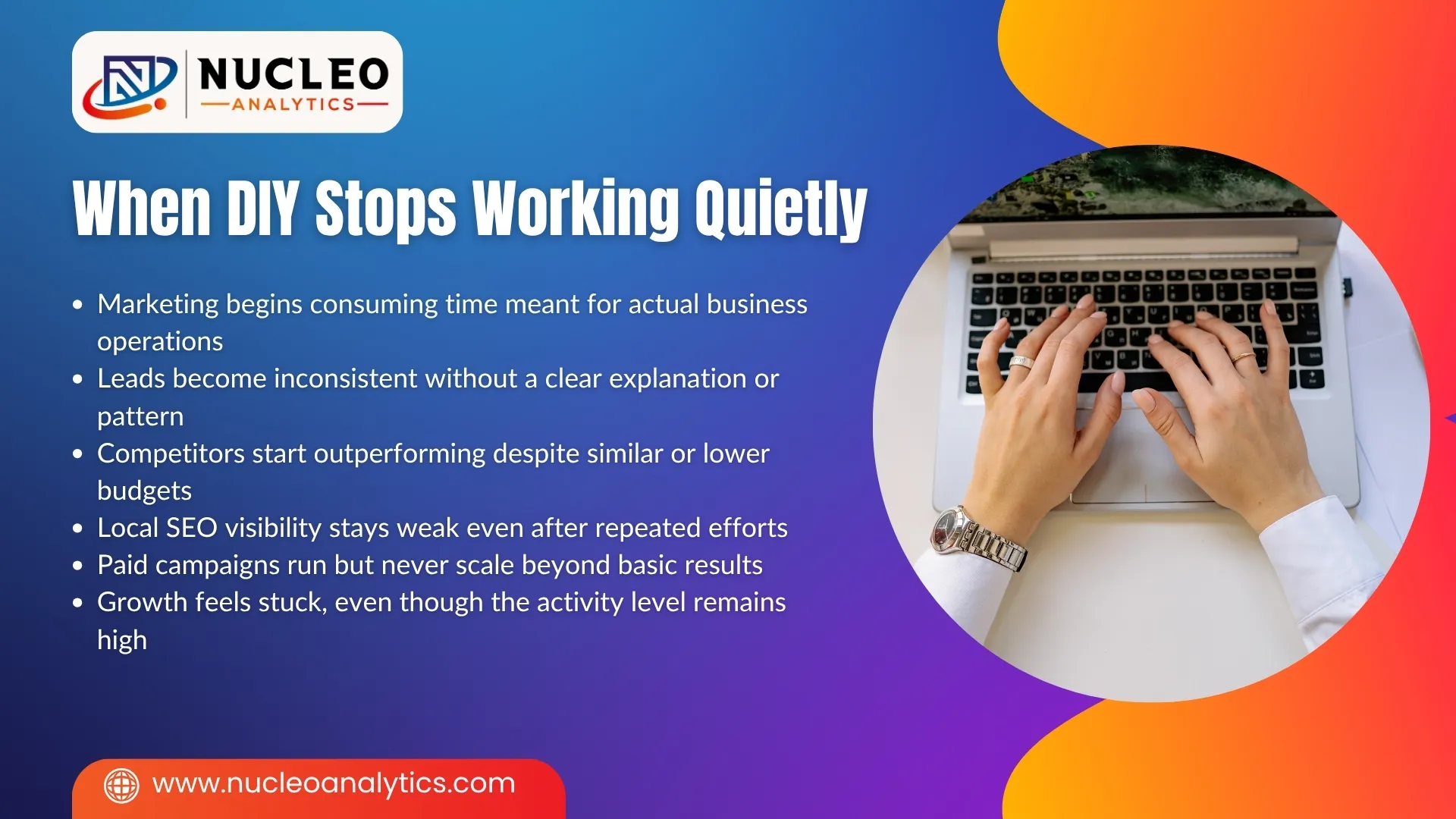
- Marketing begins consuming time meant for actual business operations
- Leads become inconsistent without a clear explanation or pattern
- Competitors start outperforming despite similar or lower budgets
- Local SEO visibility stays weak even after repeated efforts
- Paid campaigns run but never scale beyond basic results
- Growth feels stuck, even though the activity level remains high
This is usually not a sudden failure point. It is a slow realization that effort is no longer translating into progress.
The Hidden Cost Most People Ignore
- It is time spent learning instead of selling.
- It is opportunities lost due to weak visibility.
- It is customers choosing competitors who simply appear more often.
- It is growth delayed while systems are being figured out manually.
Why Strategy Always Beats Random Effort
Strategy is difficult, but effort is simple. Increasing the number of posts does not guarantee growth, running advertisements does not guarantee scaling, and unstructured SEO does not guarantee ranking. Marketing works when actions are connected into a system that compounds.
That is why businesses that move away from DIY and into structured execution usually see a shift not just in traffic, but in consistency and predictability. Because at the end of the day, growth is not about doing more things. It is about doing the right things in the right order repeatedly.
Where Nucleo Analytics Fits Into This Reality
At some point, most businesses stop trying to figure everything out internally and start looking for structure instead of experiments. That is where Nucleo Analytics usually comes into the picture. The focus is not just on campaigns or one-time fixes.
It is building systems that connect local SEO, paid ads, analytics, and conversion tracking into one working structure that actually supports growth instead of guessing. Not every business needs that immediately. But every business eventually hits a point where scattered effort stops working.
Final Thought
Most businesses don’t struggle because they avoid marketing altogether. They struggle because the effort never turns into a system that actually grows anything in a steady way. DIY marketing can get you started and even teach you a lot along the way. But it usually hits a point where time pressure and skill gaps start slowing everything down without you fully noticing it at first.
Hiring experts is not about giving up control. It is more about shifting from guessing what works to actually knowing what works based on data and experience.
The real difference shows up over time. One path stays reactive and scattered. The other builds structure, consistency, and a clearer growth direction that compounds instead of resetting every few weeks. At the end of the day, it comes down to how fast you want to grow and how much you want marketing to run on systems instead of constant trial and error.