





8 Types of Digital Marketing Explained with Pro Tips (2026)
Digital marketing in 2026 is not about doing more. It’s about doing the right things with clarity. Most businesses don’t fail because digital marketing doesn’t work. They fail because they try everything at once without understanding what each channel is actually meant to do.
One channel brings traffic. Another builds trust, Another creates demand, Another converts interest into action. If these tasks are not comprehended correctly, then money will be wasted, and there will be no change in the results.
The eight main types of digital marketing are laid out in this guide, along with their respective explanations of how they work in 2026. Besides that, the guide shares pro tips that are based on actual application rather than theory. The objective of the guide is really straightforward: to make you aware of each channel’s role and to assist you in using them without any complexities.
1. Search Engine Optimization (SEO)
SEO is still one of the key channels in digital marketing, and its usage is one of the most effective because it builds up over time. It is the opposite of ads, in that the moment you stop spending, SEO does not stop working. However, it does not provide instant gratification either. It is the consistency, structure, and patience that get rewarded.
SEO in 2026 is definitely not the same as SEO in the past, where the emphasis was mainly on individual keywords. It is a lot about the depth of the topic and the usefulness of the information provided. Search engines have really improved their skills when it comes to recognizing the context, the user’s intention, and the quality. A website that truly and in a clear and complete manner answers a question will outrank one that just targets a keyword.
Things like boosting your web page loading speed are just like scratching the surface in modern-day SEO. Beyond that, you also need a strong structure for the content, internal linking, and backlinks that are actually worthy. When users see your brand ranking organically, trust increases before they even click.
Pro tips for SEO in 2026: Pay more attention to the topic rather than just the keyword. In addition to building your image online, content can improve your marketing strategy.
Not sure which digital channels will actually bring results for your business?
2. Content Marketing
Content marketing is the foundation on which your brand gets built. It is through content that you communicate your actions, how you are of help, and what is the reason for someone to trust you. By 2026, content will not be judged by its frequency of publication but rather by the intention behind it.
Content marketing covers all types of communication, such as blogs, videos, guides, newsletters, case studies, and even landing pages. Great content addresses precise problems. It does not try to dazzle. It aims to assist. When the content is worth reading, it gains more eyes, more reading time, and spreads through word of mouth.
Creating content without a function in mind is simply one of the most common mistakes companies make. The content should be either educational, supporting SEO, building trust, or converting. If it does none of those, it is just noise.
Content marketing pro tips: communicate in an easily understood manner and steer clear of technical terms. Organize the content so that it is simple to skim. Utilize strong content pieces by repurposing them across platforms rather than constantly generating new ones. Focus on depth rather than volume. A strong content marketing strategy works hand in hand with search engine optimization, social media, and email marketing.
3. Social Media Marketing
Social media marketing in 2026 is not so much about growth hacks but rather about remaining relevant. People do not follow brands with the intention of being sold to. They rather follow brands for value, insight, or entertainment.
Not every platform matters for every business. Some brands perform best on LinkedIn. Others on Instagram or TikTok. Trying to be active everywhere usually leads to inconsistent posting and weak messaging.
Social media works best as a visibility and trust channel. Having a consistent brand presence during the consideration period increases the likelihood of your brand being picked when the potential customer decides to make a purchase. Besides, it is super helpful when used together with other marketing channels such as paid advertising and content distribution.
Expert advice for social media marketing: Select one or a maximum of two platforms and put all your efforts into them. Use video content that is short and easy to comprehend, and also use simple graphics. Maintain a human and friendly tone. Respond to comments and messages instead of just posting and leaving. Strong social media marketing doesn’t try to close sales immediately. It supports the rest of your digital marketing strategy.
4. Paid Advertising
The speed and control that paid advertising campaigns give you are the main reasons to use them. They immediately put you in front of the customers who at the moment are searching, browsing, or scrolling. Paid ads in 2026 are even smarter, yet more competitive. The human part in the strategy is still important although automation has reduced some of the burden.
Amongst various types of paid advertising, search ads, display ads, video ads, and social ads are included. Each of them serves a particular purpose. Search ads penetrate the market with intent, while display and video ads work on creating awareness. Social ads do the dual task of identifying the right audience and bringing back the previous visitors.
Misalignment is the foremost reason why paid ads do not yield the desired results. The ads are saying one thing, and the landing pages are saying something else. Or, the visitors are sent to the websites that are too general and do not have any clear action points.
Insights into paid advertising: never forget to align your ad’s intent with the landing page’s intent. Do not track only clicks, but also conversions. Begin with mini tests, followed by scaling up your budget. Utilize retargeting to achieve better performance. Paid advertising campaigns combined with SEO and content work wonders, and do not try to replace them.
Spending on ads but not seeing consistent returns?
5. Email Marketing
Email remains one of the most reliable digital marketing channels in 2026. By using marketing automation through email, businesses are able to stay in touch with their audience without the audience feeling overwhelmed.
Email is successful because it is consent-based. People take the initiative to listen to you. This makes it perfect for lead nurturing, giving updates, and having long-term relationships.
The modern email marketing revolves around the principle of relevance. The impact of sending generic newsletters to everyone is very rare. Segmented emails determined by customers’ behaviors and interests yield much better results.
Pro tips for email marketing: It is better to send fewer emails but with more value. You can concentrate on one message for each email. Automated communications can take care of follow-ups and onboarding. Subject lines have to be written in a way that they can be taken for real conversations. Email marketing automation can be said to be a part of the strategy, which involves website, paid ads, and customer retention.
6. Influencer and Creator Marketing
Influencer marketing in 2026 has got trust, but not from people with a celebrity background. When considering the audience size, the smaller creators are still the best choice in terms of engagement and audience interaction. They are often better at creating product awareness than larger influencers with passive followers.
Consumers’ kindness to the creators comes when they feel that the creator is real and relatable; hence, the influencer becomes more effective when he is allowed to speak in the brand’s language and vice versa.
This marketing channel is best suited for the areas of building brand awareness, gaining social proof, and displaying real-life use cases, but it is not the case when the brand is controlling the content or wrongly picking influencers based only on the number of followers they have.
Pro tips on influencer marketing: concentrate on perfect audience-fit rather than broad reach, creators with similar brand values are the ones that you should choose, engagement and traffic should be your metrics rather than just likes, and if an influencer’s content has good engagement, then you can support it with paid amplification.
When implemented correctly, influencer marketing not only boosts social media marketing but also adds to brand credibility.
7. Conversion Rate Optimization (CRO)
Traffic alone doesn’t grow businesses. Conversion rate optimization (CRO) is the process of enhancing the website experience that converts visitors into leads, sign-ups, or customers. It deals with the person who is already on your site.
CRO involves various factors such as layout of the page, clarity of messaging, speed of loading, forms, calls to action, and signals of trust. Changes as minor as these can consistently produce significant changes.
In 2026, the process of CRO is data-supported and ever-evolving. It is not about making random guesses. It is all about conducting tests and gaining knowledge.
CRO pro tips: Eliminate all distractions from the main pages. CTAs should be distinct and detailed. First, the mobile users should be optimized for. Test just one change at a time so you can determine what worked really well. The conversion rate optimization results in increasing returns from all other marketing channels that have been used.
8. Analytics and Data Tracking
Digital marketing without analytics and tracking is just guesswork. Data indicates what’s working, what’s failing, and where to focus next.
In 2026, tracking is still essential, although more privacy-conscious. Businesses that know their data make better decisions and lose less money.
Analytics help you comprehend user behavior, point out strong channels, increase ROI, and detect issues early. The aim is not to collect more data. It is to use the right data.
Pro tips for analytics: Don’t track vanity metrics; instead, track meaningful ones. Don’t review performance quarterly; do it regularly. Use dashboards to simplify reporting. Let data guide strategy changes. Strong analytics and tracking connect all parts of your digital marketing strategy into one system.
How These Types of Digital Marketing Work Together
The biggest mistake businesses make is treating each channel separately. Real growth happens when channels support each other.
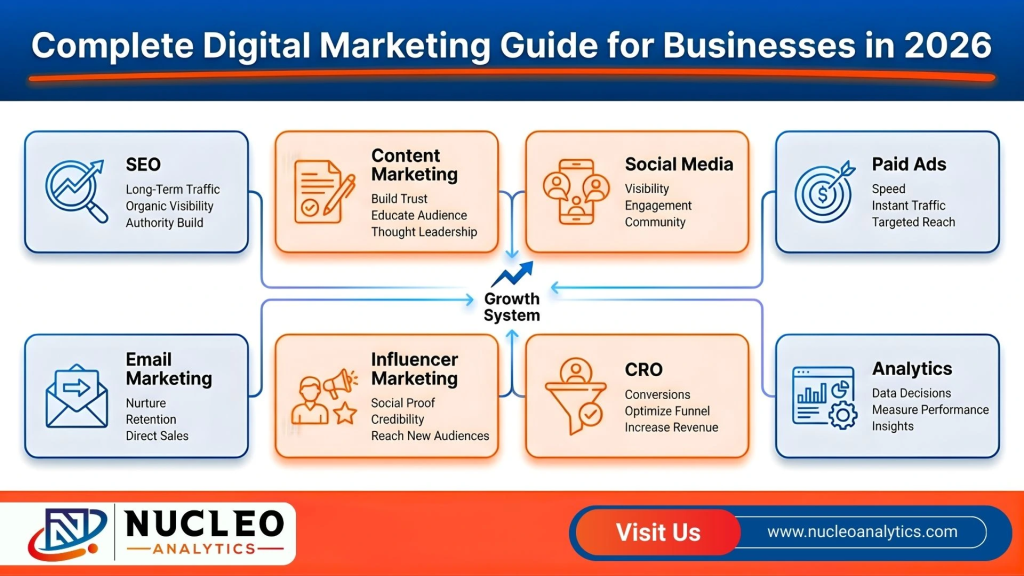
SEO brings steady traffic. Content builds trust. Social media keeps you visible. Paid ads add speed. Email nurtures relationships. CRO improves performance. Analytics guides decisions.
When these pieces work together, the results become predictable instead of random.
Where Nucleo Analytics Fits In
At Nucleo Analytics, we don’t believe digital marketing works when channels are treated like separate projects. SEO in one corner. Ads in another. Content is doing its own thing. That approach creates effort, but not momentum. Our job is to connect the dots so every part of your marketing supports the other.
We start by understanding your business first, not the tools. Every company has different goals, timelines, and constraints. Some need leads quickly. Others need long-term visibility. Some need both. Once that’s clear, we build a digital marketing setup that actually fits your reality.
What we focus on is clarity and execution, not buzzwords. We help businesses move away from random tactics and toward systems that compound over time.
Nucleo Analytics is here to lend a helping hand to your digital marketing in the following ways:
- Channel prioritization: Instead of draining your budget on every channel that is not effective, we pinpoint the digital marketing channels that will work best for your business.
- SEO and content collaboration: We interrelate SEO and content, resulting in long-term visibility through the creation of isolated wins.
- Paid ads strategy: We build paid ads that not only reflect real user intent but also connect correctly to landing pages and funnels.
- Conversion rate optimization: You are going to get more out of the already existing traffic since we are going to make your website more efficient in converting that traffic into leads or customers.
- Data-driven choices: We implement a tracking system for the things that are most important, we eliminate the things that aren’t effective, and we make changes to our strategy based on data from actual performance.
- Sustainable growth target: The things we create are pointed to longevity, scalability, and adaptability as per the growth of your business.
We do not merely run campaigns; we help you in establishing a digital marketing foundation that is simple, focused, and effective, without adding unnecessary complications.
Conclusion: Digital Marketing in 2026 Rewards Focus
Digital marketing isn’t slowing down, but the rules are clearer than ever. Businesses that win in 2026 won’t be the ones trying everything. They’ll be the ones doing fewer things better.
Understand each channel. Know its role. Build systems instead of experiments. Measure what matters. Improve consistently.
Ready to build a digital marketing strategy that actually works in 2026?
Frequently Asked Questions
Q1: What type of digital marketing works best in 2026?
Q2: Is it necessary for small businesses to adopt all kinds of digital marketing?
Q3: How long does it take to see results from digital marketing?
Q4: How do I know if my digital marketing strategy is working?
Related Posts
What is 307 Temporary Redirect and How to Fix It?
In the realm of web management, not all redirects are made equal. A 307 Redirect signals a “Route Diversion Ahead”. This tells the visitors and […]
How to Rank in Google Maps in 2026
Local visibility in 2026 shows how easily people find your business. Google Maps shows nearby businesses when people search. Businesses at the top get more […]
Digital Marketing Trends You Can’t Ignore in 2025
The digital world is evolving at a very high pace, which most of us cannot keep up with. The way business engages with their audiences […]
Digital Marketing Strategy for Professional Services
Do you know what exactly digital marketing is and why it is important? Digital marketing is all about employing different tools to connect with your […]
How to Optimize Google Business Profile in 2026?
If you run a local business, your Google Business Profile is not just “nice to have.” It is one of the first places people look […]
What is AEO in Marketing?
In today’s rapidly changing digital marketing landscape, being seen equals being ahead. Time-tested SEO methods have long ensured brands gain traction through organic search, but […]