










How to Plan an App Store Optimization Strategy?
App store success is the result of coordinated work across product, marketing, and analytics. This is not guesswork: it’s research, prioritized experiments, and continuous measurement. Think of app store optimization as a product-growth practice where the store listing is a product page you must optimize for relevance and user conversion. The steps below are sequenced to enable you to act and iterate quickly.
This manual provides a distinct, incremental approach to boosting visibility, maximizing listing views by converting them into installations, and identifying what matters through measurement. The practical, research-oriented activities, keyword strategies, and creative and A/B testing suggestions will be provided, along with localization tips and retention metrics that significantly affect progress. Use this plan to stop guessing and start growing your app with predictable experiments and measurements.
Define measurable goals
Before changing anything, set clear objectives.
- Does it focus on a geographic push, quality (higher lifetime value), or priority volume (more installs)?
- Turn them into targets, e.g., increase organic installs by 30% within 90 days or increase listing conversion by 6% to 10%.
- Align targets with revenue and retention goals in order to make the team aware of which levers to pull.
Goals define what experiments you are running and what metrics are important.
Understand store ranking fundamentals
Although Apple and Google rely on different algorithms, both of them grant importance and quality as their main criteria..
- Relevance: Title, subtitle/short description, keyword field (iOS), and category fit.
- Quality: Crash-free rate, session length, retention, and rating trends.
- Momentum: Install velocity, conversion improvements, and review activity.
Think of these as the three pillars of discoverability: relevance, quality signals, and momentum. This is the core of mobile app SEO thinking in practice.
Learn your users and use cases
Good ASO starts with user understanding.
- Demographics, device types, countries, and retention cohorts should be the current user data analyzed.
- Short surveys and 1:1 interviews should be conducted to get insights into the reasons users choose your app.
- Competitor listings should be inspected to discover the value propositions that have the most appeal.
These insights reveal the language and benefit statements to use in metadata and creatives.
Keyword research for intent and relevance
App store search favors concise, intent-heavy phrases. Start from seed concepts and expand.
- Gather terms from store search suggestions and competitor metadata.
- Go through user reviews to discover the everyday language that users apply when portraying features.
- Rank keywords based on their significance, rivalry, and potential for search volume.
Choose a well-rounded collection: high traffic, short terms, and more focused long-tail expressions. Use testing to validate gains. This is also where your app marketing and messaging teams should collaborate closely.
Title and subtitle: Decide what you own
The title and subtitle are prime real estate; use them strategically.
- Title: Keep it brand-first with one clear descriptor that explains the app. Example: “FlowBudget Simple Expense Tracker.”
- Subtitle (iOS) or short description (Play): communicate primary benefit and a small proof point.
- Avoid stuffing titles with multiple keywords. Clarity converts best.
A well-crafted title improves both search relevance and user expectations.
Is your app getting views but not installs?
Description: human-first, optimized second
Write descriptions that sell the app while supporting indexing where stores use text.
- Start with the main benefit in the first two lines.
- Use bullet lists for key features and outcomes.
- Add social proof (press, user counts) sparingly and honestly.
- Reserve detailed technical notes for the end.
Good descriptions focus on audience needs, not keyword density.
Visual assets: Icons, screenshots, and preview videos
Visuals are the primary conversion driver for most apps.
- Icon: simple, recognizable, and legible at small sizes.
- Screenshots: highlight outcomes, not internal UI. Add short captions that explain the benefit (one-liners).
- Preview video: 15–30 seconds showing the core flow and value immediately.
Test variations, small visual changes can produce large conversion swings.
A/B testing methodology
Test deliberately and interpret results with discipline.
- Test one variable at a time: icon OR first screenshot OR video.
- Run experiments long enough to achieve statistical confidence based on traffic.
- Use results to inform permanent changes; treat every experiment as learning.
Document each test and the hypothesis it was trying to validate.
Localization beyond translation
Localization is a conversion tactic that often yields outsized returns.
- Translate metadata and also adapt screenshots and examples to local cultures.
- Prioritize markets based on existing traction and income opportunity.
Good localization observes local dialects and expectations.
Manage ratings and reviews strategically
Ratings influence both ranking and conversion.
- After significant positive events in the app, ask users for their opinions via reviews.
- Negative reviews should be answered quickly and in a professional manner: Trust is created through public responses.
- Monitor the development of sentiment trends and include the persistent problems in the product roadmap.
A proactive review strategy improves perception and search signals.
Retention and engagement: the quality backbone
Stores infer quality from how long and how often people use your app.
- Focus on first-run value: immediate benefit, simple onboarding, and a clear call to action.
- Implement retention hooks that respect users and add real value (not noise).
- Use behavioral cohorts to identify where onboarding fails and fix those leaks.
Retention improvements amplify the ROI of acquisition efforts.
Metrics and dashboards you must track
Create a concise ASO dashboard with weekly alerts.
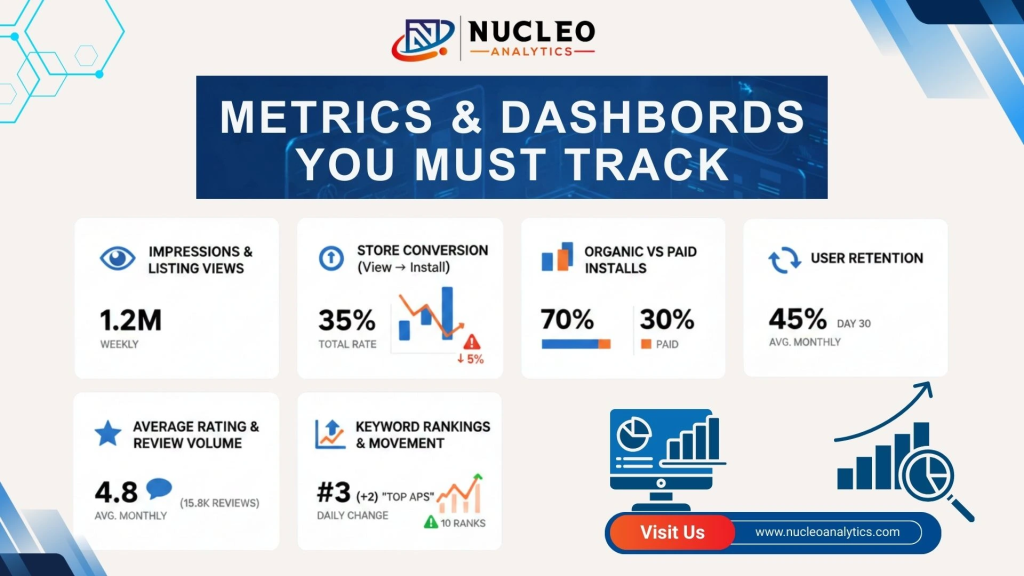
Track:
- Impressions and listing views
- Store conversion (view → install) by source
- Organic installs vs paid installs
- Retention
- Average rating and review volume
- Keyword rankings and movement
Monitor trends and investigate sudden changes quickly.
Select tools that fit your needs
You don’t need every tool. Pick a focused stack.
- A keyword research and rank tracker.
- A/B testing capability (Play Store experiments, Apple PPO).
- Review monitoring and crash analytics.
Start lean; scale tooling as your traffic and complexity grow.
Update cadence and release notes
Make releases meaningful and measurable.
- Bundle UX improvements, bug fixes, and new value in updates.
- Refresh store creatives and text when releasing major changes.
- Write clear update notes that help users understand the benefits.
Updates that solve real problems lead to better retention and review outcomes.
Category and feature tags: Optimize for discovery
The right category improves discoverability and sets user expectations.
- Choose the primary category that reflects the app’s main function.
- Use secondary categories or tags judiciously to surface in relevant contexts.
- Re-evaluate category choice if your product evolves significantly.
Misclassification increases uninstalls and harms ranking.
Align acquisition and ASO for consistent messaging
ASO performs best with coordinated acquisition campaigns.
- Match ad copy and landing creatives to store listing promises.
- Use short paid bursts to validate creatives and jumpstart store algorithms.
- Redirect traffic to the appropriate localized listing for the best conversion.
Consistency across touchpoints reduces drop-off and increases conversion.
A 30/60/90 plan for implementation
A cadence to operationalize ASO work.
- 30 days: Baseline metrics, quick metadata improvements, and design iterations.
- 60 days: Run A/B tests, localize top markets, and update onboarding.
- 90 days: Roll out winners, measure retention impact, and scale keyword efforts.
This cadence balances speed and rigor.
Common pitfalls to avoid
Be aware of recurring mistakes.
- Keyword stuffing or unnatural metadata.
- Changing multiple variables at once and losing clarity on causation.
- Ignoring retention while maximizing installs.
- Letting policy violations or crashes linger.
Avoid these, and you preserve hard-learned progress.
Competitive strategies for crowded markets
If your product is in a saturation category, apply differentiation by tactics.
- Through targeted long-tail keywords, gain ownership of a particular niche.
- Add a feature that makes your core value clearer in one screenshot.
- Drive press or influencer traffic to create a spike that the algorithm favors.
Small, defensible edges scale better than broad, diluted plays.
Weekly operational checklist
A practical sequence to maintain momentum.
Week 1: Gather data, define top metrics, and interview users.
Week 2: Draft new metadata and 3 icon variations.
Week 3: Create different types of screenshots and a mini preview video.
Week 4: Start dual tests for the elements with the highest impact.
Week 5–8: Watch, improve, and make available in the most important markets.
Repeat this loop every quarter.
A brief case study (illustrative)
Scenario: small habit app with low conversion.
Problem: High listing views, low installs.
Approach:
- User interviews revealed demand for minimal-friction one-tap logging.
- Listing rewrites emphasized “One-tap logging” in the subtitle and first screenshot.
- Icon simplified and onboarding shortened.
Result: Listing conversion rose from 3% to 7% and D7 retention improved marginally.
Small, aligned changes can shift both conversion and retention.
How copy and creatives should work together
Design draws attention; copy seals the decision.
- First screenshot must answer: “Will this app solve my problem?”
- Captions should be short outcome statements.
- Use clear action verbs: “Track,” “Save,” “Start”, not passive descriptors.
When copy and design align, conversion improves predictably.
Policy compliance and privacy posture
Maintain a clean standing with the stores.
- Be transparent about data use and subscriptions in metadata and privacy policy.
- Fix crashes and privacy alerts immediately.
- Avoid exaggerated claims that could trigger rejection or penalties.
Policy missteps can significantly reduce visibility overnight.
Team roles and governance
Clarify responsibilities to move faster.
- Product: onboarding and retention improvements.
- Marketing: metadata, creatives, and paid test campaigns.
- Analytics: dashboards and test significance.
- Engineering: releases, performance, and crash fixes.
Monthly and weekly syncs keep the loop tight and actionable.
Budget guidelines and resource allocation
Be pragmatic about spending.
- Early tests: $0–$500 for creative hours and basic tools.
- Intermediate: $500–$2,000 for pro creatives, advanced tools, and paid bursts.
- Scale: allocate for ongoing localization and testing.
Invest more after validated wins, not before.
Growth experiments that scale
Tactics that provide clear signals and learnings.
- Use product page variants (Apple) to tailor messaging by audience.
- Run short paid bursts to test creatives and observe conversion changes.
- Encourage thoughtful reviews by communicating with your users and reminding them when it is appropriate.
Consider your experiments as product decisions rather than hacks.
What success looks like (Measurable)
Define short, medium, and long-term outcomes.
- Short-term outcomes signify a higher conversion rate and keyword ranks going up.
- Medium-term outcomes concern more organic install volume along with better D7 retention.
- Long-term outcomes promise lower CPI, higher LTV, and growth that can be predicted.
Monitor the success in relation to the objectives that were established at the beginning.
Pre-release checklist for any push
Before you publish, verify the essentials.
- Backup current creatives and metadata.
- QA screenshots across device sizes.
- Confirm analytics and attribution are intact.
- Have a plan for reply templates if review volume spikes.
A checklist prevents avoidable regressions.
Continuous learning and discipline
ASO is an ongoing competency.
- Read case studies, participate in specialist forums, and follow store policy updates.
- Make weekly time for metric review and ideation.
- Build a culture of testing and documented learning.
Small, disciplined improvements compound into predictable results.
How Nucleo Analytics helps (from our perspective)
At Nucleo Analytics, ASO is an integrated product-growth discipline for us. Data diagnostics are the first step, followed by prioritizing experiments linked to your business goals, and then A/B testing to be sure of changing creatives and messaging. The whole process is managed by our team, which takes care of keyword research, localization, creative production, and analytics setup, thus allowing your product team to concentrate on the features that increase user retention. We aim at measurable gains and not vanity metrics, and we expand proven wins across markets. If you need a partner that combines product rigor with marketing, we can implement the above plan and keep iterating until the gains are permanent.
Conclusion
As we have stated earlier, app store optimization is a disciplined and repeatable activity: research, prioritize, test, measure, and scale. Start with simple aims and a simple 30/60/90 strategy, pay attention to clarity of titles and visuals and make retention a first-class indicator. Small validated additions will add up to significant organic growth over time. The above procedure will enhance visibility and ensure quality installation that is sustainable.
Want more people to find and install your app?
Frequently Asked Questions
Q1: What is App Store Optimization (ASO)?
Q2: How long does ASO take to show results?
Q3: Is ASO different for iOS and Android apps?
Q4: Why is keyword research important in ASO?
Q5: Do ratings and reviews affect app rankings?
Related Posts

Why Your Ads Deserve More TLC (Targeted Lead Clicks)
In the fast-paced digital world, having your ad noticed isn’t enough—connecting with the proper audience is essential. With billions of adverts displayed every day, your […]

10 Red Flags Clients Should Watch Out for in a Digital Marketing Agency
In the latest, fast-paced, virtual global environment, corporations mainly depend on being online to attract interactions, build trust, and boost income. But with so many […]

What Are the Top AI Visibility Solutions?
The internet is crowded. Billions of websites, millions of ads, and endless content are all competing for the same attention. The truth? Visibility has never […]

How to Generate Leads from Your Website?
Your website isn’t just a digital brochure; it’s your most powerful lead generation tool. Yet, many businesses struggle to convert visitors into actual prospects. The […]

8 Types of Digital Marketing Explained with Pro Tips (2026)
Digital marketing in 2026 is not about doing more. It’s about doing the right things with clarity. Most businesses don’t fail because digital marketing doesn’t […]

What are the 7 Cs of Digital Marketing? How to Effectively Implement Them?
Businesses are continuously looking for fresh approaches to improve their online presence, draw clients, and create close bonds with them in today’s fast-paced digital environment. […]