








What is omnichannel marketing? What are its benefits?
Let’s get one thing out of the way first.
Omnichannel marketing is not a buzzword anymore. It’s not a “nice to have” strategy either. It’s simply how modern marketing works when it’s done right.
Customers don’t move in straight lines. They scroll Instagram, Google something later, open an email, abandon a cart, come back through a WhatsApp link, and then finally convert after reading a blog or checking reviews. If your brand treats each of those touchpoints like separate worlds, you’re already behind.
That’s where omnichannel marketing comes in. Not flashy. Not complicated for the sake of it. Just connected, consistent marketing across every channel that matters.
This article will explain omnichannel marketing, how it works, the benefits, and why organizations are increasingly using companies like Nucleo Analytics to get it properly.
What Is Omnichannel Marketing?
Omnichannel marketing incorporates customer experiences in channels and touch points. Both online and offline. Organic and paid. Various digital advertising, email, the internet, social media, SMS, and in-store experiences.
The keyword here is unified.
It does not just mean being everywhere. That is multichannel marketing. Omnichannel implies that all channels will communicate with one another. Data flows. Messaging stays consistent. This makes the customer feel that they are not dealing with ten different teams that are not related.
That is why when somebody clicks a Google advertisement, visits your site, subscribes to e-mail, and then looks at a retargeting ad, the message will make sense in each step. There is nothing random or repeated. Starting over does not feel like anything.
That is how omnichannel marketing is supposed to be.
Omnichannel vs Multichannel
This is where most brands get confused. And honestly, it’s not fully their fault. These terms get used like they mean the same thing, even though they don’t.
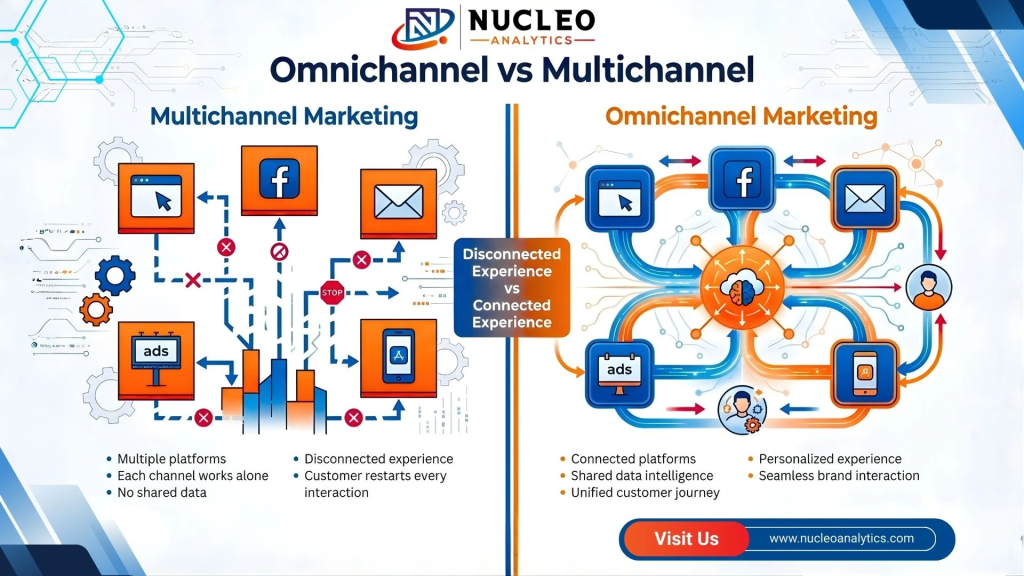
Multichannel marketing just means you show up on more than one platform.
You have a website. You post on social media. You send emails. Maybe you run ads too. Everything exists, but mostly on its own. Each channel does its job, then moves on.
Omnichannel marketing is different. Here, all those platforms are connected not just in how they look, but in how they work behind the scenes. Data moves between channels. One channel learns from another. The customer doesn’t feel like they’re starting over every time they interact with your brand.
Same channels. Same tools. Very different results.
Quick difference at a glance
| Area | Multichannel | Omnichannel |
| Channel setup | Platforms work separately | Platforms work together |
| Data sharing | Little to no | Shared across channels |
| Customer experience | Feels broken or inconsistent | Feels smooth and connected |
| Decision-making | Based on guesses | Based on real behavior |
| Growth impact | Busy but scattered | Focused and scalable |
That difference decides whether your marketing just runs… or actually grows.
Why Omnichannel Marketing Matters More Than Ever
Customer behavior has changed. That’s the short answer, and honestly, it’s enough of an answer.
People don’t trust one channel anymore. They don’t see one ad and convert. They don’t read one blog and make a decision. They research, compare, pause, get distracted, come back days later, and then finally act. Sometimes weeks later.
If your brand experience breaks at any point in that journey, they notice. The messaging feels off. The offer doesn’t line up. The tone suddenly changes. And when that happens, most people don’t complain. They just leave.
Omnichannel marketing helps organizations accept this fact more than fight it.
It keeps brands relevant throughout longer purchase cycles, especially in competitive marketplaces with slow decisions. Consistency fosters trust because people recognize your message and beliefs everywhere. It eliminates friction between touchpoints so clients don’t feel like they’re beginning over with your brand.
And maybe most importantly, it forces businesses to actually use customer data instead of collecting it, storing it, and doing absolutely nothing with it.
This matters whether you’re an e-commerce brand, a SaaS company, a local business, or even a service-based SEO agency trying to convert higher-intent leads who need more than one touchpoint to say yes.
The Process of Omnichannel Marketing
Let’s talk about the actual process of omnichannel marketing, because this is where most blogs stay vague on purpose. It’s also where many businesses fail, even when they have good intentions.
1. Understanding Your Customer Journey (Properly)
Not guessing. Not assuming. Not copying a generic funnel diagram.
Actually mapping it out.
Where do people first hear about you?
What makes them stop scrolling and pay attention?
What pushes them to research more?
Where do they hesitate or drop off completely?
Which channels influence conversions the most, even if they don’t get the final click?
This step requires analytics. Real tools, real data, and real behavior tracking. Without this, omnichannel marketing becomes a guessing game disguised as strategy.
This is also why brands often work with data-driven omnichannel marketing companies like Nucleo Analytics. Gut feeling doesn’t scale, and opinions don’t replace evidence.
2. Centralizing Data Across Channels
If your website analytics, CRM, email platform, paid ads, and social data all live in separate silos, omnichannel marketing simply won’t work. There’s no way around it.
You need a central view of the customer.
Who they are.
What they clicked.
What they ignored.
What content do they engage with?
What finally made them convert?
This is where smart tracking, attribution models, and proper integrations come in. It’s not exciting work. It won’t win awards. But it’s the foundation of everything else. Without it, you’re just stacking channels on top of each other and hoping for the best.
3. Creating Consistent Messaging (Without Sounding Robotic)
By consistency, we do not imply that we copy and paste the same message everywhere. That is indolent, and customers are aware of that.
Consistency implies that the basic concept remains the same, even in the case of format alteration.
- Your landing page should not be false about what you are promising on your Google ads.
- Your email message should not be a message that belongs to a different company.
- Your social posts must actually strengthen your core offer and not distract from your core offer in order to pursue engagement.
This is regardless of whether you are a DTC company selling products or a B2B SEO firm selling high-priced services. The viewers are listening, even when they seem not to.
4. Choosing the Right Channels (Not All of Them)
Omnichannel does not mean “be everywhere.” That’s a fast way to burn out your team and your budget.
It means being present where your audience actually engages and makes decisions.
For some brands, that’s search, email, and LinkedIn.
For others, it’s Instagram, WhatsApp, and paid social.
For many, it’s a mix that changes as the business grows.
Smart omnichannel marketing companies don’t chase trends. They prioritize channels based on data, audience behavior, and business goals. That’s how you avoid spreading yourself too thin.
5. Personalization at the Right Level
Personalization doesn’t mean using someone’s first name in every email. That’s basic, and most people ignore it.
Real personalization is about relevance.
Showing content that actually matches intent.
Time messages based on behavior, not calendars.
Adapting offers based on where someone is in their decision process.
When omnichannel personalization is done well, it feels helpful. When it’s done badly, it feels invasive. The difference isn’t technology. It’s a strategy.
6. Measuring, Optimizing, Repeating
Omnichannel marketing is never “done.” There’s no final version.
You track performance across channels.
You understand how they influence each other, not just who gets credit.
You adjust based on real outcomes, not vanity metrics like impressions or likes.
This is where analytics-focused partners like Nucleo Analytics stand out. They don’t just launch campaigns and move on. They measure what actually moves revenue and refine accordingly.
If your marketing channels feel disconnected, scattered, or just exhausting to manage, it’s probably not a content problem. It’s a strategy problem.
Nucleo Analytics helps brands build data-driven omnichannel marketing strategies that connect the dots instead of adding more noise.
Benefits of Omnichannel Marketing (The Real Ones)
Let’s skip the generic benefits and talk about what businesses actually gain when omnichannel marketing is done right.
Better Customer Experience
This one sounds obvious, but it’s foundational. Customers feel understood when the journey makes sense. They don’t have to repeat themselves. They don’t feel confused. They don’t feel pushed in different directions. That builds trust, and trust converts.
Higher Conversion Rates
When channels support each other instead of competing, conversions improve. Not magically, but consistently.
SEO supports paid ads by building credibility.
Email supports retargeting by reinforcing value.
Content supports sales by answering questions before they’re asked.
Everything works together instead of fighting for attention.
Stronger Brand Recall
Consistency builds memory. When customers see the same message, tone, and value across platforms, your brand sticks in their minds.
This is significant to competitive domains such as e-commerce, SaaS and online services such as SEO agencies, where the ability to differentiate is difficult, and attention span is limited.
Smarter Marketing Budgets
Omnichannel marketing will assist you in understanding what channels will be helpful to conversions, not only those that will receive the last-click credit. Such understanding can prevent a significant amount of unnecessary spending and redistribute funds much smarter in that.
Better Long-Term Growth
It does not deal with short-term surges or one-time victories. Omnichannel marketing creates systems that are scaled. The one that adjusts with your growth and change of behavior. Hacks are beaten by systems each and every time.
Why Businesses Are Turning to Omnichannel Marketing Companies
Doing omnichannel marketing in-house sounds great on paper. In reality, it’s hard.
It involves technical installation, data consolidation, planning, and continuous optimization. All at once.
The majority of the teams lack the bandwidth or skills to take care of all that at any given time. This is the reason why it is reasonable to collaborate with experienced omnichannel marketing companies.
Such agencies as Nucleo Analytics concentrate on analytics-based approaches, rather than channel performance. That distinction is important when you are aiming to develop in a sustainable manner rather than being busy.
How Does Omnichannel Marketing Support SEO?
SEO isn’t isolated anymore, but some still think so.
Paid ads impact organic performance.
Content efficacy guides email strategy.
Measured engagement indirectly affects search visibility.
A good SEO agency now understands omnichannel behavior, not simply keywords and rankings.
SEO works better in an omnichannel strategy. Traffic improves. Increased conversion intent. Having support improves content performance.
Conclusion
Omnichannel marketing isn’t about doing more. It’s about making what you already do actually work together.
Customers don’t see channels. They see experiences. When your messaging, data, and touchpoints are aligned, marketing feels smooth instead of scattered, and results follow.
That’s why the process matters. With the right strategy and data behind it, omnichannel marketing turns disconnected efforts into real, sustainable growth.
Ready for Smarter Omnichannel Marketing? Nucleo Analytics helps brands build connected, data-driven omnichannel strategies that work.
Frequently Asked Questions
1. How does Nucleo Analytics help with omnichannel marketing?
2. Is Nucleo Analytics an omnichannel marketing firm or data partner?
3. Is Nucleo Analytics compatible with other marketing tools and platforms?
4. Which kind of businesses can be served best by Nucleo Analytics?
5. What is the duration of results after using Nucleo Analytics’ omnichannel approach?
Related Posts

Why Your Ads Deserve More TLC (Targeted Lead Clicks)
In the fast-paced digital world, having your ad noticed isn’t enough—connecting with the proper audience is essential. With billions of adverts displayed every day, your […]
What is AEO in Marketing?
In today’s rapidly changing digital marketing landscape, being seen equals being ahead. Time-tested SEO methods have long ensured brands gain traction through organic search, but […]

Master Keyword Competition Analysis with This Simple Guide
In today’s fast-paced era of online marketing, mere posting of content does not suffice. You may possess phenomenal products or services, but unless your website […]

Best AI Tools for Content Creation in 2025 (Free + Paid)
The content creation landscape has changed tremendously, and AI tools in 2025 are no longer an option; they have become a necessary component in the […]

How Can Marketing Automation Tools Improve Your ROI?
Marketing today feels like juggling while someone keeps throwing extra balls at you.You’ve got social media, email campaigns, SEO tasks, paid ads, customer follow-ups, analytics […]

Nucleo Analytics Recognized Among Top-Rated Digital Marketing Agencies Globally in 2026
Most businesses do not struggle because they lack ideas. They struggle because digital growth becomes difficult to manage all at once. SEO changes constantly. Content […]