Social media is different now. Once you could post something on Facebook, Instagram, or LinkedIn, and most of your followers would be able to see it. Not anymore. With time, things have changed. There has been a decline in organic reach, algorithms benefit ads, and “pay-to-play” is the new norm.
For brands, that translates to the fact that you can’t simply post and expect results if you want to see anything. You need a solid strategy that involves wise content and paid promotion. And this is where social media marketing firms come in to navigate brands through the din.
So, what is “pay-to-play social media”, anyway? Why does it mean so much to businesses today? And how can brands most effectively use it without breaking the bank? We will explain it all in a simple yet effective way.
What Does “Pay-to-Play” Mean on Social Media?
The term “pay-to-play” is literally what it suggests. To get actual visibility on social media, you pay for it. Platforms are no longer a free resource where organic posts alone provide exposure.
- Organic reach declined – On Facebook, organic reach for commercial pages typically hovers below 5%. That amounts to if you have 10,000 followers, possibly 500 will view your post without advertising.
- Algorithms favor ads – The platforms need ad money. So, they elevate sponsored content.
- Competition is massive – Brands of all sizes are competing for visibility. Paying makes you noticeable in the crowd.
So, “pay-to-play” is more of a necessity and less of a choice if you desire consistent results.
Why Did Social Media Become Pay-to-Play
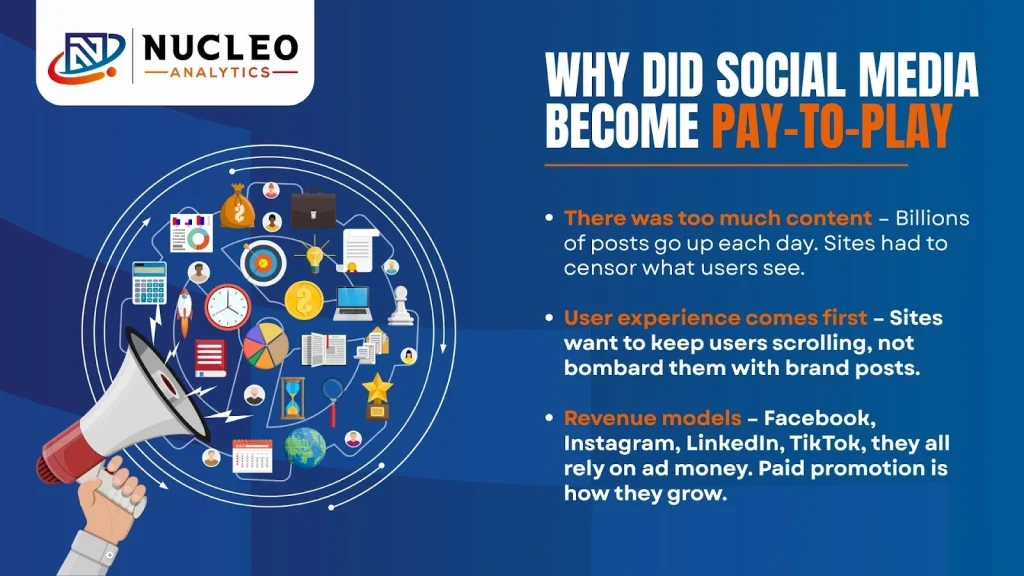
- There was too much content – Billions of posts go up each day. Sites had to censor what users see.
- User experience comes first – Sites want to keep users scrolling, not bombard them with brand posts.
- Revenue models – Facebook, Instagram, LinkedIn, TikTok, they all rely on ad money. Paid promotion is how they grow.
This shift means businesses have to think differently. Posting content is still important, but now it works best when paired with a budget.
The Realities Brands Face Today
If you’re running a business and relying only on free posting, here’s what you’re likely dealing with:
- Posts barely reaching your followers.
- Low performance despite good content.
- Frustration at the frequency at which competitors appear in the feeds.
This is why “boosting posts” or the use of ads isn’t an afterthought; it’s the core to growth on these sites.
The Benefits of Paid Social Media Advertising
So paying is a necessity. But is it worth doing? Absolutely, when done well. Some of the greatest advantages of paid social media advertising for brands include:
- Reach the people you want to reach – Ads enable you to target by age, location, interests, job title, and even behavior.
- Scale quickly – Results in days or weeks, not months.
- Measure everything – You’ll know precisely how many people saw, clicked, or bought.
- Test and learn – Ads enable you to test different messages to determine what works best.
- Stay in the game – If your competitors are paying and you’re not, they’ll take up the slack you leave behind.
Yes, it does cost money. But in relation to the potential income, the payoff can be worthwhile many times over.
Popular Myths About Pay-to-Play
Let’s dispel some myths. Many businesses stay on the sidelines due to these myths:
- “I can’t afford ads.” – You don’t have to spend a lot of money to get started. Even modest spending can deliver good returns if utilized effectively.
- “Ads are for big brands only.” – Small companies can match big brands with the right creative and targeting.
- “Organic is enough.” – No longer. Organic performs best when used as a support mechanism, rather than the primary driver.
- “Ads are just for sales.” – Nope. You can leverage them for awareness, leads, or even trust-building.
Realizing this makes companies break free from resisting and begin to plan intelligently.
Organic + Paid: The Winning Combo
Consider organic content as your brand voice, and your amplifier as paid content. One without the other doesn’t play as well.
- Organic builds trust. Regular posting reveals your brand personality.
- Paid drives extend. Ads shove that content in the faces of the correct people.
- Combining them scales. Mixing the best bits of these two ensures that you benefit from both ends.
The best brands aren’t picking one or the other; they’re weighing both.
Don’t bury your content in the feed. Speak to Nucleo Analytics today and learn how intelligent paid strategies can put your brand in front of the correct people.
What Are the Best Social Media Ads?
Not every ad is created equal. The primary types that most brands utilize are below:
- Boosted posts – Easy method to boost a current post. Suitable for engagement.
- Image ads – Easy, clean, simple to execute. Ideal for direct offers.
- Video ads – Highly interactive. Excellent for storytelling or demos.
- Carousel ads – Several images packed within an ad. Ideal for product demonstrations.
- Lead gen ads – Capture emails or sign-ups within the platform itself.
- Retargeting ads – Encourage individuals who have visited your site but have not converted.
All are valid in their own right. The best strategy is to test and combine them depending on what you’re trying to accomplish.
Social Media Advertising Services: What They Actually Do
Chances are, if you’ve heard of social media advertising services, you’re wondering what they entail. They usually encompass:
- Strategy and planning (selecting the correct platforms and audience).
- Ad creation (photos, videos, copy).
- Campaign management (performance tracking on a daily basis).
- Retargeting (talking to people who have already been exposed to your brand).
- Reporting (so that you know exactly what’s working)
For most brands, all of this can be paralyzing if it is being done within the company. Because of this, many work with agencies or companies that specialize in this.
Mistakes Brands Make with Paid Social
Now that we’ve covered what to do, let’s discuss what not to do:
Not establishing clear objectives – Unless you know you want to drive sales, leads, or awareness, you’ll be throwing money down the drain.
- Targeting too generically – Trying to reach everyone typically means reaching no one at all.
- Forgetting creatives – Ads that are boring get skipped, regardless of budget.
- Not measuring results – Creating ads without tracking ROI is like driving in the dark.
- Stopping too soon – Ads take time to make an impact, so it’s important not to stop too soon.
If brands don’t learn from such mistakes, it can cost them a lot of money and headaches as well.
How Brands Can Get Ready for the Future of Social Media
Pay-to-play is not leaving. If anything, it’s more crucial. Here’s how brands can get ready:
- Budget for ads monthly. Make it like rent or electricity, it’s an essential expense.
- Invest in creativity. The higher your visuals and videos, the higher your ads perform.
- Use data wisely. Test small, then scale what works.
- Be adaptable. Platforms continually evolve. What works today won’t necessarily work tomorrow.
- Focus on the long-term. Paid ads yield immediate results, but gaining trust in your brand takes time.
Want to squeeze every ad dollar for more value? Our professionals at Nucleo Analytics assist brands with using social media advertising services that really get the job done.
Where Nucleo Analytics Comes In
All of this might look wonderful in theory, but executing campaigns can be overwhelming. But worry not! That’s where we come in. Our team at Nucleo Analytics does more than simply run ads. We help brands build actual strategies that mix content, targeting, and data to deliver real results.
From strategy and conceptual design to campaign management and measurement, we ensure that every dollar you are spending is delivering value. Whether it’s a smaller business trying to run advertising for the first time or a larger brand taking its marketing to the next level, our advertising philosophy is straightforward and performance-based.
We know social media is noisy. That’s why we focus on highlighting your brand in the right way, not just adding to the noise.
Conclusion: Pay-to-Play Is Here to Stay
The days of free organic reach are long gone. If your brand wants visibility, growth, and actual results, you can’t ignore pay-to-play. It’s not about throwing money blindly; it’s about using strategy, creativity, and data to make your investment count.
And you don’t need to do it all yourself. With a partner like Nucleo Analytics, your brand gets the most out of social media’s pay-to-play. You’ll no longer waste dollars, but instead, experience genuine growth, increased engagement, and a better return on investment.
Ultimately, the adaptable businesses will succeed. The resistant ones will find it hard to remain in the limelight. The decision is easy: embrace the new normal, work intelligently, and let a paid advertising agency take you to results that count.
Ready to get pay-to-play to work for you? Join hands with Nucleo Analytics, a reliable paid advertising agency, and begin converting clicks into loyal customers today.