Think back to managing Google Ads years ago. You would sit there messing with bids by a few cents, adding negative keywords, and manually fixing daily schedules. It honestly sucked, but you were the one actually running the show.
Today, you do not even get to touch those buttons. Tech platforms want everything automated, basically forcing everyone to run on AI PPC systems whether it makes sense for your specific business or not. The old manual ways are dead.
It is a weird, messy time to be buying ads. Things move way too fast, the algorithms change weekly, and your money can disappear instantly if you are not paying close attention to the settings. You just have to adapt.
Look, this is not about making your life easier with spreadsheets. It completely alters how your copy gets written, who buys your products, and where your cash goes. Here is how it really works right now.
The Shift to Machine Learning: How AI is Changing PPC
The way search works right now is completely different from the old keyword matching days. Today, the system looks at what someone is actually trying to find, their recent clicks, and what they did five minutes ago just to pick an ad. That is exactly how AI is changing PPC right in front of us, and it happens instantly.
Platforms want you to trust their automated systems completely. They push broad match keywords and automated bidding because their machines can process billions of data points at once. A human cannot compete with that processing speed.
However, this does not mean you should just turn on campaigns and walk away. The algorithm only knows what you teach it. If you feed it bad information, it will waste your budget faster than ever before.
The real game now is signal management. All you have to do now is feed your data to the machine, and the process becomes much easier because the automation works in your favor and not vice versa.
Google’s New Playbook: Embracing AI-Powered Google Ads
Google Ads is no longer just a platform where you buy text space. It has turned into an ecosystem fully run by machine learning models like Gemini. To win here, you must adapt to AI-powered Google Ads structures.
Take Performance Max campaigns as an example. They mix Search, YouTube, Display, and Maps into one giant pot. You give Google the assets, and the AI Google Ads system figures out the rest.
Why Clean Signals Matter for AI Google Ads
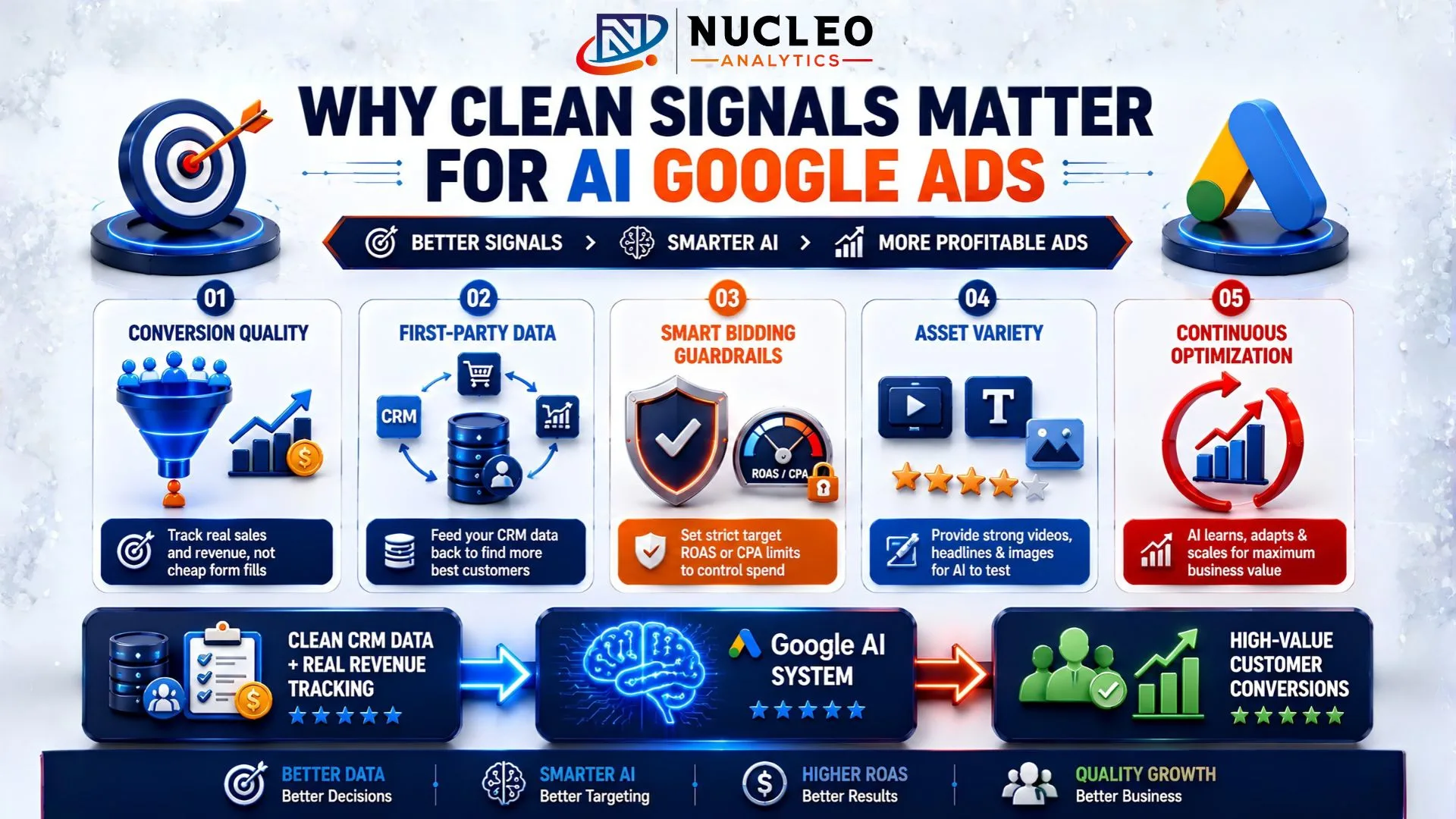
- Conversion Quality: The machine optimizes for whatever you track. If you track cheap form fills, the AI PPC system will find lots of low-quality leads. You must track actual sales and revenue to get real business value.
- First-Party Data: Feed your CRM data back into the platform. This tells the system exactly who your best customers are so it can find matching profiles.
- Smart Bidding Guardrails: Set strict target ROAS or CPA limits. Without these boundaries, the automated systems might spend heavily during high-traffic learning periods.
- Asset Variety: Provide high-quality videos, headlines, and images. The system tests different combinations automatically, so your creative assets need to be strong.
[Clean CRM Data + Real Revenue Tracking] ---> Google AI System ---> High-Value Customer Conversions
If you do not set up these guardrails, automated campaigns can easily focus on your brand name traffic. That makes your dashboard reports look amazing, but it does not bring in new customers. True growth requires forcing the machine to target non-branded, fresh audiences.
Beyond the Search Bar: The Future of PPC Advertising
People are changing how they look for information online. They are not just typing short phrases into standard search bars anymore. They talk to conversational bots and use voice assistants to get immediate answers. This reality is reshaping the future of PPC advertising for everyone.
Ads are now showing up directly inside AI-generated summaries and chat conversations. This means your ad content has to blend naturally into an ongoing conversation. It is less about shouting for attention and more about providing the exact solution a user needs.
AI assistants are also emerging in a shopping role on behalf of humans; they look at reviews and prices and then narrow down the choices. Your landing pages must be easy for these digital machines to scan and understand.
If your website data is messy, these shopping bots will ignore your business entirely. Clear text, structured product feeds, and straightforward pricing are non-negotiable now. You have to convince both the human buyer and their digital assistant.
Need Help Adapting Your Campaigns? Let Nucleo Analytics Optimize Your Ads for the Future
Navigating the Shift: AI in Paid Advertising
Marketers also fear the extinction of their profession due to the advent of automation technology. This is partly true; simple functions such as manual bidding are being automated. But AI in paid advertising actually opens up more time for big-picture strategy.
The modern marketer acts more like a pilot supervising an autopilot system. You decide the destination, load the fuel, and monitor the gauges. The machine handles the repetitive micro-adjustments during the flight.
When you try too hard to fight autopilot, you will end up crashing the plane. However, when you ignore the indicators at all costs, you will deplete your fuel.
Your focus should shift toward understanding customer behavior and building great offers. The machine can optimize the delivery, but it cannot fix a bad product. It cannot make a boring offer look exciting to a real human.
Where Humans Beat the Algorithm
- Deep Audience Psychology: Machines crunch numbers, but they do not understand human emotion. Writing an offer that truly connects with a customer's pain points still requires human empathy. You have to know what keeps your buyers awake at night.
- Business Strategy Alignment: An algorithm does not know your profit margins or inventory issues. You have to steer the ad spend toward products that actually make your company money. Humans must dictate the commercial priorities.
- Creative Angle Testing: AI can generate variations of text, but humans invent the core creative concepts. Bold, unique hooks still come from human brains. A machine only mixes old ideas; humans create entirely new ones.
- Funnel Optimization Tactics: If your landing page has a confusing checkout process, no amount of traffic will fix your sales numbers. Humans must analyze the user experience and remove friction points.
- Competitive analysis insight: It is impossible for machines to analyze vulnerabilities in a competing company’s business strategy. Humans can identify gaps in a competitor’s customer support and product line and use that information immediately when designing ad messages.
- Brand consistency across all channels: While the algorithm is preoccupied with itself, humans can make sure that your search advertising campaign sounds the same as the one you’re running on social media and in print.
- Data collection strategy: Coming up with a way to collect customer data that would be legal and compliant takes human creativity. In order to do it, you have to earn customers’ trust first.
- Designing an offer structure: Choosing between a buy one get one free and a percentage discount is impossible without a human’s business sense because there is a trade-off between immediate conversions and brand reputation.
When you use AI PPC tools to handle daily maintenance, you can focus on building better landing pages. You can improve your offers and study your competitors closely. Strategy is where you win the market today.
Spend your newly discovered free time talking to your actual customer service team. Figure out what customers complain about, and use their feedback as input to create ad copy that addresses those concerns.
At the end of the day, marketing is still just about connecting with a real person. The software and the flashy tools change constantly, but what makes someone actually pull out their credit card stays exactly the same. If you understand what your buyers care about, the tech part is easy to handle.
The Pitfalls of Fully Automated PPC Campaigns
It is easy to fall into the trap of trusting the software completely. Ad platforms make automation sound foolproof, but unguided systems can burn through cash quickly. Relying blindly on automated PPC configurations comes with real risks.
Algorithms love volume. If left alone, they often chase cheap clicks that do not convert into actual profit. They might show your ads on low-quality mobile apps just to hit a traffic goal.
Imagine your ad popping up inside a kids' gaming app. A toddler accidentally clicks your banner while trying to close a pop-up. You just paid for that click, but there is zero chance that toddler buys your software.
This happens constantly when you leave campaigns on complete autopilot. The platform's algorithm marks that click as engagement and looks for more of it. It creates a feedback loop of wasted ad budget.
Another issue is the lack of transparency. Automated campaigns often hide exactly where your budget is going. You have to dig deep into reports to ensure your money is reaching real buyers.
Guided AI Advertising | Unguided AI Advertising |
Uses CRM data for real sales | Optimizes for cheap button clicks |
Excludes junk placements & apps | Spends budget on random mobile apps |
Filters out branded search loops | Claims credit for organic traffic |
Driven by human business logic | Runs on generic platform defaults |
To avoid these traps, you need to implement negative keyword lists and exclude junk placements regularly. Keep a close eye on your actual business revenue, not just the clicks inside the platform dashboard.
You should also set up alert systems for sudden budget spikes. Sometimes an algorithm enters a learning phase and spends your daily budget within an hour. Regular manual check-ins prevent these costly surprises from destroying your monthly margins.
Do not let the convenience of automation make you lazy. A successful campaign requires constant, aggressive monitoring. Treat the automated platform like a powerful engine that always needs a skilled operator at the wheel.
Staying Ahead with Nucleo Analytics
Trying to keep up with all this stuff while running your actual business is a total headache. The platforms change their settings every single month, and one wrong checkmark can easily drain thousands of dollars from your account overnight. That is why you need real people watching your back.
At Nucleo Analytics, we do not just turn on Google's automatic settings and pray for the best. We use smart AI PPC setups but keep a heavy human hand on the steering wheel. We make sure your conversion tracking actually works, and your money goes to real buyers, not bots.
We know how to build tight guardrails around these wild algorithms so you get actual sales instead of empty clicks. We will handle the confusing technical mess while you focus on running your company.
How We Keep Google From Wasting Your Money
- Fixing Your Tracking: We set up direct server tracking so ad blockers cannot mess with your data. This gives the algorithm the exact sales data it needs to find more real buyers.
- Custom Account Scripts: We plug in our own custom scripts to watch your accounts 24/7. If Google tries to spike your budget on a weird junk website, our scripts kill it instantly.
- Human-Made Creatives: AI-generated ad copy all sounds exactly the same. Our team writes real, punchy hooks that actually grab a human customer's attention before they scroll past.
- Focusing on Margins: We do not care about vanity metrics like impression share. We sit down with you to look at your actual product margins and build a strategy around real profit.
Our team tracks these messy algorithm updates every single day so you do not have to spend your weekends stressed out reading tech forums. We treat your ad budget like it is coming out of our own pockets.
In case you decide to cooperate with us, rest assured that we will keep everything absolutely clear for you. You will know precisely how every penny will be spent by our team, without any confusing agency jargon. Let us protect your ad spend and scale what actually works.
Ready to Fix Your Campaigns? Contact Nucleo Analytics Today to Protect Your Ad Budget
Conclusion
The evolution of paid media is not stopping. Algorithms will keep getting smarter, and ad platforms will keep removing manual controls. The businesses that thrive will be the ones that learn to guide these machines effectively.
Stop fighting the automation and start orchestrating it. Focus on your data quality, perfect your creative assets, and protect your margins. That is how you win the game today.