









Should You Focus on Traffic or Conversion Rates First?
Everyone talks about traffic like it is the holy grail. More clicks, more visitors, more numbers to brag about. But let’s be real. Traffic alone does not make your site successful. You can have thousands of visitors and still get nothing if they leave without doing anything.
That is where conversion rates come in. This is the real measure of success. It indicates the number of individuals who truly take action, make purchases, register, or participate. Pursuing only traffic without considering conversions is akin to trying to fill a bucket that has holes.
Focusing correctly from the start can prevent headaches, unnecessary expenses, and significant stress. Visitors are valuable, but only if they engage in what truly counts
Through smart conversion rate optimization, every click starts to mean something—turning interest into action is what wins.
What Are Conversion Rates?
Let’s start simple. Conversion rates are the percentage of visitors who take the action you want.
That action could be:
- Buying a product
- Registering for a newsletter
- Obtaining a manual or list of tasks
- Completing a contact form
Quick example:
- 1,000 people visit your site
- 50 do what you want
- That’s a conversion rate of 5 percent
It’s simple math, but the results are huge. Conversion rates indicate if your website is effectively fulfilling its purpose. Traffic by itself? That’s merely pride. Heavy footfall without sales resembles a bustling shop with no cash register ringing. You’re welcoming, customers are entering, yet no one is making purchases.
Why Conversion Rates Matter More Than Traffic
Traffic feels sexy. Pageviews, clicks, visitors, they look impressive on reports. But the truth? Traffic doesn’t pay the bills. Conversions do.
Here’s why conversion rates should always come first:
Quality Beats Quantity
One hundred engaged visitors who genuinely value your product far outweigh a thousand casual users. Quality over numbers. Always.
Better Return on Investment
You don’t need more ads if your current traffic converts better. Every visitor already on your site is a chance to earn more revenue. Treat your existing traffic like gold.
Easier to Scale
Once your conversion rates are solid, adding traffic is like turning on a faucet. Every new visitor has a better chance to convert, and growth multiplies naturally.
At Nucleo Analytics, we tell clients: fix the leaks before you scale. It’s not flashy advice, but it’s what actually drives sustainable growth.
Ready to Boost Your Conversions?
Understanding Traffic Sources
Not all traffic holds the same value. The origin of your visitors is just as important as the number of attendees.
The primary sources of traffic are as follows:
- Organic Search: People typing queries into Google. Often high intent—though trends like zero-click searches are reshaping behavior.
- Paid Ads: Alphabet, Meta, Vimeo. Involves expenses, yet allows precise targeting of your desired audience.
- Social Media: Instagram, TikTok, LinkedIn. Casual visitors can transform with the right motivation.
- Referral Traffic: Other sites sending their audience your way. Usually engaged if the referring site is relevant.
- Email Marketing: Subscribers clicking through. Warm leads who already trust your brand.
Understanding traffic sources and conversion tracking helps you focus optimization where it counts. Chasing irrelevant traffic is like trying to sell ice to penguins—a waste of effort.
Click-Through Rate (CTR) and Its Role
Click-through rate (CTR) is important before people access your site. CTR is a measure of the number of individuals who have clicked your ad, email, or link over those who have viewed it.
Example:
- 1,000 people see your ad
- 50 click it
- CTR = 5 percent
CTR matters because it’s the bridge between traffic and conversions. High CTR brings people in. Conversion optimization makes sure they take action once inside. Without CTR, even a perfect site gets no visitors. Without conversion optimization, clicks go nowhere.
Think of CTR as getting someone in the door. Conversion optimization is making sure they leave with something in their hands.
What Is Conversion Optimization?
Conversion optimization is making your website work harder. It’s turning casual visitors into customers without spending a ton more money.
Key tactics:
- Landing Page Focus: One clear action per page. Remove distractions. Visitors should know exactly what to do.
- Speed Up Your Site: Slow pages kill conversion rates. Tools like PageSpeed Insights help.
- A/B Testing: Test headlines, buttons, images. Data beats assumptions every time.
- Mobile First: Most visitors are on phones. Make it easy with a properly mobile-friendly website. Clunky mobile experiences tank conversions.
- Strong CTAs: Clear, actionable, and specific beat clever or vague every time.
Conversion optimization is a process. Test. Adjust. Measure. Repeat. Small tweaks can create big growth over time.
Traffic vs Conversion Rates: Which Comes First?
Here’s the golden rule:
If your conversion rates are low, fix that first before chasing more traffic.
More visitors on a site that doesn’t convert is wasted effort. Like hiring more workers to operate a broken machine. No matter how many you add, the output stays low.
Focus on conversion rates first. Once your site converts, scaling traffic becomes easy. Every new visitor becomes valuable, and growth multiplies naturally.
How to Balance Traffic and Conversion Rates
Yes, you need traffic. But make it smart traffic, and pair it with strong conversion optimization.
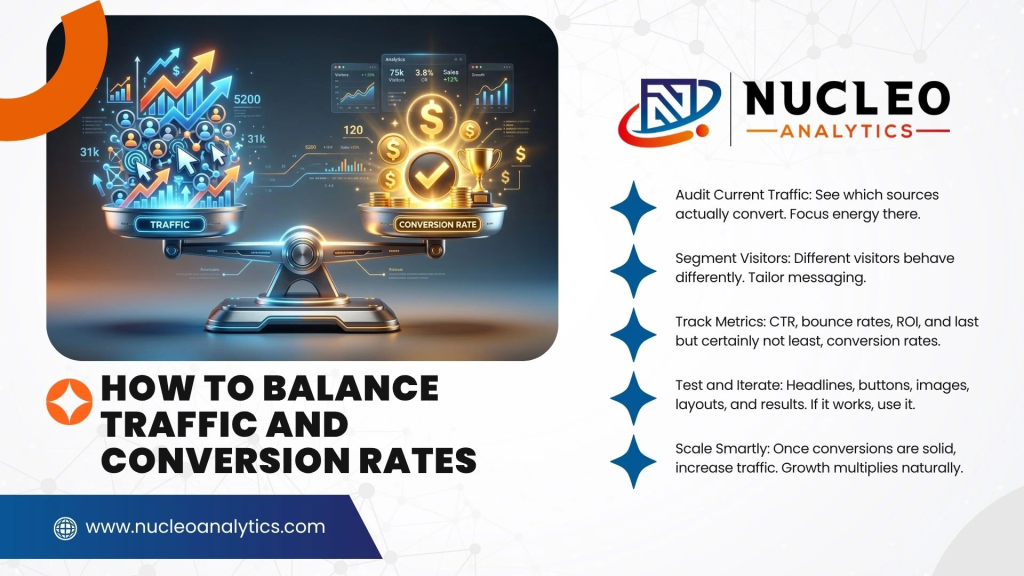
Steps to balance:
- Audit Current Traffic: See which sources actually convert. Focus energy there.
- Segment Visitors: Different visitors behave differently. Tailor messaging.
- Track Metrics: CTR, bounce rates, ROI, and last but certainly not least, conversion rates.
- Test and Iterate: Headlines, buttons, images, layouts, and results. If it works, use it.
- Scale Smartly: Once conversions are solid, increase traffic. Growth multiplies naturally.
Smart balance maximizes every click and dollar. Growth feels easier when your foundation is strong.
Real-World Example
Take an online fitness store:
- 10,000 visitors per month
- 1 percent conversion
Instead of buying more ads, they focus on conversion optimization:
- Simplify checkout
- Add reviews for trust
- Streamline navigation
- Optimize mobile experience
Result? Conversion rates double to 2 percent. Same traffic, twice the sales.
Then, when they scale traffic, every visitor has a higher chance of converting. Fix conversions first, then add visitors. It’s like fixing the engine before hitting the gas.
Common Mistakes to Avoid
Even pros trip up. Watch for these traps:
- Chasing Vanity Metrics: Large traffic volumes are useless unless they are converted.
- Neglecting Mobile Users: Unfriendly websites destroy conversions in a short time.
- Ignoring User Experience: Slim pages, bad navigation, disheveled design = lost customers.
- Skipping Testing: No test, no statistics, no progress.
- Relying on One Channel: While having traffic from organic search, it is always risky. Diversify your traffic.
Avoid the following, and your conversions will increase naturally.
The Role of a Digital Marketing Plan
Your digital marketing plan is the glue that holds traffic and conversion together.
A solid plan includes:
- Clear goals for traffic and conversions
- Audience research
- Awareness of current digital marketing trends to guide strategy
- KPIs to measure success
- Conversion optimization strategy
- Content plan to attract the right visitors while avoiding content decay.
- Regular analysis and adjustments
Traffic brings people in. Conversion optimization turns them into customers. A plan makes it all work together efficiently. Without a plan, you’re guessing. With a plan, every move has purpose.
Conclusion
Focus on conversion rates first. Traffic is useless without conversions. Nail your site’s ability to turn visitors into customers, then scale traffic smartly. CTR, traffic sources, and a solid digital marketing plan help, but nothing beats a site built to convert.
At Nucleo Analytics, we specialize in conversion optimization and actionable digital marketing plans. Turn clicks into real customers. Boost your conversion rates today and make every visitor count. Growth starts here.
Turn Clicks into Customers Today
FAQs
Is traffic consideration or conversion?
How can I boost my conversion rates?
Should I focus on a single traffic source?
How do I know if my site is working?
Related Posts

Top 8 Digital Marketing Trends 2024
The digital marketing landscape is reliably unpredictable and advancing at a rapid pace. Hope you all agree to it! While 90s fashion trends have made […]

Conversion Rate Optimization (CRO): What It Is and How to Boost Conversions
Something is very wrong if you’re spending a lot of time and money on increasing website traffic, but visitors aren’t becoming clients, leads, or subscribers. […]

Master Keyword Competition Analysis with This Simple Guide
In today’s fast-paced era of online marketing, mere posting of content does not suffice. You may possess phenomenal products or services, but unless your website […]

What Content Leaders Should Understand About Agentic AI Now?
Content marketing has always been a matter of strategy, creativity, and timing. But now, a new power is influencing how organizations create, distribute, and measure […]

How does AI Impact Content Marketing Strategies Today?
We have entered a moment where content marketing no longer feels predictable or linear. It shifts fast, audiences change their behaviour even faster, and competition […]

Instagram & TikTok SEO: How to Make Your Content Discoverable
When you’ve spent hours crafting what you envisioned as the ultimate Reel or TikTok just to have it flop with barely a few views, you […]