Most businesses don’t really lose because of bad products or weak services. They lose because nobody finds them at the right moment. And when they do get found, the traffic doesn’t always turn into actual customers.
That’s where things start getting confusing. You hear about local SEO vs national SEO and assume it’s one thing, one strategy, one playbook, but it’s not. The real question hits when you actually have to decide where to focus. Do you go all in on your city and nearby customers, or try to compete with everyone across the country at the same time? That’s really where things split.
It stops being just a topic and turns into a real business call. Local SEO is more about speed and being close to the customer. National SEO is more about reach and building authority over time. They don’t behave the same at all once you start working on them.
A lot of businesses don’t figure that out early. They end up doing a mix of both, not really committing, and then wonder why nothing feels stable or consistent. Once you see how different the direction is, it’s easier to stop guessing and actually pick a path that matches how your business earns.
Overview of Local SEO
Local SEO is built around one simple idea. Show up when people nearby are searching for what you offer. It is tied to geography, intent, and urgency. Someone is not casually browsing. They are looking for something close and available right now.
For example:
- “dentist near me”
- “best bakery in Chicago”
- “Plumber open now”
Google treats these searches differently. Instead of showing a global list of websites, it prioritizes map results, local businesses, and proximity. Local SEO focuses on visibility in that exact moment.
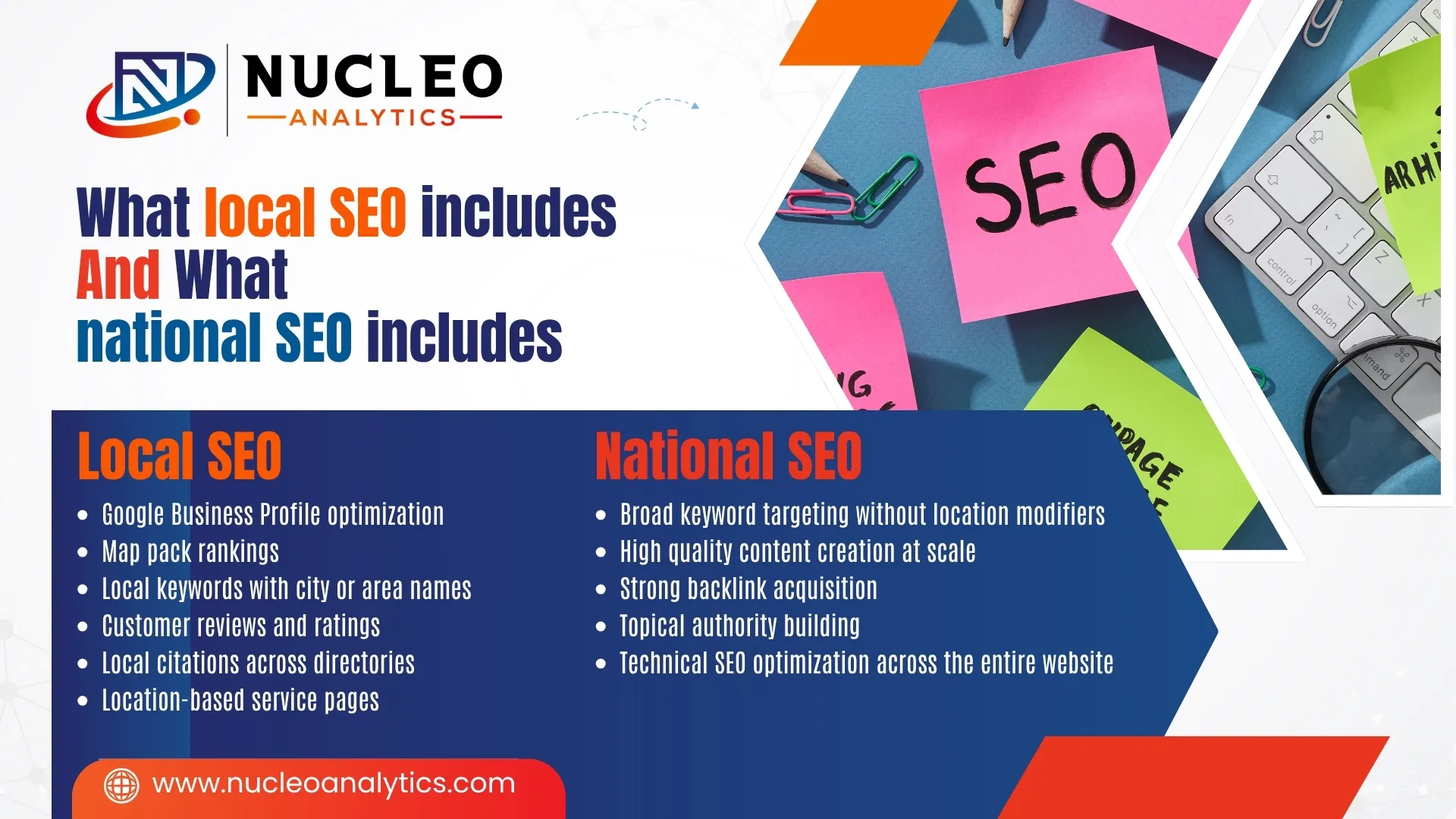
What local SEO includes
- Google Business Profile optimization
- Map pack rankings
- Local keywords with city or area names
- Customer reviews and ratings
- Local citations across directories
- Location-based service pages
The goal is not to reach everyone. The goal is to reach people within a specific radius who are ready to take action. This is where local seo for small businesses becomes extremely important. Small businesses do not need national attention. They need consistent local demand.
A well-structured local presence can turn a small shop or service provider into the first option people see in their area.
Overview of National SEO
What national SEO includes
- Broad keyword targeting without location modifiers
- High quality content creation at scale
- Strong backlink acquisition
- Topical authority building
- Technical SEO optimization across the entire website
- SaaS companies
- E-commerce brands
- Online service providers
- Businesses selling across states or nationwide
Comparison table: Local SEO vs National SEO
Pros and cons of Local SEO
Pros of Local SEO
Cons of Local SEO
Pros and cons of National SEO
Pros of National SEO
Cons of National SEO
Common SEO Mistakes Businesses Make
A lot of businesses do not fail at SEO because of effort. They fail because they are aiming in the wrong direction from the start. One of the biggest mistakes is treating local SEO like national SEO. They start writing generic blog posts when what they actually need is local pages that convert. Another common issue is ignoring Google Business Profile. Some businesses set it up once and forget it completely, then wonder why they are not showing up on maps.
There is also the keyword problem. People either go too broad or too narrow, and both end up killing visibility. And finally, many businesses never track what matters. They look at traffic, not leads. SEO is not about visitors. It is about who actually calls, books, or buys. Most SEO problems are not technical. They are direction problems.
Which option is better for different businesses
This is where most people actually need clarity. There is no universal winner. It depends entirely on how your business operates.
Local SEO is better if:
You run a business that depends on physical presence or local customers. This includes:
- Restaurants
- Dentists
- Gyms
- Local contractors
- Service providers like plumbers or electricians
If customers come to your location or you go to theirs, local SEO is the right direction.
It is also better if you want quicker leads and do not need a national scale.
National SEO is better if:
Your business is not tied to a physical location.
This includes:
- SaaS platforms
- Online stores
- Digital service agencies
- Information-based websites
- Nationwide consulting services
If your customers can come from anywhere, national SEO gives you room to grow. It also fits better for businesses thinking long term about brand authority and scalability.
Mixed approach
Some businesses sit right in the middle. They serve local clients but also take work online, sometimes even both at the same time. That’s where a mixed setup actually makes sense. Local SEO drives fast inbound leads from nearby customers, while national SEO takes it slow with broad exposure in the long term.
It’s less about picking sides and more about not boxing yourself in too early. You’re basically balancing today’s cash flow with tomorrow’s growth, without letting one completely kill the other.
How to Think About SEO Strategy the Right Way
SEO gets easier when you stop thinking of it as rankings and start thinking of it as positioning. Every search has intent behind it. Some people want something nearby. Some want information. Some are ready to buy from anywhere. Your SEO strategy should match that intent, not fight it.
If you are a local business, your goal is simple. Own your area. Be the obvious choice when someone nearby searches. If you are national, your job is different. You are not competing for location. You are competing for trust at scale.
The mistake is mixing both without a plan. That is where budgets get wasted, and results feel random. When SEO is aligned with how your customers actually search, everything starts to click into place.
Conclusion
The difference between local and national SEO is not really technical. It’s more about what you’re trying to build. Local SEO is about showing up fast when someone nearby needs you right now. National SEO is slower, but it’s about building reach and authority that stretches much wider. One brings in quick, nearby customers. The other builds something that keeps growing over time. It’s not about picking the “better” one. It’s about what actually fits how your business makes money day to day.
If you are still unsure where your focus should be, working with a team that understands both sides can save a lot of time and wasted effort. Nucleo Analytics helps businesses figure out whether they should dominate locally first or build national authority from day one. Because the wrong SEO strategy does not just slow growth, it redirects it completely in the wrong direction.