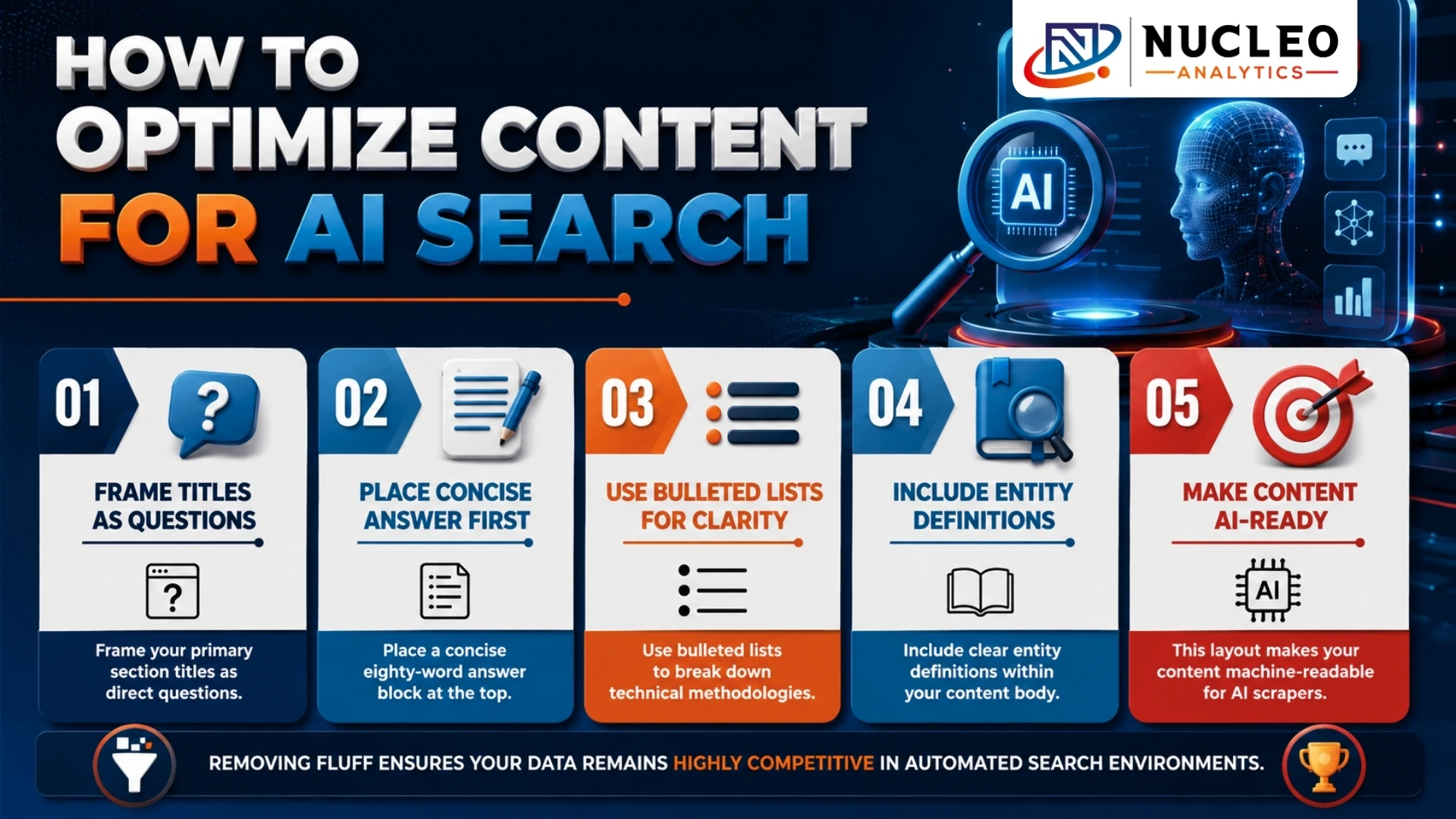


In order to effectively rank in AI search results in 2026, brands will have to rebuild their technical systems. Relying entirely on organic SEO tactics will be ineffective since the future digital environment will be ruled by conversational models and summaries.
The traditional search matrix has officially shifted toward generative response frameworks. Companies that fail to adapt their content delivery mechanics to support neural network queries will face massive traffic drops across all major platforms this year.
Market information in recent times brings out the true magnitude of this huge technology shift. According to an official announcement by OpenAI, the number of weekly active users for ChatGPT stood at 900 million by the start of 2026.
1. The Mechanics of Retrieval-Augmented Generation
Understanding how AI engines pull data is your first step toward market dominance. Generative search systems utilize Retrieval-Augmented Generation to source accurate web data before answering a query.
These algorithms crawl the web, transform text into mathematical vector embeddings, and store them in multi-dimensional spaces. Your content must fit neatly into these complex digital environments.
To achieve this, structure your writing to answer queries within the first sentences of a section. State your core conclusion first, then elaborate with structured supporting details.
- Use active voice to make your content easy for scrapers to understand.
- Present complex technical processes in sequential, step-by-step formats.
- Place your primary definitions within the first fifty words of text.
- Group related informational assets into unified, accessible sub-directories.
This direct writing style allows retrieval bots to extract your facts without wasting computational power. Eliminating unnecessary filler text makes your web pages highly attractive to automated systems.
2. Deciphering the Core Pillars of Discovery
To gain traction, your website must meet distinct AI search ranking factors. These systems favor structural clarity, data freshness, and verifiable technical authority over simple keyword presence.
If your pages are disorganized or present contradictory facts, retrieval engines will exclude your brand. They prioritize structured data architectures that yield immediate, reliable answers to complex questions.
- Structure your core arguments using simple subject-verb-object patterns.
- Keep your informational databases perfectly updated every ninety days.
- Ensure that primary headers map directly to clear consumer problems.
- Avoid vague phrasing that confuses real-time automated scraper systems.
When you satisfy these AI search ranking factors, you elevate your brand above unoptimized competitors. Clear organization makes your content the most reliable option for engines looking to build synthesis blocks.
3. How to Rank in ChatGPT Search
Learning how to rank in ChatGPT search requires a deep focus on technical data integration. OpenAI's engine handles huge search volumes, serving over 300 million active users weekly in 2026.
The system uses context, citations, and validated external websites. In order to rank in an AI search engine, the content you write needs to be digestible by the ChatGPT crawler.
First off, you need to create dedicated, valuable summary blocks at the top of your landing pages. These blocks should be roughly eighty words long and use clean Markdown tables to organize data.
- Provide unambiguous definitions for complex industry terms instantly.
- Incorporate detailed comparison tables for product and service pages.
- Use numbered sequences when detailing specific corporate execution steps.
- Include highly descriptive image captions to support multimodal processing models.
- Publish primary research reports that contain unique, extractable data.
- Maintain absolute semantic consistency across all external press releases.
ChatGPT values data transparency above all else. Your pages must state exactly what a product does, who engineered it, and its exact technical specifications.
This transparent approach helps the neural network categorize your business safely. It eliminates conversational ambiguity, allowing the engine to recommend your services to active buyers.
4. How to Rank in Google AI Overviews
Mastering how to rank in Google AI overviews demands a completely different approach to digital authority. Google integrates generative responses into over 65% of high-intent commercial search queries today.
This widespread deployment means executing comprehensive AI search optimization is non-negotiable. If your content is absent from the overview window, your organic visibility will decline rapidly.
Google's Gemini architecture builds these overviews by crawling trusted, top-tier resources. To secure a citation, your content must satisfy strict quality and trust guidelines.
To rank in AI search results, you must align your content with semantic intent. Your website must feature verified expert opinions and deeply researched educational content.
- Embed precise JSON-LD structured data throughout your domain architecture.
- Verify that your mobile page layouts load in under two seconds.
- Eliminate intrusive interactive elements that disrupt automated text rendering.
- Cite reputable academic or industry institutions within your copy.
- Design comprehensive content clusters that completely cover specialized topics.
- Optimize internal link paths to guide crawlers through logical hierarchies.
Google relies on a vast data network to power its real-time synthesis. Your main priority should be answering complex, multi-layered search queries.
Instead of targeting short-tail keywords, write content that answers comprehensive, multi-step scenarios. This structure makes your text highly useful for Google's complex generative algorithms.