



The global digital landscape has reached a profound turning point in how information is collected, organized, and delivered. The classic era of scrolling through pages of blue links is rapidly being replaced by direct, automated message generation.
Recent data shows that AI summaries now trigger on more than 55% of all digital queries, completely altering traditional user habits. This widespread deployment forces a massive shift in corporate media visibility.
As users migrate toward conversational systems, old-school digital indexing mechanics lose their competitive advantage. To stay visible, enterprises must transition toward a comprehensive architecture framework known as Generative Engine Optimization.
This emerging practice ensures that your digital brand properties are accurately categorized, prioritized, and cited by large language models. Without this intentional structural alignment, traditional web traffic channels risk total degradation.
How to Understand: What is Generative Engine Optimization
To succeed in this modern conversational environment, you must build an exact understanding of how machine intelligence handles content. This process marks a departure from historic data indexing routines.
Essentially, what is generative engine optimization boils down to the specific technical methodology of designing, structuring, and phrasing digital information so that advanced artificial intelligence synthesis systems can seamlessly extract it.
Instead of fighting for a higher click position on a traditional results page, this discipline focuses entirely on making your brand the primary referenced source inside an AI-generated answer block.
Platforms like Perplexity, ChatGPT, and Google AI Overviews do not simply map keywords to static web links. They tokenize entire pages, map concepts into multi-dimensional mathematical vector spaces, and assemble real-time prose for users.
Traditional search engines catalog pages using an inverted text index.
Generative platforms use semantic reasoning to build customized data paragraphs.
The optimization goal changes from capturing raw clicks to winning authoritative citations.
Content must be written to serve as clean training data for models.
When you optimize for these systems, you ensure your corporate knowledge assets are not skipped by crawlers. Clear data patterns turn your domain into a preferred source for mathematical answer engines.
Changing Market Dynamics and the Zero-Click Reality
The commercial impact of this technological transition is already impacting bottom lines globally. Traditional organic search click-through rates have experienced a massive decline over the last two years.
Comprehensive tracking indicates that zero-click searches have climbed to a striking 69% of all digital interactions. Consumers are getting their answers directly on the platform viewports.
This changing reality means that traditional search practices are no longer enough to support corporate conversion funnels. If your content is not cited in the summary block, it effectively ceases to exist for the consumer.
Adapting to this environment requires utilizing advanced Generative Engine Optimization frameworks across your entire digital presence. This shift ensures your corporate authority is preserved even as traditional click paths disappear.
How to Analyze: Generative Engine Optimization Examples
Observing these technical transformations in a live business environment helps clarify the operational differences between legacy content writing and machine-ready content engineering.
When reviewing real-world generative engine optimization examples, the most successful websites all share high fact density and structured data formatting. They abandon superficial text density in favor of direct assertions.
For instance, an unoptimized corporate landing page might use vague promotional taglines to describe a cloud computing architecture. An optimized page uses precise, extractable parameters that machine models prefer.
Unoptimized style: "Our software offers revolutionary speed and unmatched enterprise scaling capabilities."
Optimized style: "Our cloud architecture delivers a 45% reduction in latency and supports 10,000 concurrent database connections."
The unoptimized page gets skipped because it lacks verifiable informational substance.
The optimized layout is extracted because it contains crisp, mathematical parameters.
Another clear illustration involves product comparison frameworks. Leading e-commerce domains are replacing long paragraphs with explicit Markdown comparison tables containing prices, dimensions, and release dates.
When ChatGPT Search handles a buyer request, it instantly scans for these tabular structures to populate its conversational recommendations. This layout clarity governs discovery. If a machine intelligence system can extract your primary data points effortlessly, it will reward your domain with an authoritative source link.
How to Implement This: Generative Engine Optimization Examples
To successfully implement these changes, your digital content development workflow must focus entirely on algorithmic clarity. You must systematically eliminate any barriers that slow down real-time bot extraction loops.
Another area where we see powerful generative engine optimization examples is the deployment of dedicated, question-optimized FAQ blocks. These blocks should be positioned directly below primary headers to capture intent.
Frame headers as explicit questions that consumers type into chatbots.
Provide an immediate, declarative forty-word response directly under the title.
Utilize precise proper nouns rather than generic industry pronouns.
Embed triple schema markup containing FAQ, Article, and HowTo properties.
By analyzing successful generative engine optimization examples, your team can replicate the exact syntactic styles that machine brains favor. This updates your publishing strategy to thrive in a highly automated landscape.
Generative Engine Optimization Guide
Transitioning your entire digital footprint into a machine-citable asset requires a systematic, repeatable framework. This technical transformation must be executed with absolute precision across all web properties.
This practical generative engine optimization guide details the essential steps required to make your information fully compatible with modern retrieval-augmented generation architectures.
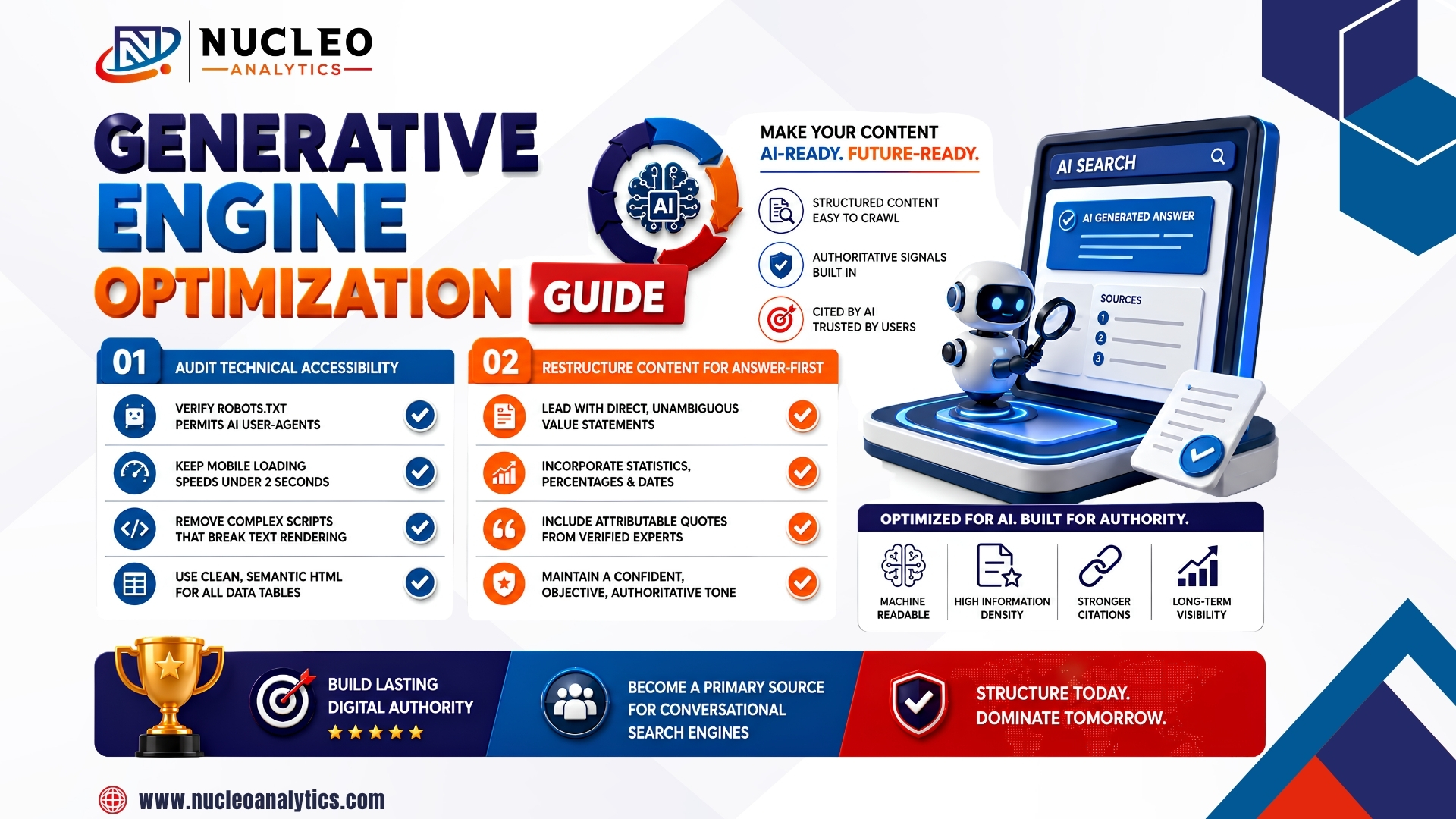
First, your development team must audit your technical accessibility parameters. AI crawlers do not always behave like standard search engine bots and require unhindered access to raw text files.
Verify that your robots.txt file permits access to specialized AI user-agents.
Keep your mobile loading speeds under two seconds to limit timeout bugs.
Remove complex interactive scripts that break automated text rendering.
Ensure all data tables are constructed using clean, semantic HTML parameters.
Second, restructure your writing style to match the "answer-first" architecture model. The first 30% of your page must contain your core conclusions. If your main point is buried at the bottom, models will skip it.
Lead your articles with direct, unambiguous value statements.
Incorporate specific statistics, percentages, and dates regularly.
Include direct, attributable quotes from verified third-party industry specialists.
Maintain a confident, objective, and highly authoritative editorial tone.
This generative engine optimization guide provides the foundation needed to build lasting digital authority. Following these structural guidelines ensures your content remains a primary source for conversational search engines.
Integrating GEO SEO and Modern Tactics
Success in the modern digital ecosystem requires a balanced approach to site architecture. You cannot afford to completely abandon traditional indexing guidelines while building machine-citable content.
Deploying a unified GEO SEO program allows your organization to satisfy traditional search ranking algorithms while optimizing for generative answer engines. These two approaches reinforce each other when executed properly.
Traditional visibility remains a powerful foundation, as engines often draw information from pages that already establish strong structural authority. Classic visibility remains a powerful foundation.
Maintain high-quality editorial standards to protect your organic keyword rankings.
Secure authoritative contextual backlinks to elevate your overall domain rating.
Use strategic internal linking to guide search bots through your text topics.
Optimize your local citation profiles to capture localized AI queries.
When you balance your GEO SEO workflows, you build an incredibly resilient digital acquisition pipeline. Your site captures classic click traffic while securing premium placements in AI summaries.
By updating your technical framework, you protect your business against ongoing algorithmic shifts. This systematic strategy keeps your domain competitive across all search formats.
The Operational Impact of GEO marketing
Modern customer acquisition demands that you optimize for all platforms where buyers seek information. Relying exclusively on a single web directory is a dangerous strategic vulnerability.
Executing an advanced GEO marketing campaign involves distributing your brand's data across a wide web of independent platforms. AI models evaluate your authority based on your total global footprint.
Distributing content across external publications significantly boosts a brand's AI citations compared to publishing only on an owned blog.
Encourage organic user discussions regarding your products on public forums.
Secure authoritative brand mentions across specialized, vertical-specific media.
Maintain comprehensive, up-to-date corporate profiles on major registries.
Publish primary research reports that contain completely unique data sets.
When you expand your GEO marketing efforts, you build widespread algorithmic confidence in your brand. AI engines cross-reference multiple web sources to verify that your company is a trustworthy recommendation.
This broad footprint ensures that when a buyer uses an AI assistant to research solutions, your products are highlighted as the industry standard. This strategy drives highly qualified leads to your business, routing motivated buyers directly to your digital profiles.
Advanced Content Engineering for AI Search Optimization
Structuring your text for modern retrieval systems requires a deep focus on semantic relationships. Artificial intelligence models use advanced entity graphs to understand the connections between brands, products, and user problems.
To achieve superior AI search optimization, your team must replace superficial keyword stuffing with deep topical authority. Your content must comprehensively cover every relevant sub-question within a given topic.
Map out entire topic clusters before beginning your technical writing process.
Provide clear, explicit definitions for complex industry terms instantly.
Use simple subject-verb-object structures to make text easy for bots to parse.
Update time-sensitive data points every ninety days to maintain freshness.
Models actively prioritize content freshness when building responses for time-sensitive queries. Stale, unverified data sets will quickly lose their citation placements to updated competitors.
Ensuring your technical text blocks are cleanly organized allows machine models to parse your pages without wasting crawl budget. This discipline forms the bedrock of modern digital authority.
Corporate Realignment with Nucleo Analytics
Succeeding in this generative information market requires advanced technical capabilities and continuous performance tracking. At Nucleo Analytics, we specialize in transitioning enterprise web properties into highly optimized, machine-readable data architectures.
Our engineering teams build comprehensive content systems that align perfectly with modern retrieval-augmented generation patterns. At Nucleo Analytics, we focus on fixing technical code errors, maximizing entity density, and implementing triple schema markups.
We help your enterprise build clear, data-dense content assets that conversational systems trust and cite. Partnering with Nucleo Analytics ensures your business maintains a dominant share of voice across all major generative discovery channels.
Conclusion
The traditional playbook for digital search visibility has changed permanently. To maintain your digital customer acquisition pipeline, implementing a comprehensive program for AI search optimization is an absolute commercial necessity.
By focusing on deep fact density, clear structural formatting, and strong brand signals across the web, you prepare your business for the conversational era. The organizations that adapt to these machine preferences today will secure long-term digital market share.