Search engines have progressed past the point where they just look for exact keyword matches. Nowadays, they concentrate on comprehending the meaning of a page, the connections between various topics, and whether the page is actually addressing a person's search intent. A page that offers relevant and valuable information will gain credibility and exposure.
Search engines have progressed past the point where they just look for exact keyword matches. Nowadays, they concentrate on comprehending the meaning of a page, the connections between various topics, and whether the page is actually addressing a person's search intent. A page that offers relevant and valuable information will gain credibility and exposure.
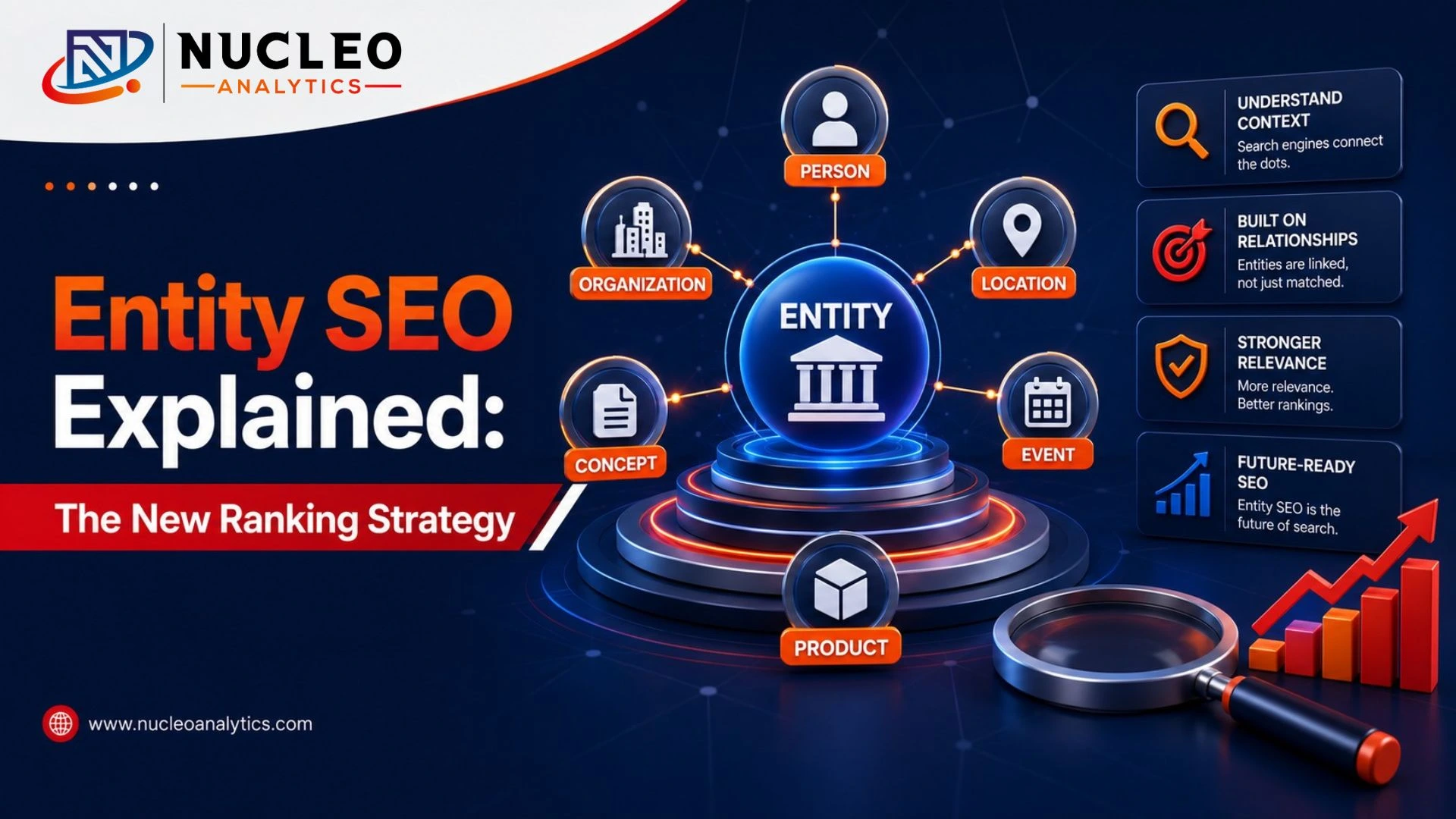
Entity SEO represents the future of search engine ranking at Nucleo Analytics. Instead of just focusing on keywords, it looks at meaning and connections in the real world. Businesses can gain credibility from search engines and users by creating valuable content with deep meaning and good connections.
What is entity SEO, and why does it matter?
Entity SEO is the practice of optimizing content around real things, people, places, ideas, and brands. Search engines use these signals to understand context. A page about “Apple” can mean fruit or the company. Entities help search engines know the difference fast.
This matters because search results now reward clarity. A page that only repeats keywords feels thin. A page that explains a topic deeply feels useful. At Nucleo Analytics, we build content that answers the topic cleanly, then connects it to related ideas. That helps search engines see the full picture.
Why this strategy works better
Search engines try to match intent, not just words. They want meaning, not noise. They want context, not guesswork. When your content shows clear topics and strong links between ideas, your page looks more complete. That can improve visibility across many related searches.
It also helps readers move faster. They do not need to decode weak content. They find the answer, the proof, and the next step. That creates trust. Trust keeps people reading. Trust also makes your site easier to remember.
How do search engines read meaning across a page?
Search engines look at names, concepts, and relationships. They look at how words sit together. They notice related phrases, supporting examples, and linked pages. This is where semantic SEO becomes powerful. It helps a page sound natural while still giving strong topic signals.
We use that approach at Nucleo Analytics when we plan content. We do not chase random terms. We map the topic first. Then we build sections that support one main idea from different sides. That gives search engines a cleaner path through the page.
The signals that help most
- Clear page topic and clear page purpose
- Related terms used in a natural way
- Internal links to useful supporting pages
- Helpful examples that match search intent
- Consistent brand language across the site
These signals may look small. Together, they tell a strong story. Search engines read that story well. Readers feel it too.
Ready to Build Stronger Search Visibility With Entity SEO?
How entity-based SEO changes content planning
Entity-based SEO pushes us to think beyond one keyword target. We ask a bigger question first: what does this topic really include? Then we break it into parts that make sense to search engines and people.
At Nucleo Analytics, that means every page starts with intent. We ask what the reader wants, what problems sit behind the search, and what related questions may come next. That gives the page more depth without making it messy.
A strong page on this topic should include names, categories, use cases, and supporting details. It should show how ideas connect. It should also stay simple. Long words can confuse readers. Clear words keep them moving.
A better way to plan content
Start with the main entity. Then list connected ideas. After that, group those ideas into sections. This keeps the page focused and easy to scan. It also helps the page rank for more than one search angle.
Why knowledge graphs matter for modern SEO
Knowledge graph SEO focuses on how search engines store and connect information. A knowledge graph helps search systems understand that one idea links to another. A company links to its service. A topic links to its subtopics. A person links to their work.
This matters because stronger connections make your brand easier to understand. When search engines see the same clear signals across your site, the trust gets stronger. At Nucleo Analytics, we use that logic to shape content clusters, service pages, and brand pages that support one another.
What this means for your brand
Your site should feel like one connected system. Each page should support the next one. Your about page should match your service page. Your blog should support your offers. That makes your site easier to crawl, easier to read, and easier to trust.
This is not about tricks. It is about clarity. Search engines love clarity because clarity reduces confusion. Readers love it for the same reason.
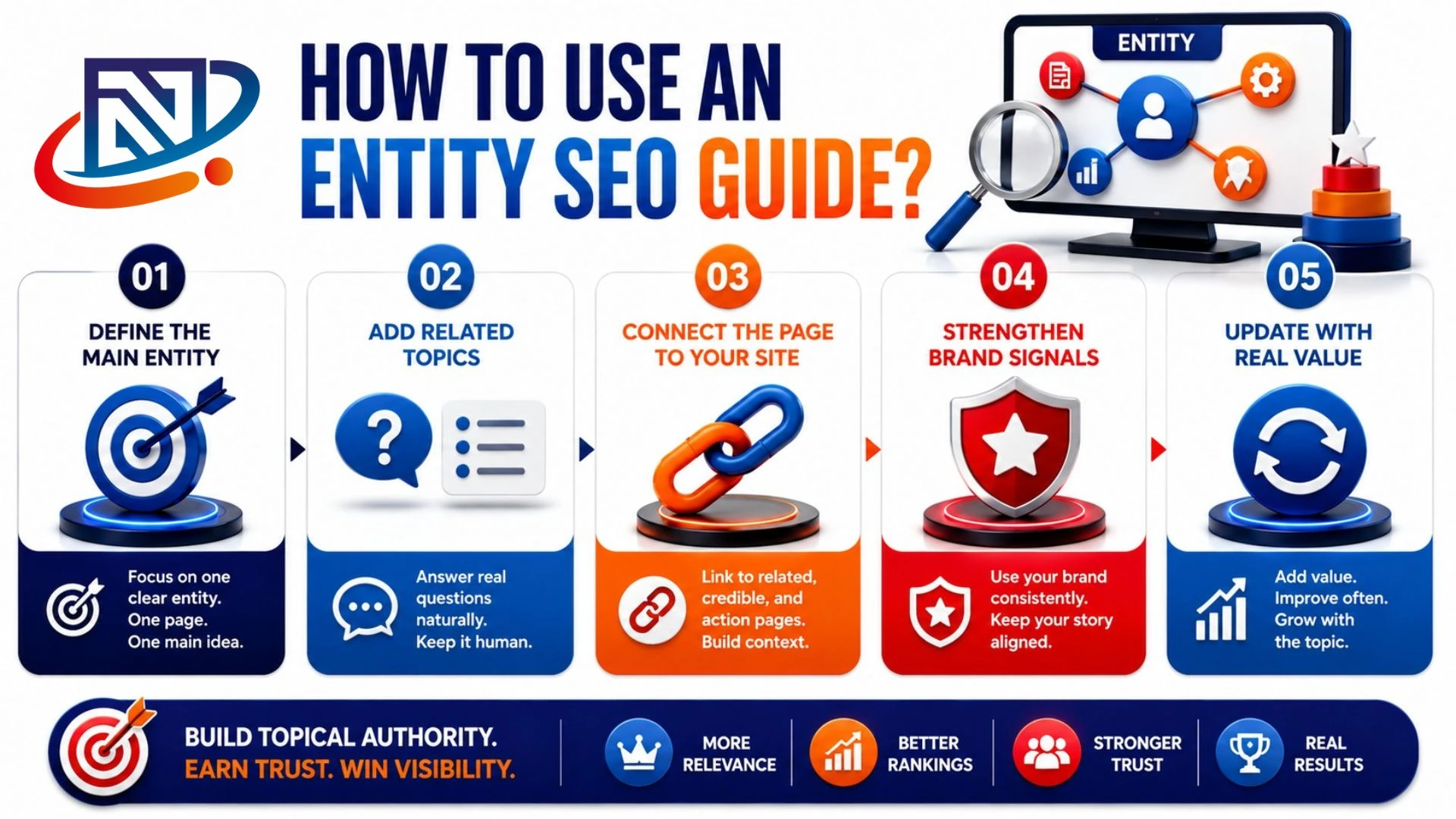
How to Use an Entity SEO Guide?
A good entity SEO guide should stay simple. It should help brands build topic authority without making content hard to read. At Nucleo Analytics, we use a basic path that keeps every page useful.
Step 1: Define the main entity
Pick the exact thing the page should own. That might be a service, a product, a person, or a concept. Keep the focus tight. One page should carry one main idea. Extra ideas can support it, but they should never steal the spotlight.
Step 2: Add related topics
List the questions people ask around that entity. Use those ideas in the body. Keep them natural. Do not force them into every line. Good content sounds human first. Search engines still notice the structure.
Step 3: Connect the page to your site
Link to pages that expand the topic. Link to pages that prove your experience. Link to pages that help readers take the next step. These links matter because they give search engines more context and give readers a clear path.
Step 4: Strengthen brand signals
Use your brand name in a steady, natural way. Make sure your About page, service pages, and blog pages all tell the same story. At Nucleo Analytics, we keep the message simple across every page. That keeps the brand easy to recognize.
Step 5: Update with real value
Keep the page fresh. Add better examples. Improve weak spots. Answer new questions. Search rewards useful updates more than empty changes. A page should grow with the topic, not freeze in time.
What does a strong entity-led page look like?
A strong page gives a direct answer early. It then expands with useful detail. It avoids fluff. It avoids random keyword piles. It keeps the reader in control. That style works because it respects time and attention.
At Nucleo Analytics, we build pages that feel complete without feeling heavy. We use simple language. We use a clean structure. We use clear examples. That makes the page easier to skim and easier to trust.
Core signs of a strong page
- The main topic appears early and clearly.
- Supporting ideas stay close to the real intent.
- Headings guide the reader through the page.
- Internal links support deeper learning.
- The brand voice stays steady throughout.
A page built this way can support more searches over time. It also helps your team create content faster because the structure is already clear.
Why search intent still drives everything
Search intent decides what the reader needs. Some people want a definition. Some want a guide. Some want steps. Some want proof. If your content misses that need, rankings struggle. If your content matches it, the page has a better chance.
This is where what is entity SEO becomes more than a question. It becomes a content test. Can your page answer the base idea fast? Can it still go deeper without losing focus? Can it guide the reader to the next step? Those answers matter.
At Nucleo Analytics, we write for the person behind the query. That keeps the content useful. It also keeps the brand voice natural and human.
Common mistakes brands make with this strategy
Many sites chase the wrong thing. They repeat keywords too much. They write pages that feel like copies. They skip internal links. They leave brand pages weak. They forget that meaning matters more than volume.
Another mistake is shallow topic coverage. A page may mention a topic but never explain it. That leaves readers unsure. It also leaves search engines unsure. Both sides need more than a surface touch.
A third mistake is a messy structure. A page without clear headings feels hard to follow. A page with weak flow loses readers fast. At Nucleo Analytics, we keep the layout clean so each section has a job.
How to Apply Entity SEO With Real Examples?
We start with one clear topic. Then we map the related ideas. Next, we build sections that support that topic from different angles. Finally, we check whether the page still reads as if a real human wrote it.
That process keeps the page honest. It also keeps the message sharp. Entity SEO works best when content stays useful first. Search visibility follows the usefulness. That is the part many brands miss.
When a page explains the topic clearly, the page becomes easier to share, too. People remember helpful pages. They return to them later. They trust the brand behind them. That trust can turn into traffic, leads, and sales.
Final thoughts
Search is moving toward meaning, context, and trust. That is why entity SEO is becoming a stronger ranking strategy. Brands that explain topics clearly will keep winning attention. Brands that build connected pages will keep gaining search strength. At Nucleo Analytics, we see this as a long-term path, not a quick trick. It is the kind of SEO that helps a site grow with purpose.
Grow Your Brand With Smarter Entity SEO Strategies Today