








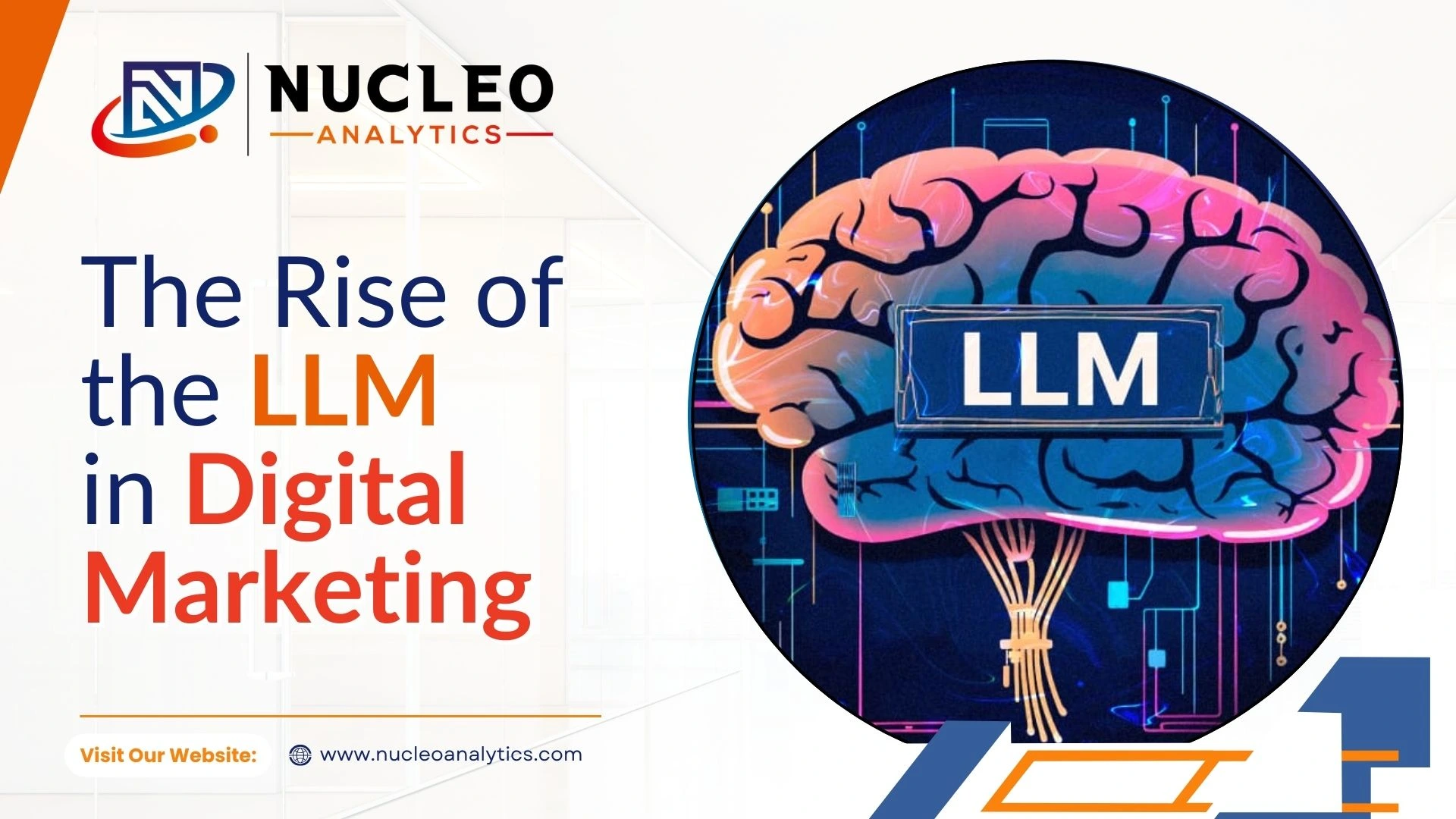
The Rise of the LLM in Digital Marketing
Digital marketing did not change overnight. It crept up in small, uncomfortable ways. One week, it was new tools for writing ads faster. The next was software that could summarise campaign data better than a junior exec. Large language models, or LLMs, slipped into marketing quietly, then stayed.
Now they sit inside content teams, analytics dashboards, email platforms, and customer journeys. Not as a novelty, but as something practical. Something that actually saves time and sharpens decisions. This shift is not about replacing people. It is about changing how marketing work gets done, and why data-driven teams are paying attention.
What are LLMs and why do they matter now?
Large language models are machine learning systems trained on massive amounts of text to predict what comes next in a sequence of words. They do more than autocomplete. When tuned and used well, they can write, summarize, translate, plan, extract insights, and even help reason about data when paired with the right tools.
Why now? A few simple reasons:
- Models are a lot better. Fluency, context window, and task flexibility improved quickly.
- Tooling improved. Wrapping models into real workflows is easier than it used to be.
- Costs dropped. Running a model for many marketing tasks now fits budgets.
- Expectations changed. Teams are willing to experiment because early wins are real.
All of that together means marketing leaders must update strategies. Ignore it, and you slowly hand a competitive advantage to someone else.
Turn LLM Experiments into Measurable Marketing Results.
Practical Ways LLMs Change Marketing Today
Below are the major areas where LLMs are already reshaping work. This is not theoretical. These are the plays teams are already running.
Faster, better content ideation and drafts
Coming up with angles, topics, or subject lines takes time. LLMs accelerate that. Feed the model your brief, target persona, and tone, and you get dozens of usable drafts. That does not replace editors; it frees them to add nuance, brand voice, and strategy.
Hyper-personalized communications at scale
Using customer data to adjust messages is old. Doing it in real time and at scale is new. LLM-powered templates can assemble personalized emails, landing page copy, and ad text that reflect recent customer behavior, past purchases, or lifecycle stage. This works with existing systems if the integrations are right.
Smarter audience research and insight synthesis
LLMs can scan product reviews, social posts, and customer service transcripts to highlight themes and emerging complaints. They act as supercharged summarizers that point you to what matters fast. That makes product marketing and messaging much more responsive.
Better creative testing and longer tail experiments
You can use models to generate dozens of ad variations or blog intros, then A/B test quickly. The result is a rapid iterate-and-measure cycle where you find creative winners faster. Over time, this yields a stronger content library and more statistical confidence in what works.
Faster reporting and accessibility
One of the quiet wins is report writing. Instead of assembling charts and writing a dry summary, teams feed the dashboard output to a model, get a readable summary, and then polish it. That reduces the time from data to decision.
Where LLMs intersect with existing marketing systems?
LLMs are tools. They do not overturn marketing basics. They augment them. The sweet spots are where models interface with systems you already use.
- Integrate with email platforms to assemble personalized sends.
- Hook into CRM data to determine moment-based messaging.
- Pair with analytics systems so content experiments feed into conversion data.
At this point, you should be thinking about how to wrap models into workflows, not whether models are useful. For example, a small team can use models to create weekly content variations and then push winners into an automated drip. That blends human judgment, automation, and learning.
A lot of teams also rely on a mix of domain-specific models and general-purpose models. The right balance depends on your vertical, brand voice, and data privacy needs.
Content quality, brand voice, and control
One common pushback is worry about voice and brand drift. Valid. Models can default toward blandness if you let them. The fix is simple in principle: set guardrails and editorial rules.
- Create brand style sheets and feed those to the model as persistent context.
- Use role-based prompts that define persona, constraints, and examples.
- Have humans review outputs before publication, especially for high-value channels.
Over time, you can tune the system so the model reliably produces content that needs only light edits. That is where the productivity gains compound.
SEO, search intent, and LLMs
People ask whether LLM-generated content will trigger search penalties or whether it will flood the web with generic pages. The short answer is: quality still matters. Search engines reward usefulness and user satisfaction. If you use models to produce thin content, you will fail. If you use them to help research, draft, and polish genuinely helpful pages, you can publish faster and keep standards high.
Practical SEO tips when using LLMs:
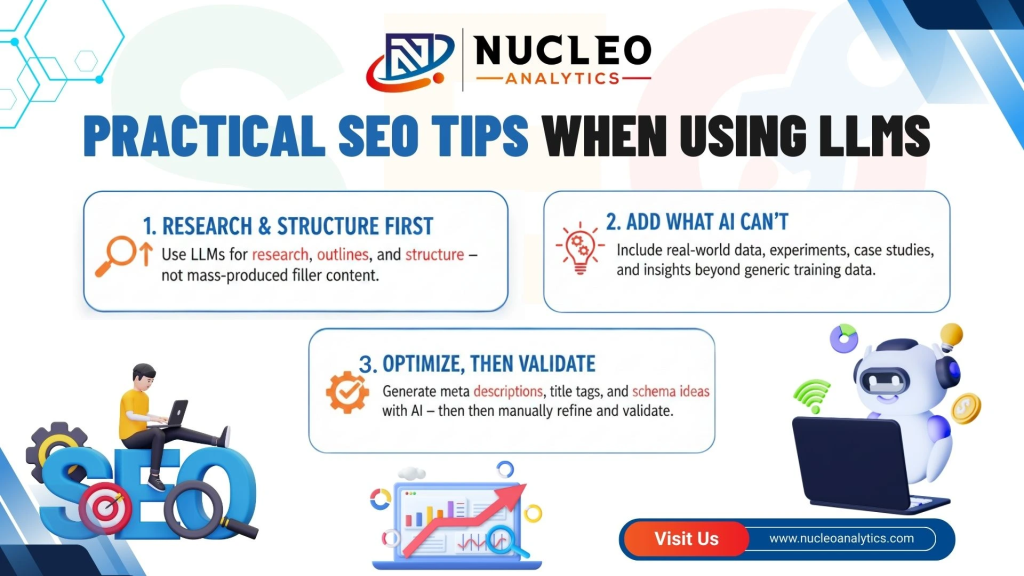
- Use the model for research and structure, not for mass-produced filler.
- Add empirical insights and data that the model cannot reproduce from generic training data.
- Use models to generate meta descriptions, title tag alternatives, and schema suggestions, then validate and tweak.
Ads, bidding, and campaign optimization
LLMs are changing creative production for paid campaigns, but they also help with strategy. You can use models to:
- Generate ad copy variations quickly.
- Draft landing page variants to match ad hooks.
- Summarize competitor creatives and propose tests.
That, combined with programmatic bidding and automated rules, means you have a system that can test lots of combinations. Budgets and guardrails still come from humans, but the speed of iteration skyrockets.
Customer experience and conversational marketing
Chatbots and conversational interfaces have been around for years. LLMs will make them more human-like and adaptable. That ups adoption for lead qualification, customer support triage, and conversational commerce. The real trick is to reduce scope early and escalate to humans as required.
A good model could take first-contact queries, gather relevant context, and then hand them off to human teams for more complex or emotionally charged topics. This helps to keep the customer experience seamless, rather than for a bot to pretend it knows everything.
Data and privacy: the non-negotiables
Where you train and deploy models matters. If your company handles PII or regulated data, you need strict controls. Many teams adopt a hybrid approach:
- Keep sensitive data in-house and use smaller domain-specific models behind the firewall.
- Use larger cloud models for public or anonymized tasks.
Always check the provider terms, and when in doubt, scrub or anonymize. This is not optional.
Risks and ethical considerations
LLMs introduce new risks that marketers must manage:
- Hallucination: models can invent facts. Never use model outputs as truth without verification.
- Bias: models reflect biases in training data. Audit outputs for fairness and representation.
- Overreliance: automation is tempting.
Good governance reduces these risks. Establish review mechanisms, write down model use cases, and get an audit trail of what models are used for what purposes.
Measuring ROI: How to demonstrate value?
Exactly which metrics to use depend on the circumstances, but the most common measures include:
- Time saved on content production.
- Increase in experiment velocity and win rate.
- Improvements in open rates, click-through, and conversion when personalization is used.
- Reduction in support resolution times for conversational systems.
Set baseline metrics before rolling out model-driven changes so you can attribute performance. Track both direct outcomes and indirect benefits, like team bandwidth freed for strategic work.
Implementation playbook: How to get started without breaking everything
So if you want to move from pilots to operational use, follow a pragmatic playbook.
- Identify low-risk, high-impact use cases
Begin with internal tasks and mid-funnel content where the cost of errors is lower. Examples include content ideation, subject line generation, internal reporting, and draft-first-pass production. - Define quality and safety standardsPut a checklist in place. What must be verified? Who reviews outputs? How are edits tracked?
- Integrate models into existing workflows
Push model outputs into the same tools teams already use. That reduces friction and increases adoption. - Monitor performance and iterate
Track results, collect qualitative feedback from users, and tune prompts and model choices. - Scale carefully
Move into more customer-facing channels only after consistent quality is proven.
Within that flow, choose LLM tools that fit your security and integration needs. Some platforms are plug-and-play, while others require engineering to build connectors. The right choice depends on your infrastructure and appetite for customization.
Where Nucleo Analytics fits in?
Nucleo Analytics was created to help teams go through this process with as little guessing as possible. We concentrate on three areas: clarity of data, integration in the workflow, and evidence-based results.
- Data Clarity: Models are only as good as the information they get. We assist in organizing customer and behavioral data so model prompts are richer and more precise.
- Workflow integration: We connect model outputs to content management systems, CRMs, and ad platforms so the work happens where teams already operate.
- Measurable outcomes: We implement tracking so you can attribute conversions and performance back to model-powered changes.
That combination matters. Too often, companies test models, get a flash win, but fail to measure or scale. Nucleo Analytics helps move from pilot to production with clear metrics and governance.
Case study examples you can relate to
Below are simplified, anonymized examples to illustrate practical wins.
A: E-commerce brand
- Problem: Product description fatigue and inconsistent voice across 1,200 SKUs.
- Approach: Use models to generate description drafts from product attributes, then human editors review and refine. Hooked into the CMS, so updates were staged and tested.
- Result: Time to publish dropped 70 percent, conversion on product pages improved 12 percent after testing.
B: B2B SaaS company
- Problem: Low response to nurture emails and slow content production.
- Approach: Generate multiple subject lines and bodies personalized by industry segment. Run multivariate tests, feed winners to the nurture program.
- Result: Open rates increased, and pipeline velocity improved, the team could run more experiments with the same headcount.
C: Support team
- Problem: High volume of repetitive, simple queries.
- Approach: LLM-powered assistant drafted responses and suggested follow-up articles. Humans reviewed and pushed answers to customers.
- Result: The first response time was cut down substantially, and agents were able to concentrate on high-value cases.
These are the kinds of victories you can duplicate if you think ahead.
Mistakes to Avoid
- Teams repeatedly trip over the same things. Avoid these pitfalls:
- These are the kinds of wins you can replicate if you plan carefully.
- Skipping measurement. If you cannot measure, you cannot learn.
- Over-personalizing without consent. Respect user privacy and consent frameworks.
- Deploying to customer-facing channels before testing thoroughly.
If you keep those traps in mind, you can take advantage of the upside without tripping over obvious errors.
Tools and tech stack considerations
You do not need to pick a single provider. A typical stack might include:
- One or more general-purpose LLMs for drafting.
- In-house or specialized models for sensitive tasks.
- An integration layer that connects model outputs to CMS, CRM, and analytics.
- Monitoring tools for quality and bias checks.
When choosing LLM tools, prioritize integration capability, security controls, and cost predictability. Also, ask whether the vendor supports fine-tuning or retrieval-augmented generation, which helps models use your brand and data accurately.
Governance: policies you should write this quarter
If your company has not written rules for model use yet, do that now. Policies do not need to be long, but they should cover:
- Approved use cases.
- Data handling rules.
- Review and sign-off processes.
- Success metrics and reporting cadence.
This protects the brand and creates a path for responsible scaling.
The future: what changes next
Expect three trends to drive the next phase:
- Better integration between models and structured data. Models will increasingly use your CRM, product data, and analytics directly to generate context-aware outputs.
- More automation around continuous learning. Models will suggest experiments and use results to refine future suggestions.
- Wider adoption of hybrid architectures where private models handle sensitive data and public models handle generic tasks.
These changes will make marketing faster, more personalized, and more experimental. That will favor companies that can move quickly without sacrificing trust.
Getting leadership buy-in
Convincing leadership is often about framing outcomes, not features. Talk about:
- Measurable time savings and capacity gains.
- Faster experiment cycles that reduce the cost per learning.
- Clear pilot plans with success metrics and roll-forward logic.
Budgeting and resource allocation
Budgets for model usage should include:
- Model costs: billing for usage or subscriptions.
- Engineering for integrations.
- Editorial resources for review.
- Monitoring and governance overhead.
Plan for an initial pilot budget and then scale based on measured ROI.
Final notes on change management
Introducing models is partly technical, partly human. Expect resistance from people worried about job loss or quality. That is normal. Emphasize that the goal is to free people from repetitive work so they can do higher-value tasks. Provide training, share wins, and iterate on governance.
Conclusion
The large language model in digital marketing is not a fad. It’s a change of empowerment across content, personalization, testing, and operations. The companies that are going to win are not the ones doing with models for gimmicks, but those who integrate these models into business processes driven by data, measure outcome and keep human judgment where it needs to be.
See How LLMs Fit into Your Marketing Stack.
Frequently Asked Questions
Q1: Are LLMs going to replace marketing writers?
Q2: Is it safe to use LLMs with customer data?
Q3: What is the easiest way to start using LLMs in marketing?
Q4: How do you measure whether LLMs are working?
Related Posts

Why Your Business Is Not Showing in Google Maps
Many business owners search Google Maps and feel confused when their business does not appear in search results. This situation creates stress because customers cannot […]
Must-Follow PPC Trends For Success in 2025
PPC ads are still necessary for every type of business to reach their target audience in this digital world. To stay ahead of the curve, […]

How to Integrate AEO With Traditional SEO Strategies?
The search engine optimization environment has changed dramatically over the recent years. The use of keywords to rank your site on the first page of […]
Why is Digital Marketing a Boon for Small Businesses?
Modern customers today rely heavily on digital means to research products and services. Hence, businesses need to reach customers where they are. Having a strong […]

Core Web Vitals Optimization: What You Need to Know?
There’s a lot of noise in SEO right now. New tools, New updates. New “hacks” every other week. But below all of that, Google just […]

How to Rank for Voice Search Queries Using Google SEO
Voice search has become the present-day scenario rather than being a futuristic concept. It is already influencing the method of information acquisition by people over […]