
Most corporate blogs talking about tech sound completely fake. They use these pristine, perfectly packaged sentences and weird boardroom buzzwords that nobody would ever say out loud to a colleague.
AI detectors instantly catch that hyper-polished style because it lacks any real human grit. It reads like a textbook instead of a conversation, which explains why implementing AI lead generation leaves so many marketing teams completely frustrated.
People buy the software and expect instant miracles. Instead, they just end up blasting out cold, robotic spam that ruins their brand reputation.
You don't need to sound perfect to win clients. You just need actual data mixed with a blunt, no-nonsense voice that people trust. Here is how you actually do it.
The Strategic Shift in B2B Client Acquisition
The old way of hunting for business is completely dead. Buying massive email lists, blasting thousands of generic messages, and cold calling random executives just does not work anymore. Buyers have zero patience for it, and their spam filters catch everything anyway.
Smart companies are completely dumping the old volume-based numbers game. They are moving toward tight, data-backed systems instead. Why? Because wasting hours of expensive human labor on dead-end spreadsheets is a fast way to go broke.
By plugging predictive data into your sales pipeline, you stop guessing who might buy. The system points you directly toward companies that actually need your services right now. It ensures your marketing budget is only spent on real, high-value opportunities.
How AI is Changing Lead Generation Across the Enterprise
To understand how modern systems optimize sales funnels, one must analyze the transition from static databases to dynamic intelligence engines. Historically, data procurement involved purchasing static lists that decayed the moment they were compiled.
Modern infrastructures, however, operate on continuous data validation. The primary disruption occurs in behavioral analysis. Advanced platforms monitor digital footprints across open webs, tracking content consumption, whitepaper downloads, and technology stack changes.
When a target enterprise exhibits a sudden spike in research behavior regarding a specific business challenge, the system flags that account in real time. This structural shift transforms the sales development representative's role completely.
Instead of spending hours investigating corporate hierarchies and contact details, personnel receive a prioritized queue of accounts actively seeking solutions. This level of precision accelerates the sales cycle and significantly reduces customer acquisition costs.
Architectural Pillars of Autonomous Prospecting
The execution of sophisticated digital discovery relies on three distinct technological layers working in tandem. These components transform raw web data into structured, actionable enterprise intelligence.
Machine Learning and Predictive Analytics
Predictive models analyze an enterprise’s historical sales data to isolate subtle commonalities among high-lifetime-value clients. By evaluating variables such as annual revenue growth, employee churn, and technology adoption cycles, the algorithm constructs an objective ideal customer profile. It then cross-references this profile against global business directories to surface identical lookalike accounts.
Natural Language Processing and Semantic Analysis
Computers can now read between the lines of public text across the internet. The software actively monitors things like executive interviews, corporate job boards, and earnings call transcripts to see where a company is struggling. By analyzing the true context behind these public statements, the system flags internal corporate shifts early. You will spot massive international expansion plans or new digital projects weeks before that company ever makes an official public announcement.
Digital Intent Signal Aggregation
Modern intent networks track web traffic patterns based on corporate IP addresses. When five different employees from the same target company start reading specific software reviews or comparison guides, the system clocks that exact behavior. This gives your sales team an immediate head start. You get a clear warning sign that a company is preparing to buy, letting you pitch them way before they ever launch a formal bidding war.
Why Automated Lead Generation Outperforms Manual Workflows
The operational advantages of deploying systemic automation across the front end of a sales pipeline extend far beyond simple speed. While a human researcher might accurately profile a dozen complex corporate accounts per day, an algorithmic system processes millions of organizational profiles concurrently.
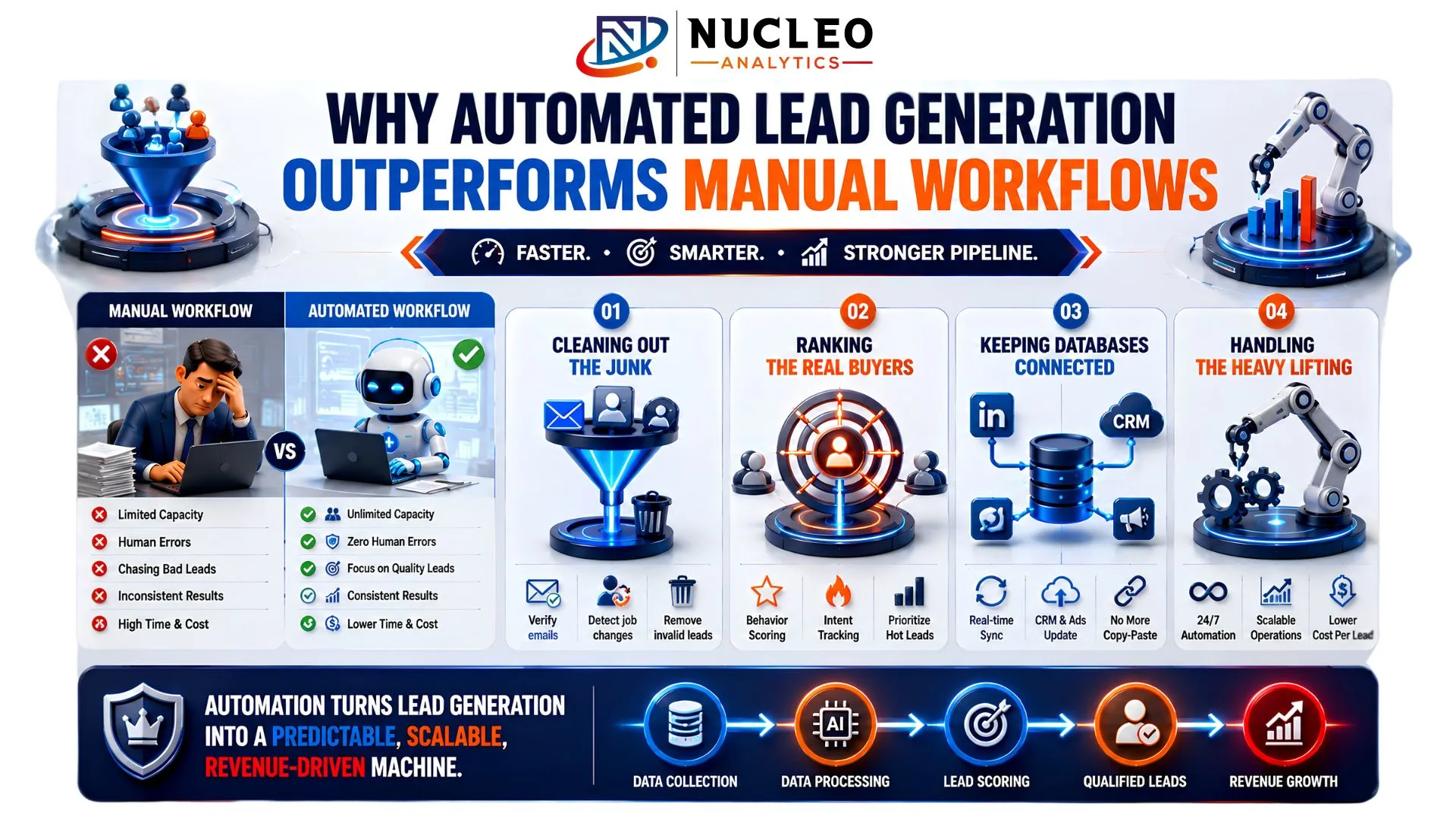
Manual prospecting is inherently flawed. Sales reps get tired, they guess wrong, and they often chase bad leads based on a gut feeling while letting actual buyers sit at the bottom of an unread spreadsheet. Machines do not have bad days, and they do not skip steps when they want to leave early on a Friday.
- Cleaning out the junk: The software constantly checks for dead emails and corporate job changes behind the scenes. This stops your team from wasting time pitching people who quit six months ago.
- Ranking the real buyers: Prospects get scored based on what they are actively doing online right now. Your team spends their energy on hot targets instead of chasing cold dead ends.
- Keeping databases connected: When a prospect interacts with you on LinkedIn, your internal CRM and ad accounts update instantly. This eliminates manual copy-pasting across five different browser tabs.
- Handling the heavy lifting: A software setup runs non-stop without burning out. Your data processing costs stay flat even when your pipeline explodes.
Transitioning to automated lead generation allows an enterprise to de-risk its pipeline development. Revenue generation ceases to rely on the fluctuating output of individual staff members and instead becomes a predictable, software-driven infrastructure.
Designing Scalable AI Lead Generation Strategies
Implementing an automated acquisition framework requires rigorous strategic design. Haphazardly deploying software without a foundational architecture often results in corrupted CRM databases, burned sender domains, and fragmented brand messaging.
Organizations must view technology as an accelerator of an already sound commercial strategy, not a remedy for flawed positioning. The architecture must map out exactly how data flows from initial web discovery down to human handoff points.
Setting up a pipeline that actually brings in cash requires setting some basic ground rules. Otherwise, your automation will just create a massive mess very quickly.
- Establish Strict Data Governance: Double-check your data sources. Make sure your software plays by the local privacy rules like GDPR so you don't end up with massive compliance fines.
- Implement Multi-Variable Scoring: Don't just rank a prospect because they work at a big company. Combine their corporate size with what they are actively reading online today so you don't chase dead ends.
- Synchronize Marketing and Sales Data: Your outbound tools need to talk to your website assets. If a prospect downloads a guide, your sales rep needs to see that interaction instantly.
- Maintain Human Oversight Gateways: Never let a machine blast emails without a real person checking the drafts first. Someone needs to verify the text sounds right and makes sense before hitting send.
Deploying these specific AI lead generation strategies preserves organizational reputation while maximizing output. The goal is to build a highly optimized system that surfaces opportunities without sacrificing the professional precision required in high-ticket B2B transactions.
Tired of Wasting Your Budget on Broken Automation and Messy Data? Let Nucleo Analytics Build a Scalable, Compliant Pipeline That Delivers Real Sales Opportunities.
Evaluating the Best AI Lead Generation Tools
The current enterprise technology landscape contains a vast array of specialized software platforms. Selecting the correct stack requires isolating which part of the pipeline currently suffers from operational bottlenecks.
Rather than searching for a single monolithic solution, enterprise architects look for best-in-class tools designed to integrate natively via robust APIs.
- Corporate Intelligence Engines: Platforms designed to crawl global registries, professional networks, and technology footprints to generate accurate corporate profiles.
- Inbound Conversational Qualification Systems: Advanced web interfaces that engage incoming site visitors, analyze corporate IP data, and schedule meetings with appropriate reps.
- Predictive Pipeline Orchestration Software: Central hubs that ingest multi-channel intent data, calculate engagement propensity, and trigger specific outbound workflows.
- Dynamic Content Optimization Tools: Software that adjusts digital assets, case studies, and landing page variations based on the industry sector of the visitor.
Identifying the best AI lead generation tools requires a clear assessment of internal pipeline deficiencies. If an organization commands strong web traffic but suffers low conversion rates, investment must favor conversational qualification rather than raw data scraping tools.
Maximizing ROI Through AI Lead Generation
The ultimate objective of integrating machine intelligence into corporate acquisition strategies is the maximization of return on marketing investment. Legacy customer acquisition methods require a linear increase in headcount and media spend to achieve business growth.
Using AI lead generation means you finally break the frustrating cycle of having to hire a new sales rep just to get a few more meetings. The software takes over the brutal grunt work of hunting down phone numbers, checking emails, and grading prospects. This lets your real team focus entirely on running actual product demos and closing deals.
This shift changes your whole balance sheet for the better. Your cost to find a good customer plummets, deals close much faster because buyers are actually interested, and your best sales reps won't quit out of pure boredom from typing data into a screen all day.
Navigating the Complexities of Artificial Intelligence Lead Generation
Automation delivers clear efficiencies, but rushing into it without a plan creates massive operational liabilities. When you mismanage this technology at scale, you risk alienating a huge portion of your market very quickly.
The biggest mistake is letting software handle your outreach without strict oversight. If algorithms write your entire messaging sequence, the copy ends up sounding clinical, detached, and completely generic.
- Destroying email deliverability: Blasting high-volume automated campaigns triggers spam filters, which can permanently ruin your corporate domain reputation.
- Amplifying bad data models: If your initial training records contain historical errors, the software will continually target low-yield market segments.
- Creating disconnected databases: Keeping your prospecting tools isolated from your main CRM creates fragmented customer records and internal tracking conflicts.
A successful artificial intelligence lead generation infrastructure requires treating software as an administrative engine, not a replacement for judgment. Let the technology crunch probabilities and organize data, but keep your experienced strategists in control of creative direction and relationship building.
Strategic Implementation and Integration Protocols
Transitioning an enterprise from legacy prospecting models to an automated data infrastructure requires a phased deployment strategy. Attempting a complete, overnight overhaul of sales workflows often creates internal friction and temporary pipeline disruptions.
Instead, revenue operations leaders should introduce automated components sequentially, verifying data integrity and team adoption at each stage before expanding the footprint of the system. This structured methodology allows sales development teams to adapt to new data inputs gradually. It ensures that the predictive algorithms have sufficient time to ingest local corporate data, leading to much cleaner scoring outputs and a more reliable pipeline.
Future Trajectories of Corporate Client Discovery
The evolution of automated business discovery shows no signs of stabilizing. As machine learning models grow more sophisticated, the boundary between inbound marketing and outbound sales will continue to blur.
We are moving rapidly toward systems capable of real-time hyper-personalization. Future acquisition infrastructures will not merely look at historical data; they will dynamically synthesize custom case studies, financial projections, and technical integration plans tailored to an individual prospect’s business model within seconds of engagement.
Organizations that defer adoption of these automated frameworks risk structural obsolescence. As market leaders implement increasingly precise, algorithmically driven acquisition strategies, the cost to compete using manual methodologies will become economically unsustainable.
Enterprise Infrastructure Optimization with Nucleo Analytics
Building, calibrating, and maintaining a modern, automated acquisition infrastructure requires specialized technical expertise. For enterprises seeking to modernize their client discovery systems without diverting internal resources from core operations, selecting an experienced integration partner is critical.
This is the precise domain of Nucleo Analytics. As a global IT and digital marketing agency, we specialize in engineering the data architecture, custom web platforms, and analytical frameworks required to power modern corporate client acquisition. We replace speculative prospecting with highly structured, data-driven frameworks.
Our technical teams integrate advanced intent tracking, optimize customer databases, and design custom digital assets that attract high-value enterprise accounts. By unifying advanced web development with precise digital marketing analytics, Nucleo Analytics ensures your organization commands a predictable, scalable pipeline. We manage the underlying technical complexities so your executive leadership can focus on conversions and core business expansion.
Let Nucleo Analytics Build a Clean, High-Precision Data Engine That Actually Fills Your Pipeline
Conclusion
The transformation of business prospecting from a manual craft into an objective, data-driven science is irreversible. Deploying AI-powered lead generation models is no longer a speculative strategy for forward-looking enterprises; it is a baseline structural requirement for maintaining market relevance. By systematically offloading data discovery, validation, and qualification to autonomous software, organizations unlock immense operational efficiencies.
The future belongs to enterprises that successfully pair the mathematical precision of algorithmic data tracking with the high-level strategic empathy of human professionals. Ready to stop wasting time on robotic outreach and burned email domains?