
nucleo analytics
nucleo analytics
  • home
  • Services
    • SEO
    • Social Media Marketing
    • Google Ads
    • Reputation Management
    • International SEO
    • Local SEO Service Agency
    • Custom Website Development
    • Mobile-Application-Development
  • Outsource
    • SEO Outsourcing Agency in India
    • SEO Consultant India
    • SEO Reseller Services
  • Testimonials
  • Case Studies
  • FAQ
  • Blog
Contact Us
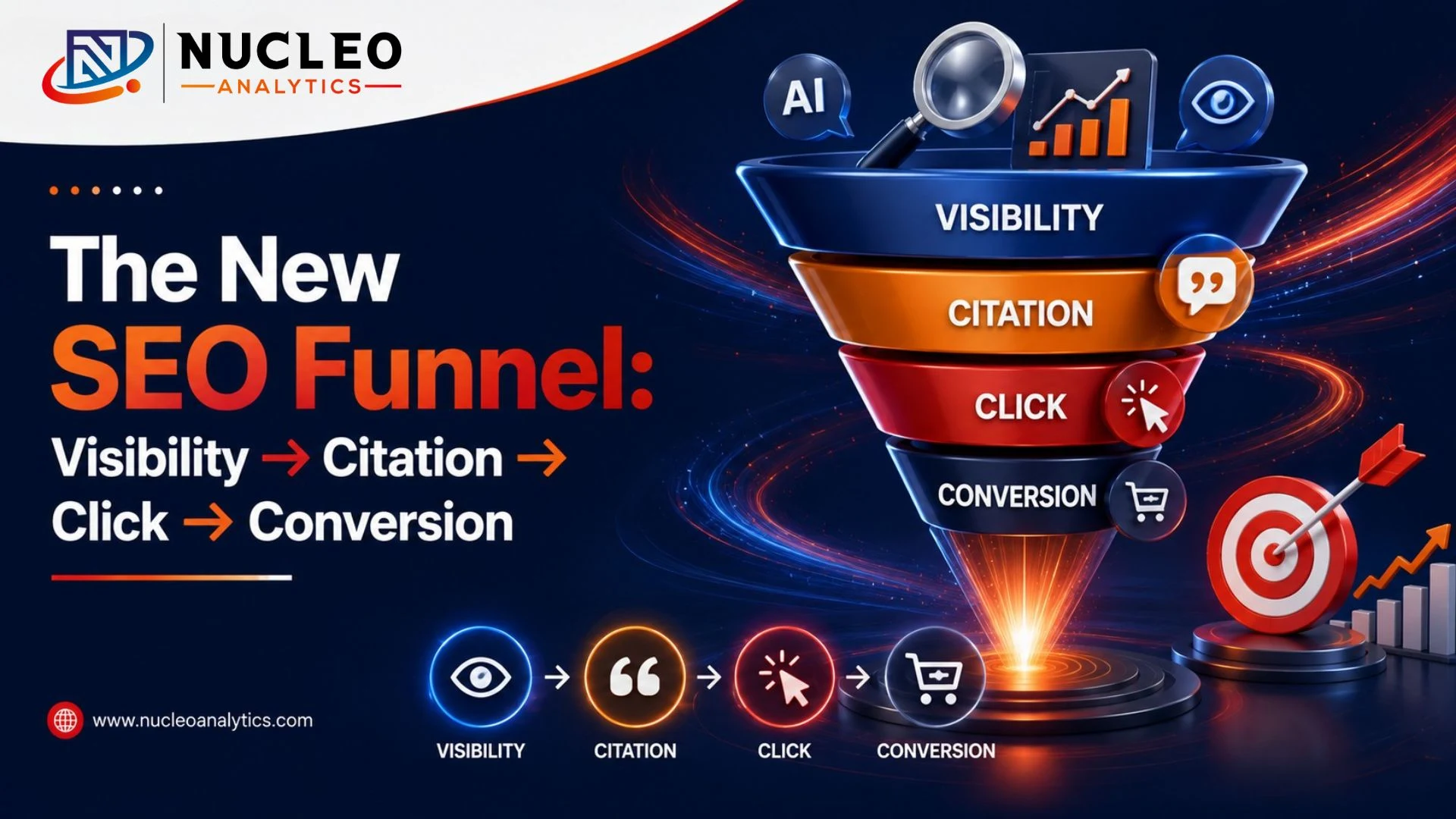
The New SEO Funnel: Visibility → Citation → Click → Conversion

The New SEO Funnel: Visibility → Citation → Click → Conversion

Written bySahilSharmaSahil Sharma
Read time
5 minutes read
Category
SEO

For the last ten years, search engine optimization followed a simple, predictable path: a prospect typed a question into Google, looked at the blue links, clicked the top result, and entered a company’s website.

Today, that linear path is broken. The rise of AI-powered search engines like Google’s AI Overviews, OpenAI’s SearchGPT, and Perplexity has completely shifted how information is consumed. 

Data shows that a massive chunk of digital searches now resolve as “zero-click” queries. This means buyers no longer need to click through to your website to evaluate your services or get answers. The AI models simply scrape, summarize, and show the answer directly inside the search window.

For growth-focused B2B brands, this is a major wake-up call. Organic marketing is no longer just about winning human clicks; it requires optimizing your data so AI systems can find and recommend you.

At Nucleo Analytics, we have rebuilt the traditional marketing approach into a clear, four-stage framework designed for this exact reality: The New SEO Funnel.

To understand why this shift matters, let's look at how the traditional search journey worked and why it no longer delivers the same results.

Why the Traditional Search Journey Collapsed

The classic search marketing funnel worked by capturing users with broad informational blogs and slowly pushing them down into product pages using internal links and gated eBooks.

[Old Linear Path] Awareness ──────> Consideration ──────> Conversion

↓

[The Modern Matrix] Visibility ────> Citation ────> Click ────> Conversion

In today’s market, this slow process fails. Because AI engines pull data from multiple websites at the same time to craft one “perfect” reply, a B2B decision maker can make a vendor shortlist and select a partner without ever landing on your domain , or even triggering your analytics.

So if your marketing plan is still stuck on ranking only for high-volume keywords in order to get raw traffic, well then you are missing the exact moments where buyers start forming opinions .

Introducing the New SEO Funnel 

The modern customer journey is non-linear and more dialog-style than people expect, plus it’s really automated under the hood. To actually move business revenue, your website has to line up with the four revised stages of the SEO funnel.

Stage 1: Visibility (The New Top-of-Funnel)

In the old days, top-of-funnel success meant holding a top-three spot on Google. In the AI era, true visibility means your brand’s core data is clean enough to be read, understood, and picked up by the machine learning models that generate answers.

To build strong top-of-funnel visibility, your content needs to be perfectly structured for both humans and AI crawlers:

Advanced Schema Data: You must use clear backend code (Organization and Service schema), so search engines instantly know who you are and what you offer.

High Information Density: Start your articles with direct, definitive answers, followed immediately by real data and expert insights.

Clear Concept Definition: Clearly define your products and processes so AI systems correctly connect your brand name with specific industry solutions.

Stage 2: Citation (The Middle-of-Funnel Validation)

Getting noticed by an AI engine is only half the battle. The real victory is securing the primary citation. When an AI search engine gives a recommendation or technical answer, it places small clickable footnotes, citations to prove its facts.

For B2B companies, these citations are the new middle-of-funnel validation. They act as an ultimate stamp of trust. When your business is cited directly inside an AI response, it builds immediate brand authority and drives high-intent traffic to your site.

To win these crucial citations, your content must focus on three core areas:

Proprietary Data: Original research, unique case studies, and corporate survey data are highly valued by AI models looking for proof.

Clean Layouts: Bullet points, explicit comparison charts, and direct question-and-answer formats make it easy for algorithms to pull your data.

Cross-Web Reputation: AI validates its own answers by looking for agreement across the web. If your brand is regularly mentioned in trade journals and industry forums, the models trust you as an authority.

Stage 3: Click (The Qualified Threshold)

Because AI interfaces filter out casual web browsers who just want quick answers, the users who actually click through to your website are incredibly valuable.

When a B2B executive clicks a citation link to visit your domain, they aren’t doing basic research anymore. They already understand your basic pitch and know you are a top contender. They are visiting your website to evaluate your operational depth, check your specific case studies, and see if your team is the right fit.

To successfully capture these pre-vetted prospects, your site must deliver a frictionless experience:

Perfect Intent Alignment: If a user clicks a link about a deeply technical problem, the page they land on must match that exact level of detail. Never send specific traffic to a generic homepage.

Lightning-Fast Speed: Enterprise buyers have zero patience for broken or slow layouts. Your technical optimization must be flawless.

Clear Internal Pathways: Guide the visitor naturally toward deep evaluation assets, like detailed technical breakdowns, whitepapers, or client success stories.


Table of Contents

  • Why the Traditional Search Journey Collapsed
  • Introducing the New SEO Funnel
  • Stage 1: Visibility (The New Top-of-Funnel)
  • Stage 2: Citation (The Middle-of-Funnel Validation)
  • Stage 3: Click (The Qualified Threshold)
  • Stage 4: Conversion (The Revenue Realization)
  • Modern Search Funnel: Building Content for Clear Intent
  • AI Search Customer Journey: Mapping the Modern Buyer’s Path
  • SEO Funnel in the AI era: Expanding Your Digital Footprint
  • Conclusion

Recent Posts

_

How to Build Content that AI Search Engines Cite

Sep 15, 2026

_

How to Measure Traffic from AI Search Engines

Sep 14, 2026

_

How to Rank in AI Search Results in 2026

Sep 14, 2026

_

Why Organic Traffic Is Falling Even When Rankings Are Improving

Sep 11, 2026

_

How to Get Cited in Google's AI Overviews

Sep 9, 2026

faq_background

FrequentlyAsked Questions

Find quick answers to the most common questions our clients ask about our services.

faq illustration

Related Posts

We’re proud to still be working with many of the same people that hired us in our early days.

How to Build Content that AI Search Engines Cite

How to Build Content that AI Search Engines Cite

Generative search engines and conversational platforms have fundamentally reshaped how information is discovered across the digital ecosystem. Millions of users now rely on automated answer engines to synthesize complex…

How to Measure Traffic from AI Search Engines

How to Measure Traffic from AI Search Engines

The quick uptake of conversational engines and answer-generation systems has completely revolutionized the way audiences find information on the internet. Millions of potential customers are now getting immediate brand…

company logo

Helping businesses grow through strategic Digital Marketing, Custom Website and Mobile App Development, AI, and Innovative technology solutions that deliver measurable, long term results.

Follow us :

FacebookInstagramPinterestlinkedinYoutube

Quick Links

  • Home
  • Services
  • Testimonials
  • Case Studies
  • FAQ
  • Blog
  • Contact Us

Services

  • SEO
  • Social Media Marketing
  • Google Ads Services
  • Reputation Management
  • International SEO
  • Local SEO Service Agency
  • Custom Website Development
  • Mobile Application Development

Policy

  • Terms of Service
  • Cancellation & Refund Policy
  • Support
  • Privacy Policy

Contact Info

  • 1688 Sector 82, JLPL Industrial Area, Sahibzada Ajit Singh Nagar, Punjab 140308, India
  • +91-959-209-7054
  • info@nucleoanalytics.com
©2026 Nucleo Analytics.All Rights Reserved.
Terms of useSitemapPrivacyRefunds & Returns

If AI can’t understand your business, your ideal customers may never discover it.

Stage 4: Conversion (The Revenue Realization)

The ultimate goal of this modern strategy is converting search presence into measurable business growth. In this updated ecosystem, search optimization and conversion rate optimization (CRO) must work together as one seamless revenue engine.

[SEO Visibility & Citation] ───> [Highly Vetted Organic Click] ───> [Closed B2B Revenue]

At this final stage, the buyer is fully informed and ready to take action. Because the AI search journey has already done the heavy lifting of educating the prospect, your onsite conversion points must be clean, direct, and completely free of roadblocks:

High-Intent Calls to Action (CTAs): Avoid low-value offers like “Sign up for our newsletter.” Instead, use direct, high-value pathways like “Request an Architecture Audit,” “Book a Technical Consultation,” or “Connect with a Solutions Specialist.”

Short Contact Forms: Keep your forms short and simple. Only ask for essential information to maximize form completions, and use automated tools to fill in the rest of the corporate details in the background.

Visible Trust Indicators: Place real client results, industry compliance certifications, and clear ROI stats right next to your contact forms to remove any last-minute hesitation.

Modern Search Funnel: Building Content for Clear Intent

To win prospects across this updated pipeline, your approach to producing web assets must change. The old method of targeting isolated keywords doesn’t work anymore because modern users talk to search platforms using natural, complete sentences.

Building an effective modern search funnel starts with mapping out the exact real-world problems your target audience runs into every day. Rather than cranking out hundreds of small, low-quality posts that chase tiny keyword variations, you should put together comprehensive content hubs that are deeply researched and structured around the full picture.

Each hub should address a major business challenge from all sides, offering both clear executive summaries and highly actionable solutions.

Additionally, your content layout must be easy for machines to read. Using clear headings, obvious definitions, and data-dense tables ensures that search algorithms can index your pages perfectly. When your site provides clean answers to tough industry problems, it naturally stands out as a leading voice.

AI Search Customer Journey: Mapping the Modern Buyer’s Path

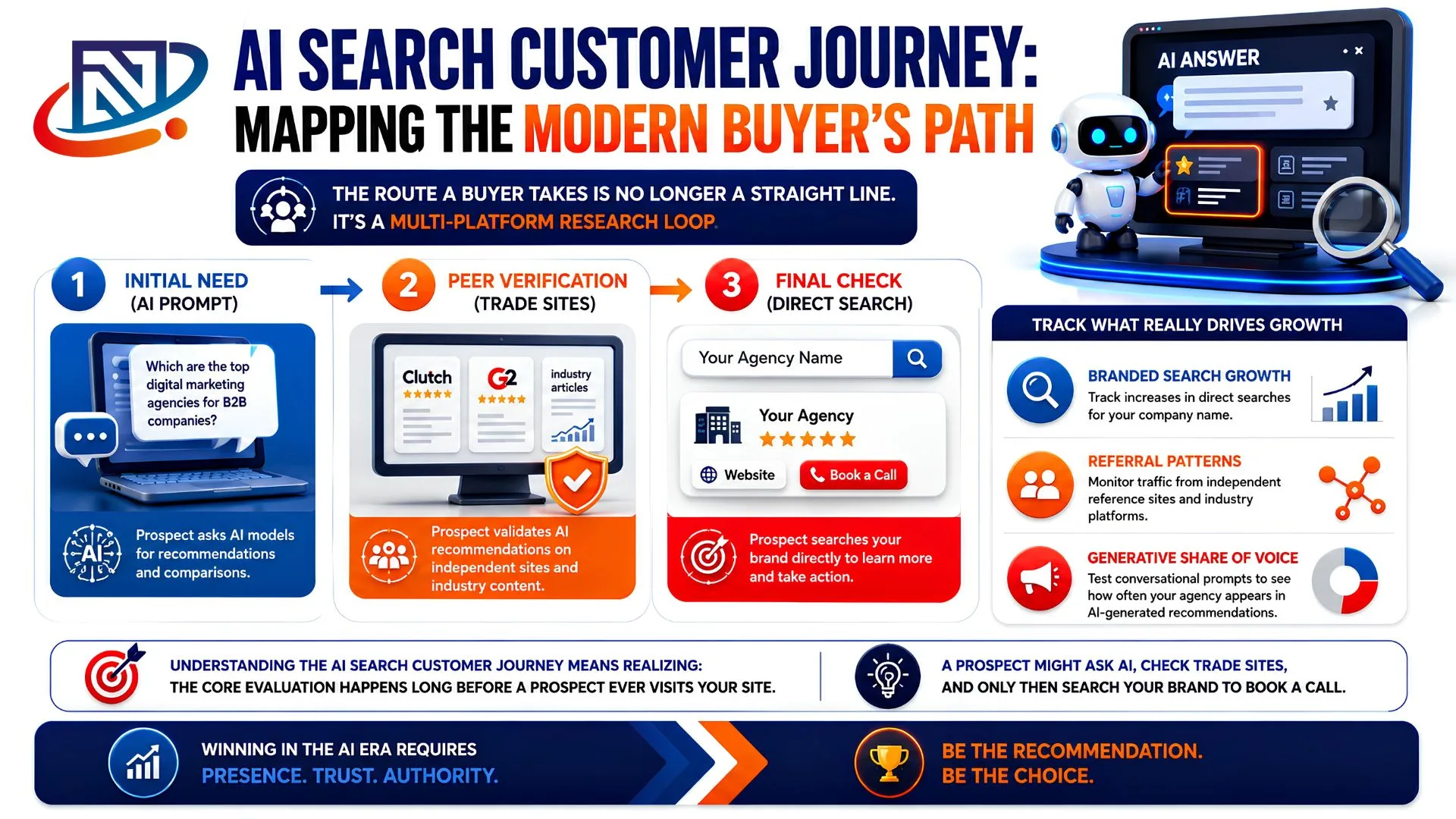
The route a buyer takes from recognizing a business need to signing a contract is no longer a straight line. It has turned into a multi-platform research loop where standard tracking metrics often miss the full picture.

Initial Need (AI Prompt) ──> Peer Verification (Trade Sites) ──> Final Check (Direct Search)

Understanding the AI search customer journey means realizing that the core evaluation happens long before a client ever visits your site. A prospect might ask an AI model to compare the top agencies in the market, check those recommendations against independent industry articles, and only then search for your brand name directly to book a call.

To successfully track this complex behavior, B2B brands need to focus on broader growth indicators:

Branded Search Growth: Tracking increases in direct searches for your company name, which shows that users saw your brand inside an AI answer and came looking for you.

Referral Patterns: Monitoring traffic coming from independent reference sites and industry platforms that feed data into AI search models.

Generative Share of Voice: Regularly testing conversational prompts to see how often your agency’s services are featured in automated vendor recommendations.

SEO Funnel in the AI era: Expanding Your Digital Footprint

Succeeding in this new space means building a digital footprint that exists everywhere your ideal clients go to find answers. When search engines act as massive data aggregators, your brand authority must extend past the walls of your own website.

Optimizing the SEO funnel in the AI era requires you to focus on your total online presence. Your case studies, data points, and company insights must be present on the outside platforms that AI models crawl to verify facts. This means getting highlighted in respected trade journals, earning features on high-authority business directories, and generating active discussions on professional networks like LinkedIn.

When search algorithms look around the web to verify a company’s capabilities, they cross-reference data across these distinct touchpoints. If your business is consistently mentioned as a trusted authority across multiple separate platforms, the algorithm’s confidence score spikes. This integrated approach ensures your team stays visible during high-value commercial searches.

Conclusion


The shift toward AI-driven search isn't really some temporary phase; it's more like a permanent way businesses go find solutions, size up service providers, and pick partners. If you keep leaning on the old click-heavy tactics, all you really do is make your brand disappear for the next generation of buyers.

Getting through this whole new environment takes something more organized, more analytical, maybe, with a balance between tidy data formatting and undeniable industry authority. By structuring your content for deep visibility, winning trusted citations, capturing highly qualified clicks, and removing all friction from your contact pages, you turn your website into a powerful B2B lead generation engine.

At Nucleo Analytics, we specialize in building these modern frameworks for scaling companies. We align your online presence with the real rules of the modern SEO funnel, ensuring your agency remains the definitive answer wherever your target clients choose to search.

Whether it’s AI search or Google, we’ll help your brand stay visible at every stage of the modern customer journey.

SahilSharma
Author

Sahil Sharma

Sahil Sharma is the Founder and CEO of Nucleo Analytics, a digital marketing and technology company helping businesses grow through SEO, Google Ads, social media marketing, website development, AI solutions, and custom product development. With years of experience developing growth strategies for businesses across multiple industries, he shares practical insights on digital marketing, emerging technologies, AI, and business growth to help organizations succeed in an evolving digital landscape.

How to Rank in AI Search Results in 2026

How to Rank in AI Search Results in 2026

In order to effectively rank in AI search results in 2026, brands will have to rebuild their technical systems. Relying entirely on organic SEO tactics will be ineffective since the future digital environment will be ru…